Vista previa
 Compartir
 Compartir
 Ver detalles
 Guía
Guía

 Descargar
 Ver artículos similares
 Radiografía
 Presentación de diapositivas
 Estadísticas
John Butler Yeats


 Leer más
Giclée / Impresión de arte
Impresiones giclée o en lienzo de calidad de museo con producción rápida y opciones de acabado flexibles. ( Encargar reproducción pintada a mano Ver versión en imagen digital)




P118B €10

P118H €10

P118W €10

P438Z €10

P508JH €12

P508YH €12

P805H €10

P805Z €10

P919BZ €10

P919G €10

P919XJ €10

P959ZH €10

P968JZ €12

W106C €8

W218G €10

W218JH €8

W218Y €10

W307PJ €10

W316G €10

W316PJ €8

W316Y €10

W398PJ €8

W4111J €10

W500HY €15

W500JH €15

W692G €12

W849H €8

W940BG €15

W953PJ €8




Elija entre nuestros tamaños predefinidos que respetan las proporciones originales de la obra.

Introduzca el ancho y el alto que necesite para adaptarse a su marco o pared. Una impresión solo puede recortarse, nunca hacerse más grande que la imagen original, por lo que un tamaño con una forma distinta perderá parte de la obra. Le enviaremos una maqueta digital para su aprobación antes de realizar cualquier impresión. La imagen que se muestra en esta página no refleja el recorte real; solo la maqueta lo hace.
Envío a todo el mundo () en 2 semanas en lugar de las 4/5 semanas estándar. (24 octubre)

Envío exprés gratuito a todo el mundo

Lienzo de lino de alta calidad

Seguro de envío completo

Garantía de reembolso de impuestos aduaneros

Garantía de fidelidad cromática exacta

Política de devolución de 100 días (solo por defectos)

Garantía de devolución del 100% del dinero

Oferta por volumen
 La opción de vidrio solo está disponible en tamaños inferiores a 110 cm.

John Butler Yeats
Giclée / Impresión de arte
Tamaño de la reproducción
-


Precio total
€ 70
A Dialogue of Vision: The Soul Within the Portrait
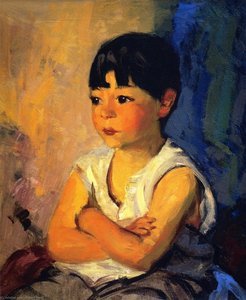
In the quiet intensity of Robert Henri’s 1909 portrait, John Butler Yeats, we encounter more than just a likeness; we witness a profound psychological encounter. This masterpiece serves as a bridge between two distinct worlds—the ethereal, Symbolist-inspired Romanticism of the Irish master and the gritty, unyielding realism that Henri would eventually pioneer through the Ashcan School. The subject, the esteemed father of poet W.B. and artist Jack B. Yeats, sits before us with a presence that is both commanding and contemplative. His gaze, directed squarely at the viewer, pierces through the layers of time, inviting an intimate communion that transcends the mere application of oil on canvas.
The composition is masterfully balanced, capturing a moment of stillness amidst the burgeoning energy of the early twentieth century. As the subject rests with hands crossed, there is a palpable sense of weight and history in his posture. The presence of other figures, partially glimpsed in the periphery, adds a layer of narrative depth, suggesting a shared space of intellectual or artistic discourse. This is not a solitary study but a window into a social and creative ecosystem where ideas were exchanged as fluidly as the brushstrokes themselves.
Technique and the Texture of Reality
To behold this work is to appreciate the visceral power of Henri’s technique. Eschewing the polished, academic finish of his predecessors, Henri employs a method characterized by rapid, energetic application. The paint is not merely applied; it is sculpted upon the surface. One can trace the movement of the brush through the thick, textured layers that define the subject's beard and the heavy folds of his attire. This tactile quality lends the portrait an organic vitality, making the sitter feel as though he possesses a physical breath and warmth.
The palette is a sophisticated study in earthy resonance. Henri utilizes a spectrum of browns, ochres, and muted grays to ground the subject in reality, yet he infuses these tones with a luminous quality that prevents the scene from feeling somber. The interplay of light and shadow—the chiaroscuro effect—is used not just for anatomical accuracy, but to sculpt emotion. The way light catches the edge of a collar or the glint in an eye creates a rhythmic movement across the canvas, guiding the viewer’s eye through a landscape of skin, fabric, and atmosphere.
A Legacy for the Discerning Collector
For the art lover or the interior designer, a reproduction of this portrait offers much more than aesthetic decoration; it provides an anchor of intellectual and emotional depth. The painting embodies the tension between the old world and the new, making it a perfect centerpiece for spaces that value heritage, storytelling, and the profound beauty of human character. Its muted, sophisticated color scheme allows it to integrate seamlessly into diverse environments, from the classic elegance of a traditional library to the bold, contemporary lines of a modern loft.
Owning a piece that captures such a pivotal moment in art history—the collision of Yeats’s lyrical depth and Henri’s unflinching honesty—is an opportunity to surround oneself with the very essence of artistic evolution. This portrait remains a testament to the enduring power of the human spirit, captured through a lens of uncompromising truth and masterful artistry.
Preguntas y respuestas
¿A qué corriente artística pertenece "John Butler Yeats" de Robert Henri?
"John Butler Yeats" es una obra de American Realism. El movimiento indica la tradición artística de la que forma parte la obra.
¿Puedo ver "John Butler Yeats" como una presentación de diapositivas a pantalla completa?
Puede ver "John Butler Yeats" de Robert Henri en formato de diapositivas en la página de Presentación de diapositivas de la obra.
¿Con qué sentimiento se asocia "John Butler Yeats"?
El tono emocional registrado para "John Butler Yeats" de Robert Henri es Reflective. Este resume el sentimiento que expresa la obra.
Biografía del artista
Orígenes y Primeros Años
Robert Henri, nacido Robert Henry Cozad el 24 de junio de 1865 en Cincinnati, Ohio, tuvo una infancia marcada por la turbulenta relación entre sus padres, John Jackson Cozad, un jugador y promotor inmobiliario, y Theresa Gatewood Cozad. Un evento significativo en 1882 alteró el curso de su vida familiar. La familia se trasladó a Nebraska durante la época del Homestead Act, pero regresaron al Este después de un incidente que llevó a un cambio de identidad para evitar problemas legales. Robert Henry Cozad adoptó el nombre Henri cuando tenía 17 años.Formación Artística y Primeras Influencias
Su formación artística comenzó en 1886 en la Academia de Bellas Artes de Pensilvania en Filadelfia, bajo la tutela de Thomas Anshutz. Posteriormente, viajó a París en 1888 para estudiar en la Académie Julian, donde recibió influencias de William-Adolphe Bouguereau y François Millet, inicialmente abrazando el impresionismo. Henri se interesó por los artistas realistas holandeses y comenzó a experimentar con la pintura al aire libre, capturando escenas urbanas espontáneas.El Ashcan School y "The Eight"
Robert Henri emergió como una figura clave del Ashcan School de realismo americano y fue un organizador de "The Eight", una asociación informal de artistas que protestaron contra las prácticas restrictivas de exposición de la poderosa y conservadora National Academy of Design. Este grupo incluía a William Glackens, George Luks, Everett Shinn y John Sloan. Henri promovió una estética que se centraba en representar la vida cotidiana urbana con honestidad y vitalidad, alejándose de los temas idealizados tradicionales.Enseñanza e Influencia en Nuevas Generaciones
Henri comenzó a enseñar en la Escuela de Diseño para Mujeres de Filadelfia en 1892. Su enfoque pedagógico se caracterizaba por fomentar la observación directa y la expresión individual. Entre sus destacados alumnos se encuentran Joseph Stella, Edward Hopper, Rockwell Kent, George Bellows, Norman Raeben, Louis D. Fancher y Stuart Davis. Henri animó a sus estudiantes a desarrollar su propio estilo y a pintar lo que veían con honestidad, independientemente de las convenciones artísticas establecidas.Madurez Artística y Legado
En 1898, Henri se casó con Linda Craige, una alumna de su clase privada. Tras la muerte de Linda en 1905, se volvió a casar con Marjorie Organ en 1908. Su obra más conocida incluye "Mujer con Manteau" (1899) y "La Nieve" ("The Snow"), adquirida por el gobierno francés para su exhibición en el Musée du Luxembourg. Robert Henri falleció en 1929, dejando un legado duradero como defensor del realismo americano e influyente maestro que inspiró a una generación de artistas. Su énfasis en la observación directa y la expresión individual contribuyó significativamente al desarrollo del arte moderno estadounidense.
Robert Henri
1865 - 1929 , Estados Unidos de América
Datos clave
- Artistas Influenciados:
- Edward Hopper
- Rockwell Kent
- George Bellows
- Artistas Que Influyeron:
- William-Adolphe Bouguereau
- François Millet
- Thomas Anshutz
- Fecha De Nacimiento: 24 de junio de 1865
- Lugar De Nacimiento: Cincinnati, EE. UU.
- Movimiento Artístico: Ashcan School, Realismo americano
- Nacionalidad: Estadounidense
- Nombre Completo: Robert Henri
- Nombres Alternativos: Robert Henry Cozad
- Obras Notables:
- Mujer con manteau (1899)
- La nieve
Artículos relacionados

John Constable: Las 25 Obras Maestras del Paisaje Inglés | OriginalUniqueArt
Descubre las 25 obras maestras de John Constable, el pintor romántico inglés que capturó la belleza del paisaje. Explora su técnica, historia y significado en OriginalUniqueArt.com. Reproducciones de arte de alta calidad para tu hogar.

Henri Matisse: Las 25 Obras Maestras que Definieron un Genio del Color | OriginalUniqueArt
Descubre las 25 obras maestras de Henri Matisse, el rey del color y padre del fauvismo. Explora su arte moderno, lienzos vibrantes y la historia detrás de cada pintura icónica. Encuentra reproducciones de alta calidad en OriginalUniqueArt.com.

John Singer Sargent: Las 25 Obras Maestras del Retrato y la Belle Époque | OriginalUniqueArt
Descubre las 25 obras maestras de John Singer Sargent, el maestro del retrato y la Belle Époque. Explora su técnica impresionista, historias fascinantes y encuentra reproducciones de arte exclusivas para decorar tu hogar con elegancia en OriginalUniqueArt.com.
Robert Henri & the Spirit of American Realism: A Legacy of Urban Life and Artistic Independence
Explore the life & legacy of Robert Henri, a pivotal figure in American Realism. Discover his captivating portraits, influence on the Ashcan School, and enduring impact on art history. Learn more at OriginalUniqueArt.
La Escuela del Cubo de Basura: Realismo Urbano y la Democratización del Arte Americano
Exploramos la Escuela del Cubo de Basura y el realismo urbano americano. Descubre cómo este movimiento artístico revolucionó la representación de la sociedad, democratizando el arte y desafiando las convenciones estéticas tradicionales.