Ver en contexto
 Enviar
 Compartir
 Detalles
 Guía
Guía

 Descargar
 Similares
 Radiografía
 Presentación de diapositivas
 Preguntas y respuestas
 Estadísticas
Rhythm Color

 Ver más
Giclée / Impresión de arte
Impresiones giclée o en lienzo de calidad de museo con producción rápida y opciones de acabado flexibles. ( Comprar pintura hecha a mano Cambiar a imagen digital)




P118B €10

P118H €10

P118W €10

P438Z €10

P508JH €12

P508YH €12

P805H €10

P805Z €10

P919BZ €10

P919G €10

P919XJ €10

P959ZH €10

P968JZ €12

W106C €8

W218G €10

W218JH €8

W218Y €10

W307PJ €10

W316G €10

W316PJ €8

W316Y €10

W398PJ €8

W4111J €10

W500HY €15

W500JH €15

W692G €12

W849H €8

W940BG €15

W953PJ €8




Elija entre nuestros tamaños predefinidos que respetan las proporciones originales de la obra.

Introduzca el ancho y el alto que necesite para adaptarse a su marco o pared. Una impresión solo puede recortarse, nunca hacerse más grande que la imagen original, por lo que un tamaño con una forma distinta perderá parte de la obra. Le enviaremos una maqueta digital para su aprobación antes de realizar cualquier impresión. La imagen que se muestra en esta página no refleja el recorte real; solo la maqueta lo hace.
Envío a todo el mundo () en 2 semanas en lugar de las 4/5 semanas estándar. (11 noviembre)

Envío exprés gratuito a todo el mundo

Lienzo de lino de alta calidad

Seguro de envío total

Garantía de reembolso de aranceles aduaneros

Garantía de fidelidad cromática exacta

Política de devolución de 100 días (solo por defectos)

Garantía de devolución del 100% del dinero

Descuento por cantidad
 La opción de vidrio solo está disponible en tamaños inferiores a 110 cm.

Rhythm Color
Giclée / Impresión de arte
Dimensiones de la reproducción
-


Precio total final
€ 72
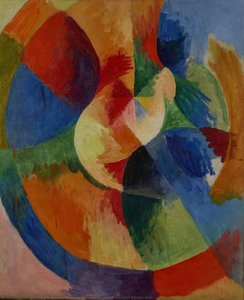
Robert Delaunay’s “Rhythm Color”: A Symphony of Geometric Light
The artwork "Rhythm Color," executed by Robert Delaunay in 1913, stands as an emblem of Orphism—a movement that irrevocably altered the trajectory of modern art. More than just a visual spectacle, it embodies a profound philosophical inquiry into the nature of perception and artistic expression itself. Delaunay’s ambition wasn't to depict reality; rather, he sought to distill its essence into pure color and form, mirroring the burgeoning fascination with scientific discoveries concerning light and vibration during this transformative period.- Style & Context: Orphism emerged from Cubism, rejecting its fragmentation of perspective in favor of a more holistic approach. Influenced by Nietzsche’s concept of Dionysian ecstasy—a primal surge of emotion and instinct—the movement aimed to liberate art from representational constraints and tap into the subconscious realm. The canvas pulsates with an energy that transcends mere visual observation.
- Technique: Delaunay employed oil on canvas, utilizing a technique characterized by layering translucent washes of color—primarily reds, yellows, and blues—over textured surfaces achieved through impasto. This method allowed for the creation of luminous effects and palpable materiality, capturing the dynamism inherent in the artist’s vision.
Decoding Geometric Harmony: Composition & Color Palette
The composition is dominated by a rectangular frame enclosing overlapping circles and geometric shapes—primarily squares and rectangles—arranged in a seemingly random yet meticulously balanced configuration. However, beneath this surface lies an underlying order rooted in mathematical principles. Delaunay’s color palette eschews traditional hues, opting instead for vibrant shades that vibrate with luminosity. The interplay of complementary colors—red against blue, yellow against violet—creates visual tension and reinforces the sense of movement throughout the artwork. Each shape contributes to a larger harmonic whole, reflecting the artist's belief in the interconnectedness of form and color.Symbolism Beyond Representation: Light & Vibration
Beyond its formal qualities, “Rhythm Color” carries symbolic weight rooted in Delaunay’s fascination with scientific theories concerning light and vibration. He believed that color possessed a vibrational energy—akin to sound—that could influence human consciousness. The luminous circles represent this radiant force, conveying an aspiration toward transcendence and spiritual illumination. They symbolize the artist's desire to capture not just what is seen but what is felt—a profound communion with the underlying rhythms of existence.Emotional Resonance: Capturing the Dionysian Spirit
Ultimately, “Rhythm Color” succeeds in evoking a powerful emotional response. Its chaotic yet harmonious arrangement mirrors the exhilaration and disorientation experienced during moments of ecstatic inspiration—a core tenet of Orphism’s philosophical underpinning. The artwork invites contemplation on themes of beauty, dynamism, and spiritual awakening, resonating with viewers who appreciate art that transcends mere visual gratification.A reproduction of “Rhythm Color” offers an exceptional opportunity to experience the brilliance of Delaunay's vision—a testament to his pioneering role in shaping the landscape of modern art.
Preguntas y respuestas
¿Qué tema y atmósfera combina "Rhythm Color" de Robert Delaunay?
"Rhythm Color" muestra abstract composition, geometric forms, color field art, dynamic rhythm, circular design, modern abstraction, vibrant palette, y su atmósfera es Elegant.
¿Cómo equilibra la luz y la sombra "Rhythm Color"?
Los valores registrados para "Rhythm Color" de Robert Delaunay son: balanced de brillo y Gentle Luminance de luminancia.
¿Qué emoción transmite "Rhythm Color" de Robert Delaunay?
"Rhythm Color" de Robert Delaunay transmite un tono emocional Reflective.
Biografía del artista
Primeros años y comienzos artísticos
Robert delaunay, un artista francés, nació el 12 de abril de 1885 en París. Es más conocido por cofundar el movimiento artístico orfismo con su esposa Sonia Delaunay y otros. Este movimiento, caracterizado por su uso de colores fuertes y formas geométricas, buscaba expresar la vida moderna a través de formas abstractas.Estilo artístico e influencias
El estilo artístico de Delaunay se caracterizó por un audaz uso del color y un claro amor por la experimentación tanto en profundidad como en tono. Sus obras posteriores fueron más abstractas, reminiscentes de Paul Klee. La influencia clave del artista se relaciona con el uso del color como medio expresivo y estructural.- La serie de la Torre Eiffel, que captura la esencia de este emblemático punto de referencia parisino en una forma única y abstracta.
- Contrastes simultáneos: sol y luna, una pintura que muestra el arte de Delaunay y su compromiso teórico con el color.
- Ventanas se abren simultáneamente, 1ª parte, 3er motivo, una pintura que demuestra el uso de bloques de colores por parte de Delaunay para crear profundidad y movimiento.
Obras notables y legado
Las obras notables de Delaunay incluyen:- La Torre Eiffel (126 x 93 cm, Museo Solomon R. Guggenheim, Nueva York, Estados Unidos)
- Contrastes simultáneos: sol y luna (orfismo)
- Ventanas se abren simultáneamente, 1ª parte, 3er motivo (orfismo)
Desarrollo artístico y evolución
Delaunay abandonó el cubismo con sus formas geométricas y colores monocromáticos para embarcarse en un nuevo estilo, el orfismo, que se centró en las formas circulares y en los colores brillantes y que también ha sido calificado de cubismo abstracto. Sus estudios sobre el ritmo y el movimiento se resolvieron en series de cuadros basados en eventos deportivos, como Sprinters (1924-1926), que culminaron en impresionantes obras abstractas centradas en el ritmo, como sus últimas series "Ritmos" y "Ritmos eternos". Realizó igualmente escritos teóricos como el ensayo Sur la lumière, publicado en «Der Sturm» (1913), en traducción de Paul Klee. Con su esposa, la también artista Sonia Delaunay, residió un tiempo en España.Significado histórico
Robert Delaunay, pionero del orfismo, dejó una huella imborrable en el mundo del arte con su audaz uso del color y las formas abstractas. Su legado continúa inspirando a artistas y entusiastas del arte por igual, convirtiéndolo en una figura significativa en la historia del arte moderno. Vea más obras de Robert Delaunay en OriginalUniqueArt La historia de la pintura - Wikipedia El movimiento artístico orfismo - OriginalUniqueArt
Robert Delaunay
1885 - 1941 , Francia
Datos clave
- Artistas Influenciados:
- Stanton Macdonald-Wright
- Morgan Russell
- Der Blaue Reiter
- Artistas Que Influyeron:
- Paul Cézanne
- Henri Rousseau
- Paul Klee
- Fecha De Nacimiento: 12 de abril de 1885
- Lugar De Nacimiento: París, Francia
- Movimiento Artístico: Orfismo, Cubismo
- Nacionalidad: Francesa
- Nombre Completo: Robert Delaunay
- Obras Notables:
- La Torre Eiffel
- Contraste simultáneo: Sol y Luna
- Ventanas abiertas simultáneamente
Artículos relacionados
Sonia Delaunay: A Life in Color – Exploring the Rhythms of Abstraction and Synesthesia
Explore the vibrant world of Sonia Delaunay, a pioneer of abstract art and co-founder of Orphism. Discover her revolutionary use of color, geometric forms, and influence on modern design. A deep dive into her life & legacy.
Orfismo: Una Sinfonía de Color y Forma – Explorando las Raíces Abstractas del Arte Moderno
Descubre el Orfismo, un movimiento artístico revolucionario del siglo XX liderado por Robert y Sonia Delaunay. Explora su teoría del color, características clave e influencia en la abstracción con OriginalUniqueArt.

Orphism Unlocked: The High-Energy Color Revolution That Defined Abstract Art
Dive into the high-energy world of Orphism. Discover how this color revolution broke Cubism's rules to define modern abstraction through light, motion, and pure visual impact. Explore the legacy of the Delaunays and bring bold, vibrant energy to your contemporary space.
Orphism Unveiled: The Radiant Dance of Color and Light in the Evolution of Abstract Art
Discover the luminous world of Orphism. Explore how masters like Robert and Sonia Delaunay revolutionized art through a radiant dance of color, light, and geometric abstraction in this deep dive into modern art history.

Abstracción Geométrica: 10 Obras Maestras que Transformaron el Arte Moderno | OriginalUniqueArt
Descubre las 10 obras maestras de la abstracción geométrica que revolucionaron el arte moderno. Explora a Mondrian, Malevich y Kandinsky en OriginalUniqueArt.com. Reproducciones de alta calidad para tu hogar.