Cambiar a impresiones
 Ver más







































 Para obras de arte o reproducciones que midan más de 105 cm (aproximadamente 41 pulgadas) en cualquiera de sus lados, el marco se enviará como un kit desmontado. Este método garantiza una entrega segura y evita daños durante el transporte.


A Window into the Romantic Soul of France
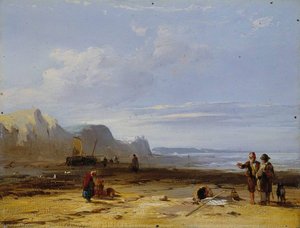
In the delicate, luminous strokes of Richard Parkes Bonington’s 1825 watercolor, Rouen, we are invited to step across the banks of the Seine and into a moment of profound serenity. This exquisite piece captures the historic cityscape of Rouen, France, not merely as a collection of stone and spire, but as a living, breathing entity bathed in the soft, melancholic light of the early nineteenth century. The composition draws the eye through a masterful layering of depth, beginning with the intimate details of the riverbank where moored fishing boats rest heavily upon the water. Here, the artist captures the tactile reality of maritime life—the weight of nets draped over wooden hulls and the solitary presence of a figure that provides a poignant sense of scale against the sprawling urban backdrop. It is a scene that feels both monumental and deeply personal, offering a quiet meditation on the passage of time and the enduring grace of the French landscape.
The technique employed by Bonington is nothing short of virtuosic, showcasing the brilliance that made him a leading figure of the Romantic movement. Using a palette dominated by warm earth tones, he achieves a remarkable sense of atmosphere, where the air itself feels thick with history and moisture. The water serves as a mirror to the soul of the city; its surface is rendered with such precision that the reflections of buildings and masts appear to ripple with life, creating a mesmerizing interplay of light and shadow. His use of watercolor allows for a transparency and fluidity that perfectly mimics the shifting clouds and the soft, pastel hues of a twilight sky. This mastery of medium ensures that every brushstroke contributes to a sense of movement—from the rhythmic flight of birds overhead to the gentle sway of the masts—preventing the static architecture from ever feeling lifeless.
For the discerning collector or interior designer, Rouen offers more than just aesthetic beauty; it provides an emotional anchor for a space. The painting carries a certain nostalgic weight, evoking the grandeur of an era defined by architectural splendor and a romanticized view of nature. The presence of the prominent church spire, rising above the rooftops, introduces a layer of spiritual symbolism, suggesting a world where the divine and the terrestrial are inextricably linked through the beauty of the natural landscape. As a high-quality reproduction, this work serves as a sophisticated centerpiece, capable of imparting a sense of timelessness and cultured elegance to any room. Whether placed in a sunlit gallery or a moody, library-style study, Bonington’s vision of Rouen continues to inspire awe, inviting viewers to lose themselves in the hazy, beautiful memories of a bygone age.
Preguntas y respuestas
¿Está "Rouen" disponible como una impresión de bellas artes?
Puede solicitar una impresión de "Rouen" de Richard Parkes Bonington directamente en su página de Impresión de arte de bellas artes: una impresión de bellas artes sobre lienzo de algodón o papel de lienzo de archivo.
¿En qué año se creó "Rouen"?
"Rouen" de Richard Parkes Bonington fue creado en 1825.
¿A qué se debe la situación de los derechos de autor de "Rouen" de Richard Parkes Bonington?
"Rouen" de Richard Parkes Bonington es de en el dominio público: sus derechos de autor han expirado. Los términos de derechos de autor se calculan a partir del fallecimiento del artista, y Richard Parkes Bonington murió en 1828.






 Ver en contexto
 Enviar
 Compartir
 Detalles
 Guía
Guía

 Descargar
 Similares
 Radiografía
 Presentación de diapositivas
 Q&A
Q&A Estadísticas