Cambiar a impresiones
 Ver más







































 Para obras de arte o reproducciones que midan más de 105 cm (aproximadamente 41 pulgadas) en cualquiera de sus lados, el marco se enviará como un kit desmontado. Este método garantiza una entrega segura y evita daños durante el transporte.


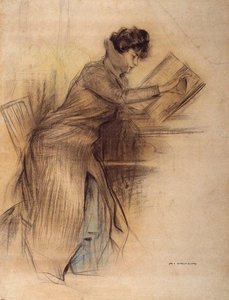
Ramon Casas i Carbó’s ‘White Lady’: A Portrait of Catalan Modernisme
Ramon Casas i Carbó's “White Lady,” painted in 1891, is more than just a portrait; it’s a delicately rendered window into the heart of Catalan Modernisme. This intimate scene captures a woman seated on a bench, an embodiment of quiet contemplation and understated elegance – a hallmark of Casas’s artistic vision. The painting immediately draws the eye to the subject's serene expression and the soft palette dominated by whites, pinks, and subtle greens, colors that evoke both fragility and resilience, reflecting the spirit of the era.
- Subject & Composition: The central figure, a woman in a flowing white dress with a blush-toned skirt, occupies the foreground with a sense of quiet dignity. Her hands folded demurely in her lap contribute to an atmosphere of stillness and introspection. The inclusion of a nearby chair subtly suggests a moment of respite, inviting the viewer into her private world.
- Technique & Style: Casas masterfully employs Impressionistic techniques, evident in his loose brushstrokes and emphasis on capturing fleeting moments of light and shadow. This approach is particularly noticeable in the rendering of the fabrics – the delicate folds of the dress and the subtle textures of the green plants – adding a remarkable level of realism to the scene.
A Window into Barcelona’s Modernista World
Painted during a pivotal moment in Catalan art history, “White Lady” reflects the burgeoning Modernisme movement that was transforming Barcelona. This period witnessed a rejection of traditional academic styles and an embrace of new influences – notably Impressionism and Japonisme – alongside a fervent desire to express Catalan identity through artistic expression. Casas, as a key figure within this movement, skillfully blended these diverse elements, creating a style uniquely his own.
- Historical Context: 1891 Barcelona was undergoing rapid industrialization and urbanization, yet simultaneously, there was a strong cultural revival focused on Catalan heritage. Casas’s work often depicted scenes of daily life in the city, capturing both its dynamism and its underlying traditions.
- The Artist's Influence: Casas’s connections within the artistic circles of Barcelona – including his friendships with figures like Santiago Rusiñol – further cemented his position as a leading voice of Modernisme.
Symbolism & Emotional Resonance
While seemingly simple in its composition, “White Lady” is rich in symbolic potential. The color white itself often represents purity and innocence, while the woman’s posture suggests vulnerability and contemplation. The green plants introduce a natural element, symbolizing life, growth, and perhaps even hope. The overall effect is one of quiet beauty and emotional depth – inviting viewers to ponder themes of solitude, reflection, and the transient nature of existence.
- Color Palette: The restrained color palette contributes significantly to the painting’s mood, creating a sense of calm and serenity.
- Light & Shadow: Casas's skillful use of light and shadow adds depth and dimension to the portrait, enhancing its realism and emotional impact.
A Timeless Masterpiece – A Perfect Reproduction
This hand-painted reproduction captures every nuance of Casas’s original masterpiece, offering a stunning addition to any art collection or interior space. The meticulous attention to detail, combined with the artist's signature Impressionistic style, ensures that this artwork will continue to captivate and inspire for generations to come. Whether you are an admirer of Modernisme, a collector seeking exceptional pieces, or an interior designer looking to create a sophisticated atmosphere, “White Lady” is a truly timeless investment.
Preguntas y respuestas
¿Es "White Lady" representativo de la temática habitual de Ramon Casas i Carbó?
"White Lady" representa portrait woman, catalan scene, white dress, bench seating, pink skirt, green plants, ramon casas, mientras que los temas recurrentes de Ramon Casas i Carbó son catalan modernisme, portraiture, urban life, elite society, casas style. Al comparar ambos, se observa cómo la obra se relaciona con los temas habituales del artista.
¿Es "White Lady" más bien clara o más bien oscura en su conjunto?
"White Lady" presenta un brillo general de bright y una luminancia de Gentle Luminance.
¿A qué etapa de la trayectoria de Ramon Casas i Carbó pertenece "White Lady" (1891)?
"White Lady", creada en 1891, pertenece al Modernisme Period de la trayectoria de Ramon Casas i Carbó.
 Ver en contexto
 Enviar
 Compartir
 Detalles
 Guía
Guía

 Descargar
 Similares
 Radiografía
 Presentación de diapositivas
 Q&A
Q&A Estadísticas