- Inicio

- Reproducción al óleo
- Ralph Goings
- Free Chips
 Preview
 Comprar impresión Comprar imagen en alta resolución
 Enviar
 Compartir
 Detalles
 Añadir a favoritos

 Descargar
 Similares
 Radiografía
 Presentación de diapositivas
Free Chips


 Ver más
Reproducción al óleo hecha a mano
Óleo sobre lienzo pintado a mano en el tamaño y marco de su elección, realizado por encargo por nuestros artistas.




P118B $10

P118H $10

P118W $10

P438Z $10

P508JH $12

P508YH $12

P805H $10

P805Z $10

P919BZ $10

P919G $10

P919XJ $10

P959ZH $10

P968JZ $12

W106C $8

W218G $10

W218JH $8

W218Y $10

W307PJ $10

W316G $10

W316PJ $8

W316Y $10

W398PJ $8

W4111J $10

W500HY $15

W500JH $15

W692G $12

W849H $8

W940BG $15

W953PJ $8




Elija entre nuestros tamaños predefinidos que respetan las proporciones originales de la obra.

Puede ingresar sus propias dimensiones para adaptarse a un marco o espacio específico. Si el tamaño seleccionado no coincide con las proporciones de la imagen original, recortaremos la obra o extenderemos la pintura con elementos adicionales pintados a mano. Se le enviará una maqueta digital para su aprobación antes de comenzar la producción.
Tenga en cuenta que la vista previa en pantalla no refleja el recorte o la extensión reales. Solo la maqueta mostrará con precisión la composición final.
Si bien existen tamaños personalizados, recomendamos seleccionar una dimensión de la lista predefinida para preservar las proporciones originales.
Tras realizar el pedido, el equipo de OriginalUniqueArt.com enviará un correo electrónico al cliente para solicitar instrucciones y proporcionarle una vista previa del boceto.
Entrega mundial () en 3-4 semanas en lugar de las 5 semanas estándar. (25 julio). Sin compromisos con la calidad.

Envío exprés gratuito a todo el mundo

Lienzo de lino de alta calidad

Seguro de envío total

Garantía de reembolso de impuestos aduaneros

Garantía de fidelidad de color

Política de devolución de 60 días (solo por defectos)

Garantía de devolución del 100% del dinero

Descuento por pedido múltiple
 La opción de vidrio solo está disponible en tamaños inferiores a 110 cm.

Free Chips
Técnica de reproducción
Tamaño de la reproducción
-


Precio total final
-
Descripción de la obra
A Window into Nostalgia: The Soul of American Americana
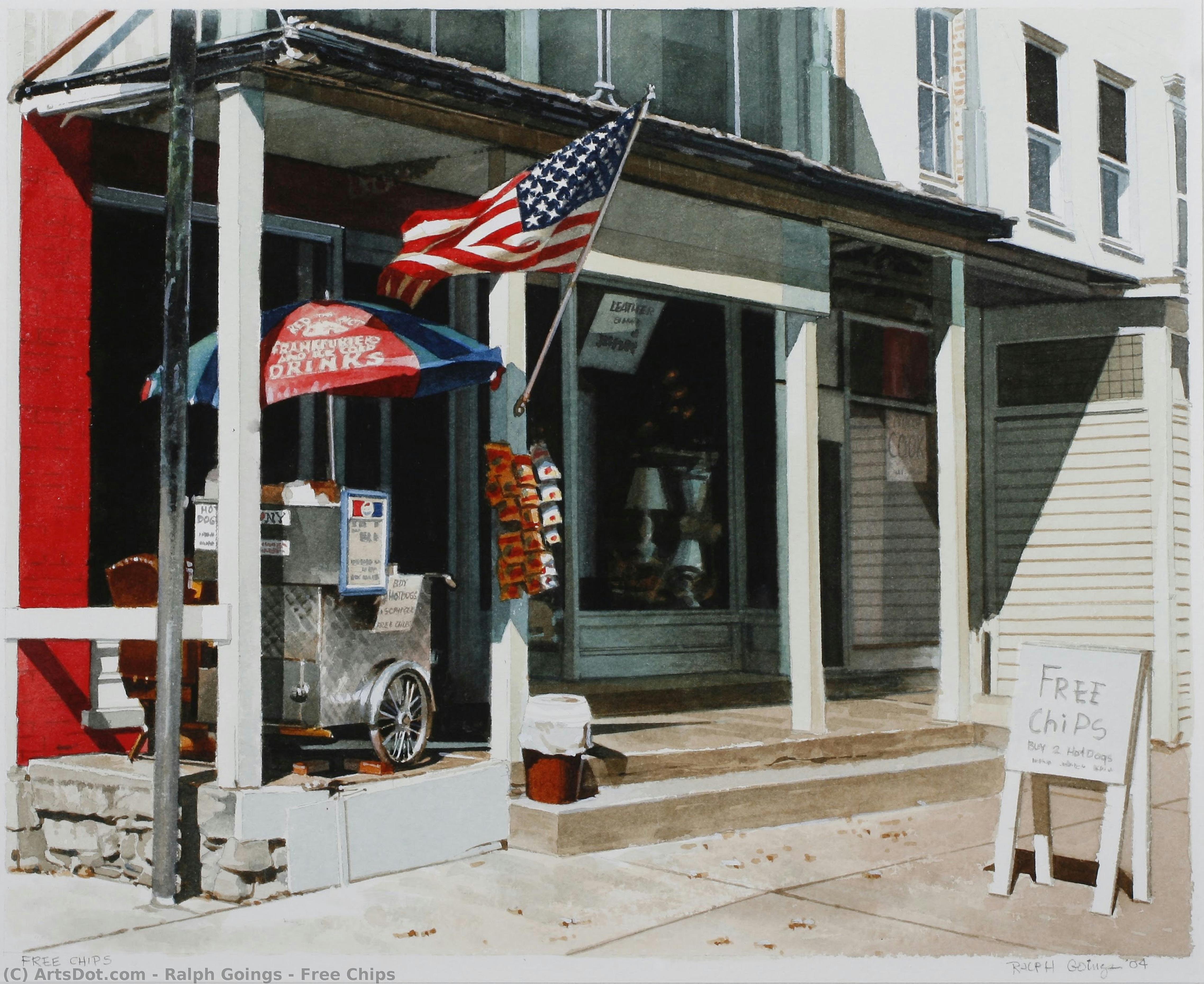
In the quiet, sun-drenched corners of the American landscape lies a profound beauty found in the most ordinary of places. Free Chips, a masterful watercolor by the renowned photorealist Ralph Goings, serves as a poignant portal to a bygone era. This piece does not merely depict a roadside diner; it captures the very essence of mid-20th-century Americana, inviting the viewer to step into a moment frozen in time. The composition is anchored by a striking red wall that commands immediate attention, acting as a vibrant heartbeat against the more muted, weathered tones of the building's facade. As your eyes wander across the scene, you encounter the gentle textures of a wooden porch and the nostalgic presence of an ice cream cart, all set beneath the proud, fluttering folds of an American flag. It is a scene that breathes with the warmth of summer afternoons and the quiet dignity of small-town life.
The technical execution of this work reveals Goings’ unparalleled ability to marry the precision of photorealism with the fluid, emotive qualities of watercolor. While his reputation is built upon the meticulous rendering of reality, here we see a breathtaking use of layering and blending. The artist employs subtle gradations in color and value to create a sense of depth that pulls the viewer into the linear recession of the street. Light plays a crucial role, casting soft, directional shadows that lend volume to the objects and texture to the fallen leaves scattered across the sidewalk. This delicate balance between sharp detail—such as the metallic glint on the snack cart—and the impressionistic softness of the background creates a dreamlike quality, making the scene feel both tangibly real and beautifully distant.
Beyond its visual splendor, Free Chips carries a deep emotional resonance that speaks to the universal human experience of memory and longing. There is an underlying sense of melancholy woven into the warmth of the palette; it is the bittersweet feeling of witnessing a way of life that is slowly fading into history. The sign advertising "Free Chips" acts as a small, humble symbol of community and hospitality, a remnant of a time when the local diner was the social anchor of the neighborhood. For collectors and interior designers alike, this artwork offers more than just decoration; it provides a narrative centerpiece. Whether placed in a contemporary gallery setting or a classic study, the painting brings an atmosphere of contemplative peace and historical depth, making it an exquisite choice for those looking to infuse their spaces with soul, story, and a timeless sense of home.
Biografía del artista
Ralph Goings: The Precision of Everyday Life
Ralph Goings (1928 – 1963) occupies a singular position within the annals of art history, inextricably linked to the groundbreaking photorealist movement alongside luminaries like Richard Estes and Chuck Close. Born in Corning, New York, his artistic trajectory commenced at California College of Arts and Crafts in Oakland, where he cultivated an unparalleled aptitude for observation—a skill that would become the bedrock upon which his distinctive style was built. Goings’ contribution transcends mere image duplication; it represents a profound confrontation with reality itself, presented with astonishing accuracy and imbued with unsettling familiarity. Early Influences: Goings' fascination with photography wasn’t merely aesthetic curiosity but rather a deliberate rejection of traditional painting’s limitations. Recognizing that capturing the essence of a scene demanded an unprecedented level of detail unattainable through freehand drawing, he articulated his conviction: “I wanted to start again to paint but I decided I wouldn't paint images anymore. I decided to push myself as far as possible in the opposite direction.” This rebellious stance against artistic convention mirrored the broader artistic currents circulating within the mid-1960s—a period marked by experimentation and a questioning of established norms. He sought inspiration from masters like Rembrandt and Caravaggio, absorbing their mastery of chiaroscuro and anatomical precision. The Photorealistic Method: Goings’ technique was revolutionary in its approach to artistic creation. Rather than relying on imagination or subjective interpretation, he adopted a method rooted in meticulous replication—projecting photographic images onto canvases and tracing them with graphite. This painstaking process demanded unwavering dedication to faithfully reproducing every subtle nuance of light and shadow, texture, and tonal range—a conscious repudiation of artistic license. As Goings himself confessed, “Many people were annoyed by what I was doing and said: ‘It’s not art, it can never be art.’ This gave me the impetus to persevere in my intent, because I liked doing something that made people angry…” He meticulously documented his process, emphasizing the importance of achieving a visual likeness indistinguishable from its source material. Notable Paintings & Recurring Themes: Goings achieved considerable renown for his evocative depictions of American domestic spaces—diners overflowing with food, brightly lit truck stops, and meticulously rendered bank interiors. Works like “Boxed Donuts” and “Free Chips” exemplify this approach, capturing the mundane yet captivating details of everyday life with astonishing precision. The ketchup bottle in "Boxed Donuts" isn’t merely a prop; it's treated as if it possesses its own sculptural quality, mirroring the meticulous attention to surface texture characteristic of his oeuvre. Similarly, “Free Chips” portrays a diner scene bathed in warm light, inviting viewers into a nostalgic tableau of Americana—a deliberate homage to the idealized vision of American life prevalent during the Eisenhower era. He frequently explored themes of stillness and contemplation, reflecting a desire to capture moments of quiet observation within the bustling world around him. Legacy & Significance: Ralph Goings’ influence extends far beyond his own artistic output. He played an instrumental role in establishing photorealism as a respected art form, challenging preconceived notions about creativity and pushing the boundaries of visual representation. His unwavering commitment to replicating photographic images served as an inspiration for subsequent generations of artists—artists who recognized the transformative potential of confronting reality with unflinching honesty. Goings’ work continues to captivate audiences today, prompting reflection on how we perceive and interpret our surroundings—a testament to his enduring vision and the indelible mark he left upon American art history. He remains a symbol of artistic rigor and intellectual curiosity, reminding us that beauty can be found in the simplest of subjects when rendered with extraordinary skill and dedication.
Ralph Goings
1928 - 1963 , Estados Unidos
Datos clave
- Artistic Movement Or Style: Fotorealismo
- Artists Who Influenced This Artist:
- Richard Estes
- Chuck Close
- Date Of Birth: 1928
- Full Name: Ralph Goings
- Nationality: American
- Notable Artworks:
- Boxed Donuts
- Free Chips
- Place Of Birth: Corning, Estados Unidos
Artículos relacionados
Las 25 Obras Maestras del MET: Arte, Historia y Decoración para tu Hogar
Descubre las 25 obras maestras del MET de Nueva York: Van Gogh, Monet, Rembrandt y más. Explora la historia, el arte y los colores que inspiran tu hogar. Reproducciones de museo en OriginalUniqueArt.com.

James Abbott McNeill Whistler: Las 25 Obras Maestras del Maestro del Arte y la Atmósfera | OriginalUniqueArt
Descubre las 25 obras maestras de James Abbott McNeill Whistler, el maestro del impresionismo y la armonía en arte. Explora retratos icónicos, nocturnos evocadores y su innovadora paleta de colores. Reproducciones de arte exclusivas en OriginalUniqueArt.com.
Las 25 Obras Maestras del National Gallery of Art: Arte, Historia y Decoración Exclusiva
Descubre las 25 obras maestras del National Gallery of Art, Washington. Explora la historia de Cézanne, Matisse, Picasso y más. Encuentra reproducciones de arte exclusivas e ideas para decorar tu hogar con lienzos inolvidables en OriginalUniqueArt.com.
Henri Matisse: Las 25 Obras Maestras que Definieron un Genio del Color | OriginalUniqueArt
Descubre las 25 obras maestras de Henri Matisse, el rey del color y padre del fauvismo. Explora su arte moderno, lienzos vibrantes y la historia detrás de cada pintura icónica. Encuentra reproducciones de alta calidad en OriginalUniqueArt.com.

Acuarelas Legendarias: 10 Obras Maestras que Transformaron el Arte | OriginalUniqueArt
Descubre 10 acuarelas legendarias de Turner, Monet y Sargent que revolucionaron el arte. Explora la historia, técnica y belleza de estas obras maestras impresionistas y románticas. Reproducciones de museo en OriginalUniqueArt.com.

