Ver en contexto
 Enviar
 Compartir
 Detalles
 Guía
Guía

 Descargar
 Similares
 Radiografía
 Presentación de diapositivas
 Preguntas y respuestas
 Estadísticas
Venice, The Pink Cloud

- 73.0 x 92.0 cm


 Ver más
Giclée / Impresión de arte
Impresiones giclée o en lienzo de calidad de museo con producción rápida y opciones de acabado flexibles. ( Comprar pintura hecha a mano Cambiar a imagen digital)




P118B €10

P118H €10

P118W €10

P438Z €10

P508JH €12

P508YH €12

P805H €10

P805Z €10

P919BZ €10

P919G €10

P919XJ €10

P959ZH €10

P968JZ €12

W106C €8

W218G €10

W218JH €8

W218Y €10

W307PJ €10

W316G €10

W316PJ €8

W316Y €10

W398PJ €8

W4111J €10

W500HY €15

W500JH €15

W692G €12

W849H €8

W940BG €15

W953PJ €8




Elija entre nuestros tamaños predefinidos que respetan las proporciones originales de la obra.

Introduzca el ancho y el alto que necesite para adaptarse a su marco o pared. Una impresión solo puede recortarse, nunca hacerse más grande que la imagen original, por lo que un tamaño con una forma distinta perderá parte de la obra. Le enviaremos una maqueta digital para su aprobación antes de realizar cualquier impresión. La imagen que se muestra en esta página no refleja el recorte real; solo la maqueta lo hace.
Envío a todo el mundo () en 2 semanas en lugar de las 4/5 semanas estándar. (5 noviembre)

Envío exprés gratuito a todo el mundo

Lienzo de lino de alta calidad

Seguro de envío total

Garantía de reembolso de aranceles aduaneros

Garantía de fidelidad cromática exacta

Política de devolución de 100 días (solo por defectos)

Garantía de devolución del 100% del dinero

Descuento por cantidad
 La opción de vidrio solo está disponible en tamaños inferiores a 110 cm.

Venice, The Pink Cloud
Giclée / Impresión de arte
Dimensiones de la reproducción
-


Precio total final
€ 72
A Symphony of Light and Color: Exploring Paul Signac’s Venice, The Pink Cloud
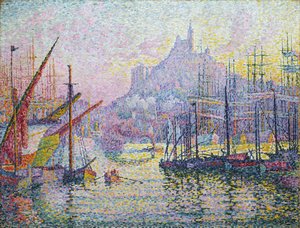
Paul Signac's "Venice, The Pink Cloud," painted in 1909, stands as a cornerstone of Neo-Impressionism—a movement that boldly challenged the conventions of Impressionism while simultaneously embracing scientific principles to revolutionize artistic vision. More than just a depiction of Venice’s picturesque canals and boats, this artwork embodies Signac's unwavering dedication to capturing the ephemeral beauty of light and color through a meticulously crafted technique. Located at the Albertina in Vienna, Austria, the canvas measures 73 x 92 cm and invites viewers into a world where optical blending creates an illusion of vibrancy surpassing mere pigment application.The Pointillist Method: A Scientific Approach to Painting
At its core lies Signac’s groundbreaking Pointillism—developed collaboratively with Georges Seurat—a technique that fundamentally altered the artistic landscape. Unlike Impressionists who blended colors on the canvas, Pointillists applied tiny dots of pure pigment onto the surface, allowing the viewer's eye to fuse them together and perceive a richer hue than could be achieved through traditional blending. This method wasn’t merely stylistic; it was rooted in optical theory championed by Eugène Chevreuil and Michel Hessayon, reflecting Signac’s fascination with scientific investigation into how color perception operates. The resulting image possesses an astonishing luminosity—a testament to the brilliance of this innovative approach.Venetian Atmosphere: Composition and Symbolism
The painting captures a quintessential Venetian scene: sailboats gliding across the lagoon under a hazy pink sky. Signac skillfully employs compositional elements – notably the placement of the larger sailboat dominating the foreground – to guide the viewer’s gaze and establish a sense of depth. The scattered boats contribute to the overall dynamism, mirroring the movement of water and conveying an impression of tranquil activity. Beyond its visual beauty, “Venice, The Pink Cloud” speaks to themes of serenity and contemplation—a reflection of Signac's own philosophical outlook on art’s role in capturing moments of sublime experience. The pink hue of the cloud itself is particularly significant, symbolizing not only atmospheric haze but also a subtle allusion to Venetian rose gardens – emblems of romance and beauty.Signac’s Evolution: From Structured Pointillism to Divisionist Expression
While Signac initially adhered to Seurat's rigorously structured Pointillism, he gradually embraced a looser Divisionist technique—characterized by broader brushstrokes that nevertheless maintain the optical blending principle. This stylistic shift allowed Signac to infuse his paintings with greater emotional intensity and expressive freedom. Works like “Evening, Avignon” and “The Papal Palace” demonstrate this evolution, showcasing vibrant colors and textured surfaces that convey a palpable sense of atmosphere.A Legacy of Impressionistic Innovation
“Venice, The Pink Cloud” exemplifies Post-Impressionism’s commitment to bold color palettes and distorted forms—a deliberate departure from Impressionist realism. Its enduring appeal lies in its ability to transport viewers back to Venice at the turn of the century, capturing not just a visual record but also an emotional resonance that speaks to the timeless fascination with beauty and tranquility. Reproductions crafted by OriginalUniqueArt faithfully recreate Signac’s masterful technique, ensuring collectors and interior designers alike can experience the captivating allure of this iconic artwork.Preguntas y respuestas
¿En qué espacio se recomienda colocar "Venice, The Pink Cloud" de Paul Signac?
Una reproducción de "Venice, The Pink Cloud" queda muy bien en un Living Room.
¿Qué nivel de luminosidad transmite "Venice, The Pink Cloud" de Paul Signac?
En cuanto a la luminosidad percibida, "Venice, The Pink Cloud" de Paul Signac es bright.
¿Qué relevancia tiene "Venice, The Pink Cloud" dentro de Neo-Impressionism?
"Venice, The Pink Cloud" de Paul Signac se clasifica como Recognized y pertenece al movimiento Neo-Impressionism.
Biografía del artista
Primeros años y formación
Paul victor jules signac, un pintor neoimpresionista francés, nació el 11 de noviembre de 1863 en París. Inicialmente, cursó estudios de arquitectura antes de decidirse a convertirse en pintor a los 18 años. Esta decisión fue influenciada por una exposición de la obra de Claude Monet.Estilo artístico e influencias
El estilo de Signac se caracterizó por el uso de pequeños puntos de color puro, que yuxtapuso para crear una sensación de profundidad y luz. Esta técnica, conocida como puntillismo, se desarrolló en colaboración con Georges Seurat. La obra de Signac también estuvo influenciada por sus viajes a lo largo de la costa europea, donde capturó la belleza de las ciudades portuarias en acuarelas.Obras notables y asociaciones
- Boulevard de Clichy (1886), una obra postimpresionista que muestra el meticuloso estilo de Signac.
- El boyero rojo, Saint-Tropez (1895), una vibrante pintura marina con un boi de color rojo anaranjado contra un fondo azul oscuro.
- Miembro fundador de la Société des Artistes Indépendants, que organizó exposiciones anuales que marcaron tendencias en el arte del siglo XX.
Legado e influencia
La obra de Signac tuvo un profundo impacto en el desarrollo del fauvismo, influyendo en artistas como Henri Matisse y André Derain. Como presidente de la Société des Artistes Indépendants, Signac apoyó a los artistas más jóvenes y expuso obras controvertidas de los fauves y los cubistas.- Explore más obras de Paul Signac en https://OriginalUniqueArt.com/@/paul-signac
- Descubra la técnica del puntillismo y su influencia en el neoimpresionismo en https://es.wikipedia.org/wiki/Puntillismo
Fechas clave
- 11 de noviembre de 1863: Nacimiento en París
- 1884: Co-fundación de la Société des Artistes Indépendants
- 15 de agosto de 1935: Fallecimiento a los 71 años

Paul Signac
1863 - 1935 , Francia
Datos clave
- Artistas Que Influyeron:
- Claude Monet
- Eugène Delacroix
- Georges Seurat
- Estilo Artístico: Neoimpresionismo, Puntillismo
- Fecha De Fallecimiento: 15 de agosto de 1935
- Fecha De Nacimiento: 11 de noviembre de 1863
- Influencia En Artistas:
- Henri Matisse
- André Derain
- Lugar De Nacimiento: París, Francia
- Nacionalidad: Francesa
- Nombre Completo: Paul Signac
- Obras Notables:
- Boulevard de Clichy (1886)
- El Pinar de Saint Tropez
- El Faro, Saint-Tropez
Artículos relacionados
The Subdued Radiance of Pastel Palettes: Exploring Emotional Resonance in Art History
Explore the emotional power of pastel palettes in art history! Discover Impressionism, Post-Impressionism & color psychology insights. Find museum-quality reproductions at OriginalUniqueArt.

La ciencia del color: Cómo Seurat y Signac revolucionaron la visión con el puntillismo
Descubre la ciencia y el rigor técnico detrás del puntillismo de Seurat y Signac. Explora este legado maestro ahora.

Paul Signac: Pointillism, Politics & the Pursuit of Harmony in Modern Art
Explore the life & art of Paul Signac, a key figure in Neo-Impressionism. Discover his Pointillist technique, anarchist beliefs, and stunning coastal scenes. Learn about his influence on modern art history.

El Arte del Pastel: Luz, Textura y la Pureza del Pigmento en la Tradición Pictórica
Descubre la técnica del pastel y su pureza cromática desde los maestros clásicos hasta Degas. Explora el arte de la luz y el pigmento puro.

La Sutileza del Pastel: Técnica, Historia y Resonancia Emocional en el Arte
Descubre la sutileza del pastel: técnica, historia y artistas clave como Degas y Renoir. Guías expertas sobre materiales, conservación y cómo expresar emociones a través de este bello arte.