Vista previa
 Compartir
 Compartir
 Ver detalles
 Guía
Guía

 Descargar
 Ver artículos similares
 Radiografía
 Presentación de diapositivas
 Estadísticas
Sunset, Herblay, Opus 206


 Leer más
Giclée / Impresión de arte
Impresiones giclée o en lienzo de calidad de museo con producción rápida y opciones de acabado flexibles. ( Encargar reproducción pintada a mano Ver versión en imagen digital)




P118B €10

P118H €10

P118W €10

P438Z €10

P508JH €12

P508YH €12

P805H €10

P805Z €10

P919BZ €10

P919G €10

P919XJ €10

P959ZH €10

P968JZ €12

W106C €8

W218G €10

W218JH €8

W218Y €10

W307PJ €10

W316G €10

W316PJ €8

W316Y €10

W398PJ €8

W4111J €10

W500HY €15

W500JH €15

W692G €12

W849H €8

W940BG €15

W953PJ €8




Elija entre nuestros tamaños predefinidos que respetan las proporciones originales de la obra.

Puede introducir sus propias dimensiones para adaptarse a un marco o espacio específico. Si el tamaño seleccionado no coincide con las proporciones de la imagen original, recortaremos la obra de arte o extenderemos la imagen con un borde con efecto espejo o de color sólido. Se enviará una maqueta digital para su aprobación antes de que comience la producción.
Tenga en cuenta que la vista previa en pantalla no refleja el recorte o la extensión real. Solo la maqueta mostrará con precisión la composición final.
Aunque existen tamaños personalizados, recomendamos seleccionar una dimensión de la lista predefinida para preservar las proporciones originales.
Envío a todo el mundo () en 2 semanas en lugar de las 4/5 semanas estándar. (29 septiembre)

Envío exprés gratuito a todo el mundo

Lienzo de lino de alta calidad

Seguro de envío completo

Garantía de reembolso de impuestos aduaneros

Garantía de fidelidad cromática exacta

Política de devolución de 100 días (solo por defectos)

Garantía de devolución del 100% del dinero

Oferta por volumen
 La opción de vidrio solo está disponible en tamaños inferiores a 110 cm.

Sunset, Herblay, Opus 206
Giclée / Impresión de arte
Tamaño de la reproducción
-


Precio total
€ 69
A Symphony of Light and Science: The Magic of Sunset, Herblay
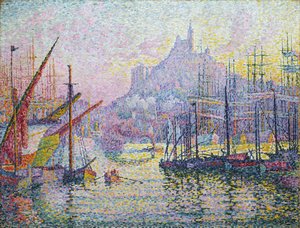
In the quiet transition between day and night, where the sun dips below the horizon to leave behind a trail of amber and indigo, lies the soul of Paul Signac’s “Sunset, Herblay, Opus 206.” This masterpiece is far more than a mere landscape; it is a profound exploration of how we perceive the world. Completed in 1889, during a period of intense artistic revolution in France, the painting captures a tranquil vista of the River Seine near the village of Herblay. As the twilight descends, the water becomes a shimmering mirror, reflecting the dying light through a meticulous dance of color. The scene is punctuated by the silhouettes of trees and the gentle presence of boats, while two subtle figures drift within the composition, inviting the viewer to join them in a moment of quiet contemplation amidst the grandeur of nature.
To gaze upon this work is to witness the triumph of Neo-Impressionism. Moving away from the spontaneous, fleeting brushstrokes of the Impressionists, Signac embraced a more disciplined, almost scientific approach known as Pointillism. Influenced by the color theories of scientists like Helmholtz and his close collaborator Georges Seurat, Signac did not blend his pigments on a palette. Instead, he applied tiny, distinct dots of pure, unadulterated color side by side upon the canvas. This technique relies on the viewer's eye to perform the work of blending; as you stand before the painting, the orange and blue dots merge optically, creating a luminous vibration that feels much more alive than traditional mixing could ever achieve. It is a method that mirrors the harmonious layering of a musical symphony, where individual notes coalesce into a singular, breathtaking melody.
An Emotional Resonance for the Modern Interior
For the discerning collector or interior designer, “Sunset, Herblay, Opus 206” offers an unparalleled opportunity to introduce depth and intellectual rigor into a living space. The painting’s use of complementary colors—the warm, glowing oranges clashing softly against the cool, receding blues—creates a natural visual tension that is both stimulating and soothing. It possesses a unique ability to anchor a room, providing a focal point that commands attention through its texture and light rather than through loud or jarring imagery. The serene atmosphere of the Seine at dusk brings a sense of peace and timelessness, making it an ideal centerpiece for spaces designed for relaxation, such as a master suite or a sophisticated library.
Beyond its technical brilliance, the artwork carries a deep emotional weight. It symbolizes the beauty found in precision and the harmony that arises when science and art intersect. Owning a high-quality reproduction of this piece allows one to inhabit the same atmosphere of tranquility and wonder that Signac captured over a century ago. Whether placed in a contemporary minimalist setting or a more classical, ornate environment, this painting serves as a window into a moment of perfect equilibrium, reminding us all to pause and find the symphony within the silence of a sunset.
Biografía del artista
Primeros años y formación
Paul victor jules signac, un pintor neoimpresionista francés, nació el 11 de noviembre de 1863 en París. Inicialmente, cursó estudios de arquitectura antes de decidirse a convertirse en pintor a los 18 años. Esta decisión fue influenciada por una exposición de la obra de Claude Monet.Estilo artístico e influencias
El estilo de Signac se caracterizó por el uso de pequeños puntos de color puro, que yuxtapuso para crear una sensación de profundidad y luz. Esta técnica, conocida como puntillismo, se desarrolló en colaboración con Georges Seurat. La obra de Signac también estuvo influenciada por sus viajes a lo largo de la costa europea, donde capturó la belleza de las ciudades portuarias en acuarelas.Obras notables y asociaciones
- Boulevard de Clichy (1886), una obra postimpresionista que muestra el meticuloso estilo de Signac.
- El boyero rojo, Saint-Tropez (1895), una vibrante pintura marina con un boi de color rojo anaranjado contra un fondo azul oscuro.
- Miembro fundador de la Société des Artistes Indépendants, que organizó exposiciones anuales que marcaron tendencias en el arte del siglo XX.
Legado e influencia
La obra de Signac tuvo un profundo impacto en el desarrollo del fauvismo, influyendo en artistas como Henri Matisse y André Derain. Como presidente de la Société des Artistes Indépendants, Signac apoyó a los artistas más jóvenes y expuso obras controvertidas de los fauves y los cubistas.- Explore más obras de Paul Signac en https://OriginalUniqueArt.com/@/paul-signac
- Descubra la técnica del puntillismo y su influencia en el neoimpresionismo en https://es.wikipedia.org/wiki/Puntillismo
Fechas clave
- 11 de noviembre de 1863: Nacimiento en París
- 1884: Co-fundación de la Société des Artistes Indépendants
- 15 de agosto de 1935: Fallecimiento a los 71 años

Paul Signac
1863 - 1935 , Francia
Datos clave
- Artistas Que Influyeron:
- Claude Monet
- Eugène Delacroix
- Georges Seurat
- Estilo Artístico: Neoimpresionismo, Puntillismo
- Fecha De Fallecimiento: 15 de agosto de 1935
- Fecha De Nacimiento: 11 de noviembre de 1863
- Influencia En Artistas:
- Henri Matisse
- André Derain
- Lugar De Nacimiento: París, Francia
- Nacionalidad: Francesa
- Nombre Completo: Paul Signac
- Obras Notables:
- Boulevard de Clichy (1886)
- El Pinar de Saint Tropez
- El Faro, Saint-Tropez
Artículos relacionados
The Science of Light: How Seurat and Signac Revolutionized Color with Pointillism
Explore the scientific revolution of Pointillism. Discover how Georges Seurat and Paul Signac utilized optical color mixing and light theory to transform modern art through Neo-Impressionist precision and luminous technique.
Paul Klee: Las 25 Obras Maestras que Definen un Genio del Arte Moderno | OriginalUniqueArt
Descubre las 25 obras maestras de Paul Klee, el genio del arte moderno. Explora su expresionismo único, composiciones abstractas y vibrantes paletas de colores. Reproducciones de alta calidad y decoración con arte en OriginalUniqueArt.com.
The Science of Light: Decoding the Optical Precision of Neo-Impressionism
Explore the scientific brilliance of Neo-Impressionism. Discover how masters like Georges Seurat revolutionized art through optical mixing, color theory, and the precision of Pointillism to capture the true essence of light.

Paul Cézanne: Las 25 Obras Maestras que Definieron el Arte Moderno | OriginalUniqueArt
Descubre las 25 obras maestras de Paul Cézanne que revolucionaron el arte moderno. Explora su técnica, inspiración y significado en paisajes, bodegones y retratos. Reproducciones de alta calidad para decorar tu hogar con arte inolvidable. ¡Explora la colección completa en OriginalUniqueArt.com!

Paul Signac: Pointillism, Politics & the Pursuit of Harmony in Modern Art
Explore the life & art of Paul Signac, a key figure in Neo-Impressionism. Discover his Pointillist technique, anarchist beliefs, and stunning coastal scenes. Learn about his influence on modern art history.