
() ·
Una pintura hecha para ti, a mano
Reproducción al óleo hecha a mano
Óleo sobre lienzo pintado a mano en el tamaño y marco de su elección, realizado por encargo por nuestros artistas. ( Cambiar a impresiones Cambiar a imagen digital)
Descripción del objeto
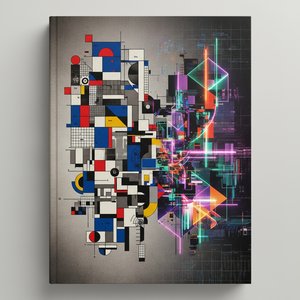
Explore Paul Kelpe’s "Untitled" – a dynamic geometric abstraction in watercolor/gouache. Discover its bold colors, layered forms & subtle symbolic depth from this 1902 German-born artist.
Biografía del artista
Paul Kelpe (1902-1985): Pionero estadounidense de la abstracción geométrica y constructivista, conocido por sus murales vanguardistas en Williamsburg y experimentos innovadores con objetos encontrados. Descubre su obra maestra.
 Ver más
desde ·
Capítulo 1
¿Qué tamaño debería tener?
Deslice para cambiar el tamaño; la imagen de la izquierda muestra el marco con su anchura real. Se mantienen las proporciones originales.
Elija entre nuestros tamaños predefinidos que respetan las proporciones originales de la obra.

Indique el ancho y el alto que necesite para adaptarse a su marco o pared. Al tratarse de una obra pintada a mano, si requiere un tamaño con una proporción distinta, el artista puede pintar un poco más alrededor de la imagen o recortarla ligeramente; usted elige. Le enviaremos una maqueta digital para su aprobación antes de comenzar la pintura. La imagen que se muestra en esta página no refleja el resultado real; solo la maqueta lo hace.
Capítulo 2
¿Cómo debe llegar?
Elige el acabado de los bordes del lienzo
Elige tu marco

Blanco €1

Bordes difuminados €1

Continuación de imagen €1

P118B €10

P118H €10

P118W €10

P438Z €10

P508JH €12

P508YH €12

P805H €10

P805Z €10

P919BZ €10

P919G €10

P919XJ €10

P959ZH €10

P968JZ €12

W106C €8

W218G €10

W218JH €8

W218Y €10

W307PJ €10

W316G €10

W316PJ €8

W316Y €10

W398PJ €8

W4111J €10

W500HY €15

W500JH €15

W692G €12

W849H €8

W940BG €15

W953PJ €8

H24-GOLD €30

H24-SILVER €30

H36-GOLD €45

H36-SILVER €45
Con marco
Moldura: . Dimensiones totales con marco: .
Capítulo 3
¿Quién lo pinta y debería cambiar algo?
Tras realizar el pedido, el equipo de OriginalUniqueArt.com enviará un correo electrónico al cliente para solicitar instrucciones y proporcionar una vista previa del boceto
Envío a todo el mundo () en 3-4 semanas en lugar de las 5 semanas estándar. (10 noviembre). Sin comprometer la calidad.
Capítulo 4
Los últimos retoques
¿Una placa de identificación, como en un museo?
Detalles de la placa de bronce grabada
This elegant plaque features the artist's name and the title of the artwork, finely engraved for a timeless presentation.
It is made from bronze with a refined, elegant finish. The text is precisely laser-engraved for a sharp and permanent result. Measuring 9x2 cm, the plaque is compact yet easy to read. It's built to be durable and scratch-resistant, offering a professional, museum-quality look. Mounting is simple thanks to the included adhesive backing.
Detalles de la placa de acrílico transparente
The plaque includes essential engraved details such as the artist's name, the title of the artwork, the date it was created, the type of media used-like oil on canvas or watercolor-a brief description of the piece, and a QR code that links to the complete artwork information.
It is crafted from clear acrylic, offering a sleek, modern appearance. The text is UV-engraved in black to ensure strong visual contrast. With a size of 10x15 cm, it ensures optimal readability. It comes equipped with two metal hooks for secure wall mounting. The plaque is designed to be weather-resistant, making it suitable for various environments, and it includes interactive features that work seamlessly with smartphone scanning.
Detalles de la placa de acrílico negro
This elegant plaque includes engraved information such as the artist's name, the title of the artwork, the date it was created, the type of media used (like oil on canvas or watercolor), a short description of the artwork, and a QR code for quick access to more information.
The plaque itself is made from refined black acrylic with a premium finish. The text is laser-engraved in white for high contrast and readability. Its size is 10x15 cm, designed to be easy to read. It comes with two metal hooks for professional mounting. The design is sleek and fits any interior style. It is also weather-resistant and durable, with built-in digital integration for mobile compatibility.
¿Un barniz protector?
¿Para cuándo lo necesita?
Capítulo 5
Su pintura, tal como la solicitó

Untitled
Técnica de reproducción
Dimensiones de la reproducción
-

Selección de artistas premium
Mayor nivel de detalle, delicadeza y tiempo de producción adicional
-

Enmarcado de reproducción
-
-
Para obras de arte o reproducciones que midan más de 105 cm (aproximadamente 41 pulgadas) en cualquiera de sus lados, el marco se enviará como un kit desmontado. Este método garantiza una entrega segura y evita daños durante el transporte.
Se requiere montaje profesional: este no es un producto para hacer usted mismo (DIY).
El kit debe ser ensamblado y el lienzo tensado por un enmarcador profesional con experiencia, utilizando cola para madera (no incluida), una tenaza para tensar lienzos y sargentos para mantener los bastidores alineados mientras la cola se seca. Un montaje incorrecto o una tensión desigual del lienzo pueden dañar la obra de arte de forma permanente y no están cubiertos por nuestra garantía.
 Para obras de arte o reproducciones que midan más de 105 cm (aproximadamente 41 pulgadas) en cualquiera de sus lados, el marco se enviará como un kit desmontado. Este método garantiza una entrega segura y evita daños durante el transporte.
Se incluyen todos los listones de madera maciza, cortados con precisión según las medidas.
Se ensambla con los tornillos incluidos, además de cola para madera para las uniones de las esquinas, la cual no se incluye y debe ser proporcionada por su enmarcador.
Se requieren herramientas profesionales que no están incluidas: un alicate para tensar lienzos (tensor) y abrazaderas para mantener los bastidores alineados mientras se seca el pegamento.
Importante:
Las uniones de las esquinas requieren cola para madera, los listones deben sujetarse con prensas hasta que la cola esté completamente seca, y para tensar el lienzo en el bastidor ensamblado se requiere una pinza para tensar lienzos. Ninguno de estos elementos está incluido en el kit. Por favor, contacte con un profesional del enmarcado con experiencia antes de realizar un pedido de este tamaño.

Cartela
-
-

Barniz protector
Barniz brillante (realza los colores y protege contra la luz y la humedad)
-

Personalizar mi obra
Ejemplos de lo que se puede personalizar: sustituir el rostro por una foto del cliente; añadir una mascota (por ejemplo, cambiar un gato por un perro); incluir un mensaje oculto en el fondo; cambiar el paisaje o los elementos del fondo.
-

Envío urgente
Envío a todo el mundo () en 3 o 4 semanas, en lugar de las 5 semanas habituales. (10 noviembre). Sin comprometer la calidad.
-
Envío urgente
Envío internacional () en 5 semanas. (17 noviembre).
Incluido
Precio total final
€ 268
La opción de vidrio solo está disponible en tamaños inferiores a 110 cm.
Incluido en cada pedido
- Envío exprés gratuito a todo el mundo
- Lienzo de lino de alta calidad
- Seguro de envío total
- Garantía de reembolso de aranceles aduaneros
- Garantía de fidelidad cromática exacta
- Política de devolución de 100 días (solo por defectos)
- Garantía de devolución del 100% del dinero
- Descuento por cantidad


 Ver en contexto
 Enviar
 Compartir
 Detalles
 Guía
Guía

 Descargar
 Similares
 Radiografía
 Presentación de diapositivas
 Preguntas y respuestas
 Estadísticas
En cifras
- 29marcos disponibles para elegir
- tamaños estándar, en sus propias proporciones
- 5semanas para pintar y entregar la obra
Sobre el original

- 35.0 x 23.0 cm

Esta obra está protegida por derechos de autor
La obra de arte que se muestra en esta página está protegida por las leyes de propiedad intelectual, lo que significa que no podemos crear ni vender legalmente una reproducción idéntica. Esta protección se hace cumplir en virtud de acuerdos internacionales como el Convenio de Berna y por las leyes nacionales, incluidas aquellas establecidas por el Ley de derechos de autor de los EE. UU. - Título 17.
Como una alternativa respetuosa y legal, ofrecemos obras de arte personalizadas y pintadas a mano inspiradas en la original. Nuestros expertos y profesionales del arte estudian cuidadosamente el estilo, el sentimiento y la esencia artística de la obra original para crear una pieza nueva y única que evoque la misma sensación, siendo al mismo tiempo una creación original por derecho propio.
Este método cumple plenamente con las normativas de derechos de autor, ya que no implica la copia ni la duplicación de la obra protegida. En su lugar, se trata de una reinterpretación creativa: una nueva pintura influenciada por la original, pero que no es idéntica a ella.

Paul Kelpe
1902 - 1985, Alemania
Datos rápidos sobre Paul Kelpe
- Artistic Movement Or Style: Arte abstracto, Constructivismo
- Artists Or Movements Influenced By This Artist: ['American Abstract Art']
- Artists Who Influenced This Artist:
- Kandinsky
- Moholy-Nagy
- Schwitters
- Date Of Birth: 1902-01-15
- Full Name: Paul Kelpe
- Nationality: Alemana-Americana
- Notable Artworks:
- Murallas de Williamsburg
- Sin título
- Place Of Birth: Minden, Alemania
Biografía del artista
A Pioneer of American Abstraction: The Life and Art of Paul Kelpe
Paul Kelpe, born in Minden, Germany in 1902, emerged as a pivotal figure in the development of abstract art within the United States. His journey, spanning both continents and artistic movements, was marked by an unwavering commitment to geometric abstraction and innovative experimentation. Initially drawn to music, Kelpe’s path dramatically shifted after encountering the burgeoning world of abstract painting, igniting a passion that would define his life's work. He embarked on formal training at the Academy of Arts in Hanover, immersing himself in art history and architecture while simultaneously absorbing the revolutionary ideas circulating within the European avant-garde. This period proved formative, as Kelpe came under the influence of luminaries like Wassily Kandinsky and László Moholy-Nagy, and encountered the groundbreaking work of artists such as Kurt Schwitters, Naum Gabo, and El Lissitzky. The tenets of Suprematism and Constructivism resonated deeply with him, shaping his aesthetic sensibilities and providing a foundation for his future explorations. While acknowledging Schwitters’ impact, Kelpe deliberately diverged from what he perceived as the German artist's chaotic style, opting instead for meticulous precision and rigorously defined geometric forms. He envisioned his paintings not as representations of nature, but as carefully orchestrated “organizations of forms,” devoid of superfluous brushwork and imbued with a sense of structural clarity.From Found Objects to Geometric Constructions
Kelpe’s early artistic endeavors were characterized by a daring willingness to challenge conventional boundaries. Dissatisfied with traditional painting techniques, he pioneered the integration of found objects into his compositions, creating groundbreaking “combine” paintings that predated similar explorations by American artists. These works, born from a playful yet intellectually rigorous approach, seamlessly blended two- and three-dimensional elements, blurring the lines between painting and sculpture. This innovative technique showcased Kelpe’s keen formal understanding and inventive spirit. However, he soon transitioned away from literal assemblage, instead choosing to depict mechanical components—wheels, gears, and other industrial motifs—within his abstract compositions. These paintings celebrated a harmonious relationship between humanity and technology, reflecting the optimism of the machine age while maintaining a distinctly geometric aesthetic. He envisioned his paintings not as mere depictions of objects but as explorations of spatial relationships and structural principles.Navigating Realism and Abstraction: The WPA Years
The early 1930s found Kelpe in Chicago, a city where the art scene remained largely anchored in realism. Despite this prevailing artistic climate, he resolutely pursued his abstract vision, becoming something of an anomaly within the local community. He secured employment as a muralist with the Works Progress Administration (WPA), but faced challenges reconciling his aesthetic principles with the program’s emphasis on representational imagery. Forced to incorporate recognizable elements into his designs, Kelpe cleverly infused them with his signature geometric sensibility, depicting factories and industrial landscapes as “Bauhaus-inspired arrangements of geometric machinery.” Even these concessions were met with criticism from those who deemed his work too abstract, highlighting the resistance towards non-representational art during that era. Nevertheless, he persevered, creating murals for the Chicago branch of the Public Works of Art Project and later a representational American Scene mural for Southern Illinois University Library, depicting the region’s industrial, agricultural, and commercial history. These projects demonstrated his versatility while subtly asserting his unique artistic voice.The Williamsburg Murals and Lasting Legacy
In 1936, Kelpe relocated to New York City, a move that proved pivotal in his career. He was selected by Burgoyne Diller for the WPA’s mural program at the Williamsburg Housing Project in Brooklyn, alongside artists such as Ilya Bolotowsky and Albert Swinden. This commission provided him with an unprecedented opportunity to create large-scale abstract murals—the first of their kind in the United States. Kelpe's two contributions to the project are distinguished by their intricate geometric compositions, vibrant color juxtapositions, and unique surface textures. His masterful use of triangles, rectangles, trapezoids, and circles, arranged in striped, gridded, or bubbled patterns, created a dynamic interplay of form and color that captivated viewers. A critic for New York magazine lauded his work as “masterly,” praising its subtle balance of oranges and greens and its evocation of “jazz-age exuberance.” These murals, now on loan to the Brooklyn Museum, stand as enduring testaments to Kelpe’s artistic vision and his pioneering role in establishing abstract art within the American landscape. He continued to paint, teach, and exhibit throughout his life, leaving behind a rich body of work that continues to inspire and challenge audiences today. His unwavering dedication to geometric form, combined with his willingness to experiment and push boundaries, paved the way for future generations of abstract artists.Artículos relacionados
Beyond Form & Color: Geometric Abstraction's Evolution in 20th/21st Century Art
Explore the evolution of geometric abstraction from Cubism to contemporary art. Discover key artists like Malevich & Mondrian, investment insights, and expert collecting advice at OriginalUniqueArt.

Acuarelas Legendarias: 10 Obras Maestras que Transformaron el Arte | OriginalUniqueArt
Descubre 10 acuarelas legendarias de Turner, Monet y Sargent que revolucionaron el arte. Explora la historia, técnica y belleza de estas obras maestras impresionistas y románticas. Reproducciones de museo en OriginalUniqueArt.com.

Abstracción Geométrica: 10 Obras Maestras que Transformaron el Arte Moderno | OriginalUniqueArt
Descubre las 10 obras maestras de la abstracción geométrica que revolucionaron el arte moderno. Explora a Mondrian, Malevich y Kandinsky en OriginalUniqueArt.com. Reproducciones de alta calidad para tu hogar.

Expresionismo Abstracto: 10 Obras Maestras que Transformaron el Arte |
Descubre las 10 obras maestras del Expresionismo Abstracto: Pollock, Rothko y más. Explora la historia, técnica y significado de estos lienzos icónicos. Reproducciones de arte exclusivas en .