Cambiar a impresiones
 Ver más







































 Para obras de arte o reproducciones que midan más de 105 cm (aproximadamente 41 pulgadas) en cualquiera de sus lados, el marco se enviará como un kit desmontado. Este método garantiza una entrega segura y evita daños durante el transporte.


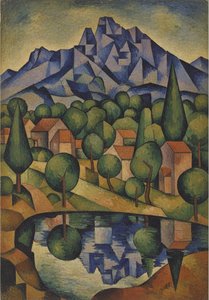
House and Trees
Paul Cézanne’s *House and Trees*, painted in 1890, stands as a cornerstone of Post-Impressionism and a testament to Cézanne's revolutionary approach to depicting the natural world. Currently residing at The Barnes Foundation in Philadelphia, this artwork transcends mere representation; it embodies Cézanne’s profound engagement with form and structure—a departure from Impressionistic fleeting impressions toward an enduring vision of reality.Composition and Style
The painting presents a simple yet powerfully evocative scene: a rustic house nestled amongst mature trees. Cézanne eschewed traditional perspective, favoring instead a flattened space where objects appear to exist simultaneously in multiple planes. This technique—characteristic of Cézanne’s oeuvre—creates an illusionistic depth that defies conventional visual conventions. Repetitive brushstrokes build up complex fields of color, layering textures and suggesting movement without resorting to linear depiction. The artist meticulously observed the contours of his subjects, capturing their essence rather than attempting to reproduce them accurately. This deliberate simplification is not a rejection of realism but rather an elevation of artistic expression—a conscious decision to prioritize form over illusion.Artistic Influences
Cézanne’s artistic journey was marked by encounters with influential movements like Romanticism and Realism, which instilled in him a deep appreciation for capturing the grandeur and emotional intensity of nature. However, he swiftly moved beyond these stylistic constraints, forging his own distinctive visual language through intense study of Impressionist principles. Cézanne's unwavering focus on underlying geometric forms—circles, squares, triangles—became central to his artistic method. He sought to distill the essence of an object into its fundamental shapes, mirroring a broader philosophical preoccupation with permanence and stability amidst the ephemeral nature of experience. This approach profoundly impacted subsequent artists like Henri Matisse and Pablo Picasso, who recognized Cézanne as “the father of us all.”Legacy
Cézanne’s groundbreaking innovations irrevocably altered the trajectory of modern art. He championed a radical rethinking of artistic representation—a rejection of academic dogma in favor of subjective observation and formal experimentation. His insistence on exploring the sculptural qualities of painted surfaces paved the way for Cubism, where artists fragmented objects into geometric planes to convey multiple perspectives simultaneously. Cézanne’s influence extends far beyond painting; his aesthetic principles resonated throughout sculpture, architecture, and design—inspiring generations of creatives to challenge conventions and pursue artistic truth.Relevance in Modern Art
The Post-Impressionist movement, spearheaded by Cézanne, fundamentally reshaped the artistic landscape of the early 20th century. Artists like Vincent van Gogh and Paul Klee embraced Cézanne’s exploration of color and form, adapting his techniques to express their own emotional visions. Cézanne's legacy continues to inspire artists today who strive for originality and intellectual rigor—a reminder that true artistic achievement lies in transcending stylistic imitation and forging a path toward genuine creative expression.- Peaches, Pears and Grapes by Paul Cézanne
- Bouquet by Paul Gauguin
- Pine Trees in Front of the Wall of the Asylum by Vincent van Gogh
OriginalUniqueArt's Handmade Oil Painting Reproductions
At OriginalUniqueArt, we offer high-quality, handmade oil painting reproductions of Cézanne’s masterpieces. Our skilled artists carefully recreate the original paintings using traditional techniques and materials.- Explore our collection: Peaches, Pears and Grapes by Paul Cézanne
- Discover more: Bouquet by Paul Gauguin
- Admire this iconic piece: Pine Trees in Front of the Wall of the Asylum by Vincent van Gogh
Learn More About Paul Cézanne and His Artistic Movement
For more information on Paul Cézanne and his contributions to Post-Impressionism, visit Paul Cézanne's page on OriginalUniqueArt. You can also explore the Wikipedia article on Paul Cézanne for a deeper understanding of his life and work.Preguntas y respuestas
¿Cuándo se creó "Casa y árboles" y a qué movimiento pertenece?
"Casa y árboles" de Paul Cézanne data de 1890 y pertenece al Post-Impressionism.
¿Existe una ficha informativa sobre "Casa y árboles" de Paul Cézanne para estudiantes?
Una página de Ficha informativa está disponible para "Casa y árboles" de Paul Cézanne: una ficha imprimible sobre la obra, diseñada para estudiantes y su uso en el aula.
¿Qué ubicación se adapta mejor al formato de "Casa y árboles" de Paul Cézanne?
El formato Formato horizontal de "Casa y árboles" de Paul Cézanne es ideal para un Vestíbulos de hoteles. El formato y el espacio orientan conjuntamente la ubicación de una reproducción.
 Ver en contexto
 Enviar
 Compartir
 Detalles
 Guía
Guía

 Descargar
 Similares
 Radiografía
 Presentación de diapositivas
 Q&A
Q&A Estadísticas