

 Ver en contexto
 Enviar
 Compartir
 Detalles

 Descargar
 Similares
 Radiografía
 Presentación de diapositivas
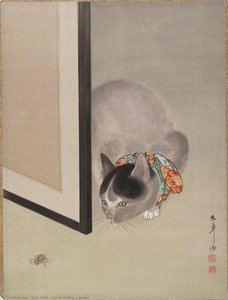
Cat Watching a Spider
 1888
1888 38.0 x 28.0 cm
 Ver más
Adquiera una imagen digital de alta resolución y optimizada, muy superior a la vista previa en línea.
Cada archivo es preparado meticulosamente por nuestros especialistas internos mediante el uso de herramientas avanzadas y un experto retoque manual. Nos aseguramos de que cada imagen posea una claridad excepcional, una precisión cromática impecable y un detalle minucioso.
El archivo final se entrega por correo electrónico en un plazo de 72 horas, optimizado para su uso inmediato en entornos profesionales, editoriales y de impresión. Esta es la misma calidad en la que confían los estudios de diseño, las editoriales y las galerías de primer nivel.
Imagen Digital
Descarga un archivo de alta resolución para exhibición personal, impresión y proyectos creativos. ( Comprar impresión Comprar pintura hecha a mano)
Incluido en cada pedido de imágenes digitales
Entrega digital experta, garantizada.
Al elegir OriginalUniqueArt.com, no solo está adquiriendo una imagen; está recibiendo una obra de arte digital mejorada profesionalmente, elaborada con precisión y respaldada por una garantía de satisfacción. Esto es todo lo que incluye su pedido, automáticamente:

Entrega rápida por email
Recibirá su archivo de imagen digital en alta resolución por correo electrónico en un plazo de 72 horas tras realizar su pedido, listo para su uso inmediato.

Archivo digital optimizado por IA
Su obra de arte se optimiza profesionalmente mediante herramientas avanzadas de IA y edición manual, garantizando el máximo detalle, claridad y precisión cromática.

Reenvío gratuito de por vida
¿Has borrado o perdido tu archivo por error? No te preocupes: te lo volveremos a enviar en cualquier momento, sin coste adicional.

Sin gastos de importación, siempre
Disfrute de su obra de arte al instante sin aduanas, aranceles ni gastos de envío; las descargas digitales siempre están libres de impuestos.

Garantía de fidelidad de color
Garantizamos que su imagen digital refleje los colores originales con la mayor fidelidad posible, mediante el uso de herramientas profesionales y gestión del color.

Garantía de satisfacción de 60 días
Si no está satisfecho con su imagen digital, la revisaremos o le reembolsaremos el 100% en un plazo de 60 días, sin preguntas.

100% Garantía de devolución de dinero
¿No está satisfecho? Obtenga un reembolso completo dentro de los 60 días posteriores a la recepción de su archivo digital, sin necesidad de explicaciones.

Descuentos por pedidos grandes
Compra 3 imágenes, ahorra 10% - Compra 5, ahorra 15% - Compra 10+, ahorra 20%. Ideal para proyectos creativos, galerías y agencias.
Biografía del artista
Oide Tōkō: A Master of Subtle Emotion in the Meiji Era
Born in Tokyo in 1841, Oide Tōkō (also known as Ōide Aya) emerged during a pivotal period in Japanese history – the Meiji Restoration (1868-1912). This era witnessed rapid modernization and Westernization alongside a fervent desire to preserve traditional Japanese aesthetics. Tōkō’s work stands as a compelling testament to this complex interplay, offering intimate glimpses into daily life and profound explorations of human emotion within a distinctly Japanese framework.
Early biographical details about Tōkō are somewhat sparse, though he was recognized as a skilled painter from an early age. His formal training remains largely undocumented, suggesting he may have been part of a guild system or learned through apprenticeship – common practices for artists at the time. The name “Kagyu-zuruya” (蝸牛窟), often associated with his work, translates to "snail shell cave," hinting at a secluded and contemplative artistic practice. His courtesy name, Sōkyō 素巧, meaning “simple skill,” reflects a dedication to understated elegance and naturalism in his compositions.
A Palette of Quiet Observation
Tōkō’s style is characterized by its remarkable subtlety and psychological depth. He primarily worked in ink and color on silk or paper, employing a delicate brushwork that prioritized capturing fleeting moments and nuanced expressions. Unlike the grand narratives often favored during the Meiji period, Tōkō's paintings frequently depict solitary figures engaged in quiet activities – a woman tending to her garden, a child playing with a toy, or a man gazing pensively into the distance. These scenes are not dramatic; rather, they convey a sense of serene contemplation and understated emotion.
His most famous work, “Cat Watching a Spider” (猫と蜘蛛), exemplifies this approach perfectly. The painting isn’t about action or spectacle but about the quiet observation of two creatures sharing a space. The cat's expression is ambiguous – curiosity, boredom, perhaps even a touch of melancholy – inviting viewers to project their own emotions onto the scene. This ability to evoke such complex feelings with minimal visual elements was a hallmark of Tōkō’s artistry.
Influences and Artistic Context
Tōkō's work is deeply rooted in traditional Japanese painting techniques, particularly those associated with the yamato-e style – a school emphasizing naturalism and emotional expression. However, he also absorbed influences from Western art, notably Impressionism’s focus on capturing light and atmosphere. The subtle gradations of color in his paintings, reminiscent of Monet or Renoir, demonstrate this assimilation without sacrificing the core tenets of Japanese aesthetics.
During the Meiji period, there was a conscious effort to promote both Western and Eastern art forms. Tōkō’s work gained recognition as Japan sought to establish its own unique artistic identity. His paintings were exhibited in Japan and internationally, contributing to a growing appreciation for Japanese art abroad.
Legacy and Market Value
Oide Tōkō died in 1905, leaving behind a relatively small but highly valued body of work. His paintings have been offered at auction multiple times, with prices ranging from $1,000 to $5,000, reflecting their increasing recognition as significant examples of Meiji-era Japanese art. His ability to capture the quiet dignity and emotional resonance of everyday life continues to resonate with collectors and viewers today.
His work is a poignant reminder that beauty and profound meaning can be found not in grand gestures but in the subtle details of human experience – a lesson beautifully articulated by Oide Tōkō through his evocative paintings. The Dictionary of Artists in Japan (DAJ) highlights his birthdate as May 24, 1841, and his death date as March 14, 1905, solidifying his place within the historical record of Japanese art.
oide tōkō
1841 - 1905 , Japan
Breves datos
- Artistic Movement Or Style: Meiji period art
- Date Of Birth: 1841-05-24
- Date Of Death: 1905-03-14
- Full Name: oide tōkō
- Nationality: Japanese
- Notable Artworks: ['Cat Watching a Spider']
- Place Of Birth: Tokyo, Japan

