Cambiar a impresiones
 Ver más







































 Para obras de arte o reproducciones que midan más de 105 cm (aproximadamente 41 pulgadas) en cualquiera de sus lados, el marco se enviará como un kit desmontado. Este método garantiza una entrega segura y evita daños durante el transporte.


Michelangelo Buonarroti: A Renaissance Titan
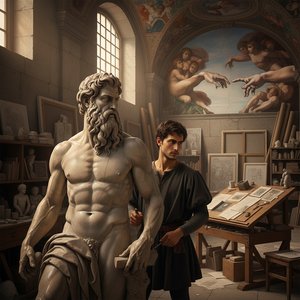
Michelangelo di Lodovico Buonarroti Simoni (6 March 1475 – 18 February 1564), known mononymously as Michelangelo, was an Italian sculptor, painter, architect, and poet of the High Renaissance. Born in the Republic of Florence, his work was inspired by models from classical antiquity and had a lasting influence on Western art. Michelangelo's creative abilities and mastery in a range of artistic arenas define him as an archetypal Renaissance man, along with his rival and elder contemporary, Leonardo da Vinci. Given the sheer volume of surviving correspondence, sketches, and reminiscences, Michelangelo is one of the best-documented artists of the 16th century. He was lauded by contemporary biographers as the most accomplished artist of his era. Michelangelo achieved fame early. Two of his best-known works, the Pietà and David, were sculpted before the age of 30. Although he did not consider himself a painter, Michelangelo created two of the most influential frescoes in the history of Western art: the scenes from Genesis on the ceiling of the Sistine Chapel in Rome, and The Last Judgment on its altar wall. His design of the Laurentian Library pioneered Mannerist architecture. At the age of 71, he succeeded Antonio da Sangallo the Younger as the architect of St. Peter's Basilica. Michelangelo transformed the plan so that the Western end was finished to his design, as was the dome, with some modification, after his death. Michelangelo’s artistic style was characterized by an unparalleled fusion of observation and imagination—a hallmark of the Renaissance spirit. He meticulously studied human anatomy, striving for accuracy and realism, yet simultaneously imbued his figures with profound emotion and spiritual significance. This duality is evident throughout his oeuvre, from the monumental sculptures to the breathtaking frescoes that adorn some of Christendom’s most sacred spaces. His approach was revolutionary; he sought not merely to depict beauty but to convey divine truth through artistic representation.Early Life and Training (1475-1496)
- Michelangelo di Lodovico Buonarroti Simoni was born on March 6, 1475, in Caprese Michelangelo, Tuscany.
- Initially, his father resisted an artistic career but conceded to his son’s exceptional talent for drawing.
- At age 13, he apprenticed with Domenico Ghirlandaio, learning fresco and drawing techniques.
- He soon gravitated towards sculpture, studying classical works in the Medici gardens — a pivotal influence.
Early Period: Establishing Mastery (1490-1505)
- Around 1496, he received his first major commission: the sculpture of the Pietà, completed in 1499.
- The Pietà, housed in St. Peter's Basilica, showcased his mastery of marble carving and emotional depth.
- His next landmark work was the colossal statue of David (1501-1504), symbolizing Florentine republican ideals.
The Cappella Sistina
The Cappella Sistina is a significant cultural and religious landmark, built between 1473 and 1481 during the reign of Pope Sixtus IV. The chapel has served as a place of both religious and functionary papal activity since its construction. For more information on Michelangelo's works and the Cappella Sistina, visit /art/list/?Filter=A@D3CJBF-The-Museum-Cappella-Sistina-(Italy). Michelangelo’s legacy extends far beyond his individual creations. He fundamentally reshaped artistic conventions and established a standard of excellence that continues to inspire artists today. His unwavering dedication to anatomical precision, combined with an expressive understanding of human emotion—a hallmark of the Renaissance spirit—solidified his position as one of history's greatest geniuses. The enduring power of his art testifies to the transformative potential of creativity and the pursuit of beauty as a reflection of divine truth.Preguntas y respuestas
¿Dónde se encuentra actualmente en exposición "Salmon - Boaz - Obed" de Miguel Ángel?
Puede ver la obra original "Salmon - Boaz - Obed" en el Cappella Sistina, Ciudad del Vaticano, Italia.
¿Qué representa "Salmon - Boaz - Obed" de Miguel Ángel y qué atmósfera transmite?
"Salmon - Boaz - Obed" de Miguel Ángel combina michelangelo, sistine chapel, frescoes, religion, mary, child jesus, renaissance art con una atmósfera Elegante.
¿Qué sentimiento transmite "Salmon - Boaz - Obed" de Miguel Ángel dentro de Rennaissance?
Dentro del movimiento Rennaissance, "Salmon - Boaz - Obed" se presenta con un tono Romántico.
 Ver en contexto
 Enviar
 Compartir
 Detalles
 Guía
Guía

 Descargar
 Similares
 Radiografía
 Presentación de diapositivas
 Q&A
Q&A Estadísticas