

 Vista previa
 Compartir
 Compartir
 Ver detalles

 Descargar
 Ver similares
 Radiografía
 Presentación de diapositivas
Still Life with Fruit


 Leer más
Reproducción al óleo hecha a mano
Óleo sobre lienzo pintado a mano en el tamaño y marco de su elección, realizado por encargo por nuestros artistas. ( Pedir impresión Comprar descarga)




P118B $10

P118H $10

P118W $10

P438Z $10

P508JH $12

P508YH $12

P805H $10

P805Z $10

P919BZ $10

P919G $10

P919XJ $10

P959ZH $10

P968JZ $12

W106C $8

W218G $10

W218JH $8

W218Y $10

W307PJ $10

W316G $10

W316PJ $8

W316Y $10

W398PJ $8

W4111J $10

W500HY $15

W500JH $15

W692G $12

W849H $8

W940BG $15

W953PJ $8




Elija entre nuestros tamaños predefinidos que respetan las proporciones originales de la obra.

Puede ingresar sus propias dimensiones para adaptarse a un marco o espacio específico. Si el tamaño seleccionado no coincide con las proporciones de la imagen original, recortaremos la obra o extenderemos la pintura con elementos adicionales pintados a mano. Se le enviará una maqueta digital para su aprobación antes de comenzar la producción.
Tenga en cuenta que la vista previa en pantalla no refleja el recorte o la extensión reales. Solo la maqueta mostrará con precisión la composición final.
Si bien existen tamaños personalizados, recomendamos seleccionar una dimensión de la lista predefinida para preservar las proporciones originales.
Tras realizar el pedido, el equipo de OriginalUniqueArt.com enviará un correo electrónico al cliente para solicitar instrucciones y proporcionarle una vista previa del boceto.
Envío a todo el mundo () en 3-4 semanas en lugar de las 5 semanas estándar. (21 agosto). Sin comprometer la calidad.

Envío exprés gratuito a todo el mundo

Lienzo de lino de alta calidad

Seguro de envío completo

Garantía de reembolso de aranceles aduaneros

Garantía de fidelidad cromática exacta

Política de devolución de 60 días (solo por defectos)

Garantía de devolución del 100% del dinero

Oferta por volumen
 La opción de vidrio solo está disponible en tamaños inferiores a 110 cm.

Still Life with Fruit
Técnica de reproducción
Tamaño de la reproducción
-


Precio total
$ 300
Descripción de la obra
A Symphony of Form and Spirit
In the quiet, contemplative realm of early twentieth-century American modernism, Marsden Hartley’s Still Life with Fruit (1916) emerges as a profound meditation on arrangement and hidden emotion. At first glance, the canvas presents a deceptively simple tableau: a collection of vibrant fruits resting upon a pristine white cloth. Yet, beneath this surface lies the unmistakable touch of an artist searching for spiritual resonance within the mundane. Hartley, a man whose life was marked by early loss and a restless quest for meaning, imbues this composition with a peculiar, almost sentient energy. The arrangement of pears, oranges, and bananas is not merely a study in botanical accuracy but a deliberate construction of shape and light that invites the viewer into a deeper, more psychological space.
The brilliance of this particular work lies in its uncanny ability to evoke human expression through inanimate objects. As one gazes upon the symmetrical arrangement at the center of the table, a subtle magic unfolds; the specific placement of two pears, a rounded fruit, and a curving banana coalesces into the suggestion of a smiling face. This playful, almost surrealist touch provides a poignant contrast to the underlying intensity of Hartley’s technique. The artist utilizes bold, deliberate strokes and a careful balance of color to guide the eye across the plate, where apples and oranges are positioned with a rhythmic precision that feels both organic and meticulously planned. It is this tension between the natural world and the artist's subjective perception that makes the piece so captivating for the modern collector.
A Masterclass in Composition and Light
Technically, Still Life with Fruit serves as a testament to Hartley’s mastery of form and his ability to manipulate light to create depth. The interplay between the bright, citrus hues of the oranges and the softer, more muted tones of the pears creates a visual melody that resonates throughout the frame. The white cloth acts as a luminous stage, reflecting light in a way that pushes the colorful subjects forward, giving them a sculptural presence. For interior designers, this painting offers a remarkable versatility; its structured composition provides a focal point of stability, while its vibrant palette can breathe life into a sophisticated, contemporary space or complement the textured warmth of a classical study.
Beyond its aesthetic appeal, the work carries a historical weight that speaks to the evolution of American art. Created in 1916, during a period of immense global transition, Hartley’s focus on the intimate and the symbolic reflects a broader movement toward finding internal truth amidst external chaos. To possess a reproduction of this masterpiece is to hold a piece of art history that celebrates the beauty found in the overlooked. It is an invitation to slow down, to observe the subtle geometries of our surroundings, and to find the "smiling face" hidden within the stillness of our own lives.
Biografía del artista
Primeros años y formación
Marsden Hartley, un pintor, poeta y ensayista modernista estadounidense, nació el 4 de enero de 1877 en Lewiston, Maine. Era el hijo menor de nueve hijos de padres ingleses que se habían establecido en los Estados Unidos. Después de la muerte de su madre a la edad de ocho años, Hartley’s padre se volvió a casar y él fue dejado atrás en Maine para trabajar en una fábrica de zapatos durante un año. Este período de soledad más tarde influiría en su perspectiva artística.Carrera Artística
En 1892, Hartley se reunió con su familia en Cleveland, Ohio, donde comenzó su formación artística en la Escuela de Arte de Cleveland. Luego se mudó a Nueva York en 1898 para estudiar pintura bajo William Merritt Chase en la Escuela de Arte de Nueva York y luego asistió al Academia Nacional de Diseño. La amistad de Hartley con Albert Pinkham Ryder, junto con los escritos de Walt Whitman y los trascendentalistas estadounidenses, lo inspiró a ver el arte como una búsqueda espiritual.Obras Notables y Exposiciones
- El agujero de hielo (1908), ahora en el Museo de Arte de Nueva Orleans, marcó la transición de Hartley hacia obras maduras.
- Color otoñal (ca. 1910), expuesta en el Museo Metropolitano de Arte, refleja su temprano compromiso con el modernismo.
- Retrato de un oficial alemán (1914), también en el Museo Metropolitano de Arte, encarna su experiencia con pintores modernistas europeos.
Vida Posterior e Influencia
Después de regresar a los Estados Unidos en 1916, Hartley continuó pintando por todo el país. En 1937, declaró su intención de convertirse en "el pintor de Maine", alineándose con el movimiento del regionalismo. Este período se caracteriza por obras como Mt. Katahdin (Maine), Otoño -2 (1939–40), ahora en el Museo Metropolitano de Arte.- Ver las obras de Marsden Hartley en OriginalUniqueArt
- Explorar las mayores pinturas de todos los tiempos
- Leer más sobre Marsden Hartley en Wikipedia

Marsden Hartley
1877 - 1943 , Estados Unidos de América
Datos clave
- Artistas Que Influyeron:
- Albert Pinkham Ryder
- Walt Whitman
- Transcendentalistas americanos
- Fecha De Nacimiento: 4 de enero de 1877
- Lugar De Nacimiento: Lewiston, Estados Unidos
- Movimiento Artístico: Modernismo americano
- Nacionalidad: Estadounidense
- Nombre Completo: Marsden Hartley
- Nombres Alternativos: Edmund Hartley
- Obras Notables:
- The Ice Hole (1908)
- Autumn Color (ca. 1910)
- Portrait of a German Officer (1914)
Artículos relacionados

Grant Wood & American Regionalism: Identity, Myth & the Rural Landscape
Explore the world of Grant Wood & American Regionalism with OriginalUniqueArt. Discover the symbolism behind 'American Gothic', recurring themes, and the movement's lasting impact on art history. High-quality reproductions available.

Realismo Estadounidense: 10 Obras Maestras que Cambiaron el Arte y la Decoración
Descubre 10 obras maestras del Realismo Estadounidense: Winslow Homer, Edward Hopper y más. Explora la historia, técnica y emoción de estos icónicos cuadros. Encuentra reproducciones de arte de museo en OriginalUniqueArt.com.

American Regionalism: The Soul of the Heartland and the Mastery of Grant Wood
Explore the profound history of American Regionalism. Discover how Grant Wood captured the heart of the Midwest through masterpieces like American Gothic. An expert guide to the movement, its cultural impact, and the enduring beauty of American Realism.
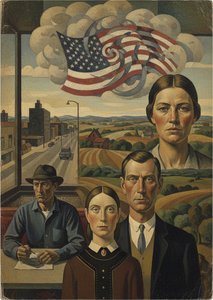
Ecos del Lugar: Regionalismo e Identidad Americana en el Arte Entre Guerras
Descubra el Regionalismo americano: un movimiento artístico que capturó la esencia de la identidad rural y la vida en Estados Unidos entre guerras. Análisis experto, obras clave y legado cultural.

Regionalismo Americano: Un Crisol de Identidad en el Arte y la Sociedad
Explora el Regionalismo Americano: su historia, artistas clave como Benton y Wood, y su profundo compromiso con la sociedad de la Gran Depresión. Un análisis exhaustivo para amantes del arte.



