- Inicio

- Impresión en lienzo
- Lee Krasner
- Rising Green
 Preview
 Enviar
 Compartir
 Detalles

 Descargar
 Similares
 Radiografía
 Presentación de diapositivas
Rising Green
 Acrylic On Canvas
- WallArt
- Abstract Expressionism
 1972
1972 209.0 x 176.0 cm
 Museo Metropolitano de Arte
 Ver más
Giclée / Impresión de arte
Impresión giclée o en lienzo de calidad de museo con producción rápida y opciones de acabado flexibles. ( Switch to hand made Painting Switch to Image)




P118B $10

P118H $10

P118W $10

P438Z $10

P508JH $12

P508YH $12

P805H $10

P805Z $10

P919BZ $10

P919G $10

P919XJ $10

P959ZH $10

P968JZ $12

W106C $8

W218G $10

W218JH $8

W218Y $10

W307PJ $10

W316G $10

W316PJ $8

W316Y $10

W398PJ $8

W4111J $10

W500HY $15

W500JH $15

W692G $12

W849H $8

W940BG $15

W953PJ $8




Elija entre nuestros tamaños predefinidos que respetan las proporciones originales de la obra.

Puede introducir sus propias dimensiones para adaptarse a un marco o espacio específico. Si el tamaño seleccionado no coincide con las proporciones de la imagen original, recortaremos la obra de arte o extenderemos la imagen con un borde con efecto espejo o de color sólido. Se enviará una maqueta digital para su aprobación antes de que comience la producción.
Tenga en cuenta que la vista previa en pantalla no refleja el recorte o la extensión real. Solo la maqueta mostrará con precisión la composición final.
Aunque existen tamaños personalizados, recomendamos seleccionar una dimensión de la lista predefinida para preservar las proporciones originales.
Entrega mundial () en 2 semanas en lugar de las 4/5 semanas estándar. (28 julio)

Envío exprés gratuito a todo el mundo

Lienzo de lino de alta calidad

Seguro de envío total

Garantía de reembolso de impuestos aduaneros

Garantía de fidelidad de color

Política de devolución de 60 días (solo por defectos)

Garantía de devolución del 100% del dinero

Descuento por pedido múltiple
 La opción de vidrio solo está disponible en tamaños inferiores a 110 cm.

Rising Green
Giclée / Impresión de arte
Tamaño de la reproducción
-


Precio total final
$ 80
Descripción de la obra
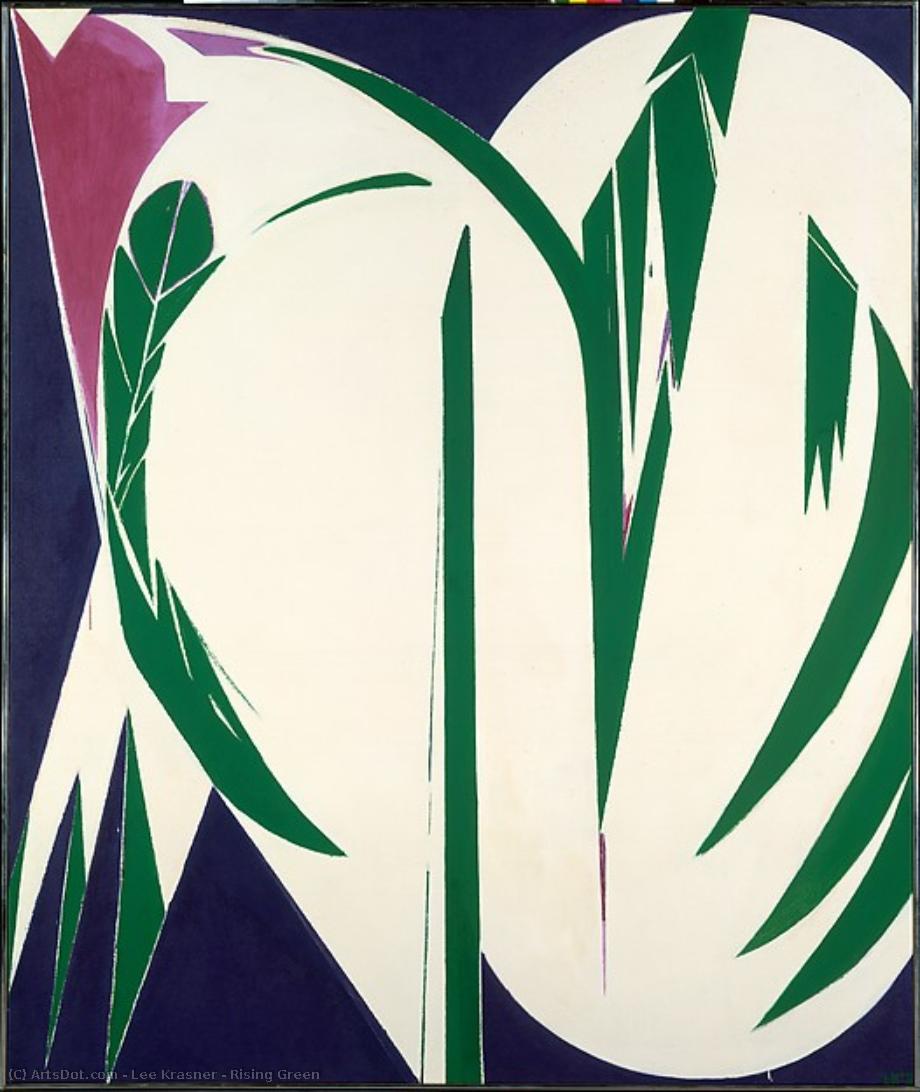
A Verdant Echo: Lee Krasner’s ‘Rising Green’
Lee Krasner's “Rising Green,” painted in 1972, isn’t merely a depiction of nature; it’s an embodiment of its vital force. This monumental work, measuring a commanding 209 x 176 cm, stands as a testament to Krasner’s evolving Abstract Expressionist style and her persistent fascination with the natural world. Created in a spacious barn previously occupied by her late husband, Jackson Pollock – a space imbued with the legacy of his groundbreaking techniques – “Rising Green” feels both deeply personal and powerfully resonant. The painting immediately draws the eye with its stark contrast: a vast expanse of pristine white serves as the backdrop for a dynamic collection of verdant shapes that seem to surge upwards, suggesting an unstoppable growth or emergence. It’s a visual declaration of life pushing through constraint, a potent metaphor for resilience and renewal.
Formal Elements & Technique
The composition is strikingly asymmetrical, avoiding any sense of static equilibrium. Bold, elongated forms dominate the canvas, recalling the elegant arabesques found in Henri Matisse’s late collages – a deliberate nod to Krasner's admiration for the French master. The technique employed is remarkably reductive; flat color application, reminiscent of screen printing or similar methods, minimizes detail and emphasizes the interplay of shape and space. This simplification isn’t an absence of feeling, however, but rather a focused distillation of essence. The smooth texture achieved through this method contributes to the painting's immediate impact, creating a surface that feels both tactile and luminous. The deliberate lack of traditional perspective—depth is built through layering and overlapping—further enhances the sense of movement and dynamism, pulling the viewer into the heart of the composition.
Roots in Nature & Symbolism
While abstract at first glance, “Rising Green” is undeniably rooted in nature. The leaflike forms, repeated and varied throughout the canvas, evoke powerful vegetation – reeds, grasses, or perhaps even a stylized representation of burgeoning plant life. This connection to the natural world isn’t simply decorative; it speaks to Krasner's lifelong interest in depicting organic forms and her desire to capture the energy and vitality of the landscape. The stark white ground can be interpreted as representing both emptiness and potential – a blank slate upon which these verdant shapes assert their presence, symbolizing growth emerging from stillness. The painting’s overall mood is one of hopeful expansion, suggesting an unstoppable force of life.
Context & Legacy
Created in 1972, “Rising Green” represents a pivotal moment in Krasner's career. Following the death of her husband, Jackson Pollock, she began to explore new avenues for expression, moving beyond the shadow of his fame and establishing herself as a significant figure in her own right. This work demonstrates her continued experimentation with abstract forms while retaining a deep connection to nature – a theme that would recur throughout her oeuvre. It’s a powerful example of Krasner's ability to translate complex emotions and ideas into visually arresting compositions, solidifying her place as a pioneering voice within the Abstract Expressionist movement. A reproduction of “Rising Green” offers a captivating glimpse into the mind of this extraordinary artist, bringing her vibrant vision to any space.
Biografía del artista
Lee Krasner: A Pioneer of Abstract Expressionism
Lena Krassner, born October 27, 1908, in Brooklyn, New York City, was a transformative figure in the realm of American art—a woman who defied convention and established herself as one of the foremost practitioners of Abstract Expressionism. Her artistic journey began with an early fascination for painting, fueled by enrollment at Washington Irving High School for Girls where she pursued a course focused on visual arts. This formative experience instilled within her a foundational understanding of artistic principles that would shape her subsequent endeavors. Following graduation, Krasner continued her education at Cooper Union’s Women’s Art School with a scholarship, diligently completing the necessary coursework to earn a certificate in teaching art—a testament to her commitment to fostering creativity and disseminating knowledge. Further enriching her artistic development was her time at the National Academy of Design (NAD) between 1928 and 1932, where she honed her skills alongside luminaries like Hans Hofmann, cementing her position within the burgeoning avant-garde movement. Hofmann’s influence proved particularly significant, encouraging Krasner to embrace spontaneity and explore expressive gestures as core components of her artistic process—a radical departure from academic traditions that would become synonymous with her distinctive style. Early Influences: Krasner's formative years were profoundly impacted by exposure to European Modernism, notably Cubism and Surrealism. These movements instilled in her a fervent desire for experimentation and abstraction, prompting her to question established norms and seek new avenues of artistic expression. Artists like Picasso and Matisse served as inspiration, demonstrating the power of visual language to convey emotion and provoke contemplation—a conviction that would permeate her entire oeuvre. Collaborations with Pollock: Her marriage to Jackson Pollock marked a pivotal moment in Krasner’s life and career, solidifying her place within the epicenter of Abstract Expressionism. While often overshadowed by Pollock’s fame—particularly during his peak years—Krasner consistently championed bold color palettes and dynamic compositions—a stylistic approach that distinguished her from many contemporaries. She recognized Pollock's genius as a fellow innovator, admiring his willingness to challenge conventions and embrace unconventional techniques—a partnership that fostered mutual respect and propelled both artists to unprecedented heights of artistic achievement. Krasner’s Artistic Style: Krasner’s artistic style is characterized by a distinctive gestural technique—characterized by rapid brushstrokes and energetic movements—that prioritizes emotional expression over meticulous representation. She favored vibrant hues, particularly reds, yellows, and blues, which she skillfully layered to create textured surfaces that conveyed palpable energy and dynamism. Her canvases pulsed with life, reflecting her belief in the importance of capturing spontaneous feeling rather than painstakingly replicating visual reality. This approach—rooted in Hofmann’s encouragement—allowed Krasner to liberate herself from constraints imposed by traditional art forms, forging a path toward artistic freedom and innovation. Notable Works: Krasner's artistic legacy is enshrined in iconic pieces such as “Combat” (1965), a striking floral composition demonstrating her masterful use of printmaking techniques—a deliberate departure from conventional painting methods—and “Another Storm” (1963), which embodies her unwavering dedication to exploring the expressive potential of color and texture. These canvases stand as enduring symbols of Krasner’s artistic vision, showcasing her ability to transform seemingly simple subjects into powerful statements about human experience—a testament to her profound understanding of art's capacity to communicate emotion and provoke contemplation. Historical Significance: Lee Krasner’s contribution to Abstract Expressionism transcends mere stylistic innovation; she championed the role of women in art history—a courageous stance during a period when female artists faced considerable obstacles. Recognized for her unwavering commitment to artistic integrity and her refusal to conform to societal expectations, Krasner became an emblem of resilience and determination—inspiring generations of artists to pursue their creative passions with boldness and conviction. Her influence continues to resonate today, cementing her place as one of the most influential figures in 20th-century art—a woman who irrevocably altered the landscape of American painting and secured her enduring legacy as a pioneer of expressive abstraction.
Lee Krasner
1908 - 1984 , Estados Unidos
Datos clave
- Artistic Movement Or Style: Expresionismo abstracto
- Artists Or Movements Influenced By This Artist: ['Jackson Pollock']
- Artists Who Influenced This Artist: ['Hans Hofmann']
- Date Of Birth: 27 octubre 1908
- Full Name: Lena Krassner
- Nationality: Americana
- Notable Artworks:
- Combat
- Another Storm
- Place Of Birth: Brooklyn, Estados Unidos
Artículos relacionados

Morris Louis: Pioneering Color Field Painting & Abstract Expressionism's Legacy
Explore the groundbreaking abstract expressionism of Morris Louis, a pioneer of Color Field painting. Discover his innovative techniques, influential series & lasting legacy in post-war American art. Learn more at OriginalUniqueArt.
Jacob Kainen: A Pioneer of American Color Field Painting & Abstract Expressionism
Explore the life & work of Jacob Kainen, a pivotal figure in American Abstract Expressionism and Color Field painting. Discover his journey from Social Realism to vibrant abstraction and lasting influence on 20th-century art.

El Lienzo Central: Impacto Psicológico y Estético de la Pintura Abstracta en la Composición Interior
Descubre el impacto psicológico y estético de la pintura abstracta en tu hogar. Guías expertas, artistas clave y consejos para coleccionar arte con OriginalUniqueArt.
Navegando la Expresión Abstracta: Una Guía a los Movimientos Contemporáneos para la Resonancia Emocional en la Selección de Arte
Descubre el expresionismo abstracto con nuestra guía experta. Analizamos a Rothko, Newman y otros maestros para ayudarte a seleccionar arte que resuene contigo. ¡Encuentra la obra perfecta!
Expansión Visual en Espacios Reducidos: Estrategias de la Abstracción para Maximizar el Impacto Estético en Interiores Compactos
Descubre cómo la abstracción transforma espacios reducidos en ambientes amplios y elegantes. Guía experta con consejos prácticos para decoración interior, paletas de colores y técnicas visuales impactantes.

