 Ver en contexto
 Enviar
 Compartir
 Detalles
 Guía
Guía

 Descargar
 Similares
 Radiografía
 Presentación de diapositivas
 Preguntas y respuestas
 Estadísticas
Instrumento musical


 Ver más
Giclée / Impresión de arte
Impresiones giclée o en lienzo de calidad de museo con producción rápida y opciones de acabado flexibles. ( Comprar pintura hecha a mano Cambiar a imagen digital)




P118B €10

P118H €10

P118W €10

P438Z €10

P508JH €12

P508YH €12

P805H €10

P805Z €10

P919BZ €10

P919G €10

P919XJ €10

P959ZH €10

P968JZ €12

W106C €8

W218G €10

W218JH €8

W218Y €10

W307PJ €10

W316G €10

W316PJ €8

W316Y €10

W398PJ €8

W4111J €10

W500HY €15

W500JH €15

W692G €12

W849H €8

W940BG €15

W953PJ €8




Elija entre nuestros tamaños predefinidos que respetan las proporciones originales de la obra.

Introduzca el ancho y el alto que necesite para adaptarse a su marco o pared. Una impresión solo puede recortarse, nunca hacerse más grande que la imagen original, por lo que un tamaño con una forma distinta perderá parte de la obra. Le enviaremos una maqueta digital para su aprobación antes de realizar cualquier impresión. La imagen que se muestra en esta página no refleja el recorte real; solo la maqueta lo hace.
Envío a todo el mundo () en 2 semanas en lugar de las 4/5 semanas estándar. (9 noviembre)

Envío exprés gratuito a todo el mundo

Lienzo de lino de alta calidad

Seguro de envío total

Garantía de reembolso de aranceles aduaneros

Garantía de fidelidad cromática exacta

Política de devolución de 100 días (solo por defectos)

Garantía de devolución del 100% del dinero

Descuento por cantidad
 La opción de vidrio solo está disponible en tamaños inferiores a 110 cm.

Instrumento musical
Giclée / Impresión de arte
Dimensiones de la reproducción
-


Precio total final
€ 72
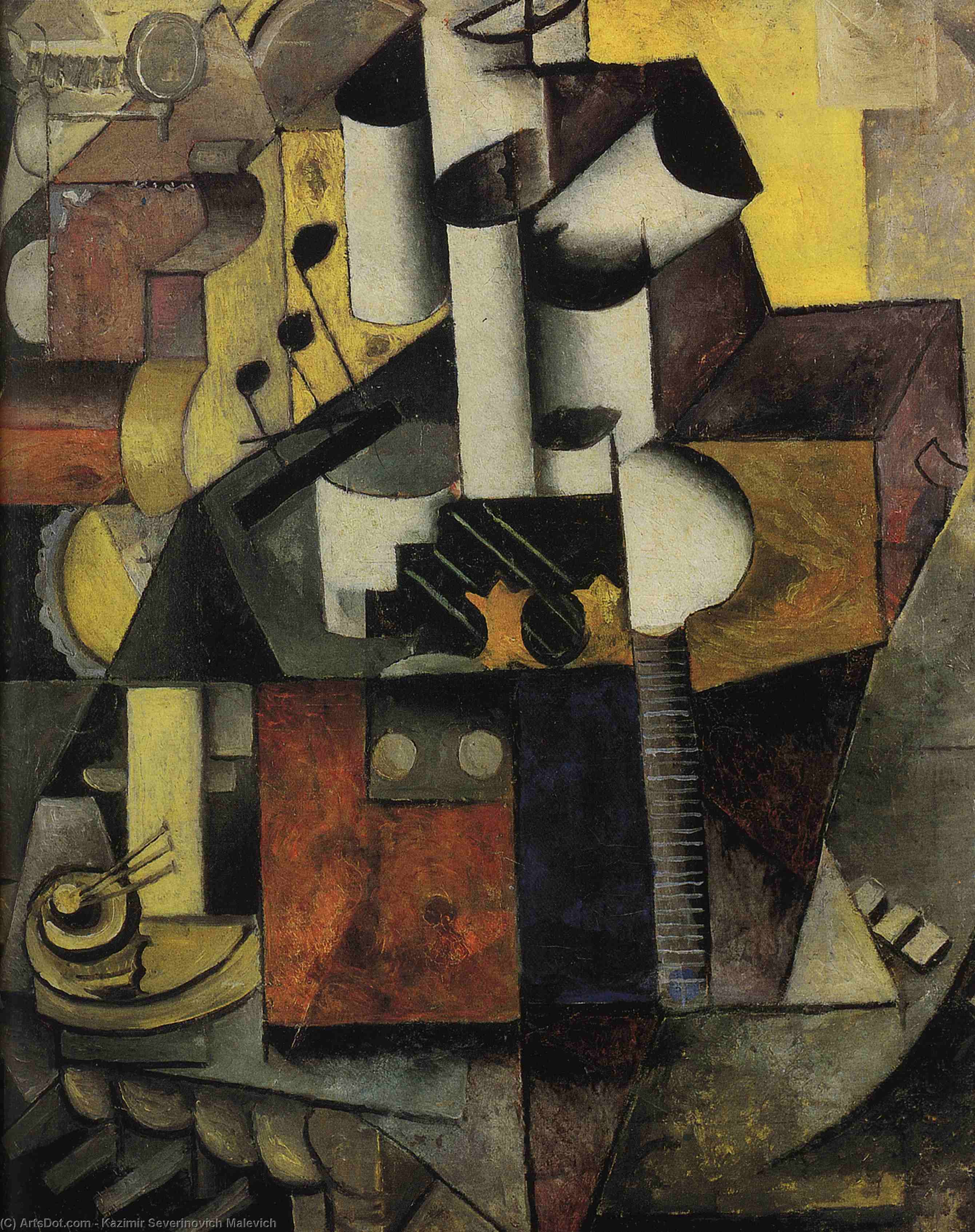
Kazimir Malevich’s Musical Instrument: A Cubist Exploration of Sound and Form
Kazimir Severinovich Malevich, a Russian artist whose legacy continues to inspire artists globally, created the captivating painting Musical Instrument in 1913. This work stands as a cornerstone of Cubism, an artistic movement that fundamentally reshaped European painting and sculpture during the early 20th century—a bold departure from traditional perspectives and representations. It’s more than just pigment on canvas; it's a deliberate challenge to how we perceive visual reality itself.The Cubist Movement: Breaking Boundaries
Cubism, spearheaded by Pablo Picasso and Georges Braque, wasn’t merely about depicting objects realistically; it was a defiant rejection of established conventions. Artists like Malevich were profoundly influenced by this revolutionary approach, experimenting with new ways to capture the essence of reality. The very term “Cubism” encapsulates this ethos—associated with artworks produced primarily in Paris (Montmartre and Montparnasse) or near Paris (Puteaux)—representing a seismic shift in artistic thinking. Instead of striving for accurate representation, Cubists fragmented objects into geometric planes, presenting multiple viewpoints simultaneously. This technique aimed to convey the complexity of perception, mirroring how our eyes see things from different angles at once.Malevich’s Unique Vision: Simplifying Complexity
Malevich’s distinctive style within Cubism involved merging disparate elements into harmonious combinations, challenging viewers to reconsider how they perceive visual information. Unlike contemporaries like Georgia O’Keeffe and Paul Klee who sought to translate sound into visual experiences—a fascinating ambition—Malevich adopted a more pared-down aesthetic. He prioritized clarity and geometric precision, focusing on conveying fundamental concepts rather than meticulous detail. This deliberate simplification allowed him to distill the complexities of musical instruments into powerful visual symbols. Consider it an attempt to capture not just what an instrument *looks* like, but what its presence *feels* like—a distillation of sound into form.Composition and Color: Guiding the Eye
Musical Instrument is characterized by careful color orchestration—primarily shades of grey tones interwoven with assertive black lines. These elements serve as structural dividers, delineating distinct sections within the painting and directing the viewer’s gaze across the canvas. At its heart lies a guitar, meticulously rendered against a backdrop of other guitars and violins, creating a dynamic interplay between form and texture. Furthermore, two birds—positioned strategically on the left side and upper right corner—add depth and visual interest to the composition, enriching the overall narrative without distracting from Malevich’s core message. The grayscale palette reinforces the idea of stillness and contemplation—a deliberate choice that underscores the painting’s symbolic significance.Beyond Cubism: Exploring Musical Symbolism
Malevich's artistic journey extended beyond the confines of Cubism, demonstrating his unwavering pursuit of innovative expression. His exploration of Suprematism—a subsequent style characterized by pure geometric forms—further solidified his reputation as a visionary artist who dared to challenge conventional notions of art and perception. Yet, Musical Instrument remains an invaluable testament to his initial foray into Cubism—a captivating piece that embodies both stylistic experimentation and profound artistic contemplation. It’s a visual meditation on the essence of music itself, rendered in a style that anticipates the radical simplification of later abstract art movements.Notable Related Works
Malevich’s prolific output included Painting by 'Kazimir Severinovich Malevich' | Kazimir Severinovich Malevich:Musical instrument (Cubism,), housed at the Stedelijk Museum in Amsterdam, Netherlands—a masterful demonstration of Cubist principles applied to a musical subject. This painting exemplifies Malevich’s ability to distill complex ideas into striking visual representations. Also noteworthy is Painting by 'Kazimir Severinovich Malevich' | Kazimir Severinovich Malevich:Musical instrument - Lamp (Cubism,Oil,), which showcases his exploration of musical instruments alongside symbolic imagery. Painting by 'Pablo Picasso' | Pablo Picasso:Guitar on pedestal (119 x 76 cm,Synthetic Cubism,) exemplifies the broader influence of Cubism on European art—a movement that irrevocably altered artistic conventions. Explore Malevich’s groundbreaking achievements and immerse yourself in the legacy of Suprematism at OriginalUniqueArt.com.Preguntas y respuestas
¿Quién creó "Instrumento musical" y en qué año?
"Instrumento musical" fue creada por Kazimir Malevich en 1913.
¿Qué color predomina en la composición de "Instrumento musical" de Kazimir Malevich?
El color que más destaca en "Instrumento musical" es el Verde ftalocianina (#1f1d1b). El color dominante resulta muy útil a la hora de combinar una obra de arte con un espacio interior.
¿Es "Instrumento musical" una de las obras más populares de Kazimir Malevich?
El nivel de popularidad registrado para "Instrumento musical" de Kazimir Malevich es Icónico.
Biografía del artista
Kazimir Malevich: Un pionero del arte abstracto
Primeros años e influencias
- Nacido en el Óblast de Kyiv, Ucrania, en 1878, en una familia polaca, la vida temprana de Kazimir Severinovich Malevich fue moldeada por el paisaje rural ucraniano y su rica cultura popular.
- Su crianza le inculcó un aprecio por las expresiones artísticas tradicionales que más tarde influirían sutilmente en su obra.
- La formación formal comenzó en Kyiv, pero Malevich rápidamente buscó horizontes artísticos más amplios, moviéndose hacia Moscú y finalmente relacionándose con los movimientos vanguardistas europeos emergentes.
- Influencias clave: La exposición temprana al arte popular, combinada con un deseo de expresión moderna, formó la base de su estilo único.
Desarrollo artístico y movimientos clave
- Inicialmente, Malevich exploró varios estilos, incluyendo Impresionismo, Simbolismo, Fauvismo, y Cubismo. Un viaje decisivo a París en 1912 le expuso a los últimos avances en el arte europeo.
- Gradualmente se alejó de las formas representacionales, buscando un lenguaje artístico puramente basado en formas geométricas y color.
- Esto llevó al desarrollo de Suprematismo alrededor de 1915 – un movimiento abstracto centrado en “la supremacía del sentimiento puro” en el arte.
- El Suprematismo rechazó cualquier intento de representar objetos del mundo visible, priorizando en cambio las formas geométricas básicas como cuadrados, círculos y rectángulos.
Logros importantes y obras notables
- Cuadrado Negro (1915): Probablemente su obra más famosa, representa una ruptura radical con el arte tradicional y se considera una pieza fundacional de la pintura abstracta.
- Blanco sobre Blanco (1918): Una serie que explora la pureza de la forma y el color, presentando formas geométricas blancas contra un fondo blanco – llevando la abstracción a sus límites.
- Stroyuschiysya dom [Casa bajo construcción] (1916): Un ejemplo temprano del Suprematismo que muestra su perspectiva única sobre la cultura ucraniana a través de formas abstractas.
- También escribió extensamente sobre teoría del arte, articulando los principios filosóficos detrás del Suprematismo y abogando por una nueva conciencia artística.
Significado histórico y legado
- La obra de Malevich impactó profundamente el desarrollo del arte abstracto del siglo XX, influyendo en movimientos como Minimalismo y Constructivismo.
- Desafió las nociones convencionales de representación y allanó el camino para el arte no objetivo.
- Sus ideas sobre el sentimiento puro y la abstracción geométrica siguen resonando con los artistas de hoy en día.
- A pesar de enfrentar persecución política bajo Stalin – inicialmente apoyado, luego reprimido – Malevich perseveró en su práctica y enseñanza.
- Influencia en artistas posteriores: Influyó directamente a artistas como El Lissitzky e indirectamente moldeó a innumerables otros a través del perdurable legado del Suprematismo.
Vida tardía y muerte
- En sus últimos años, Malevich revisó la pintura figurativa, intentando sintetizar sus principios abstractos con formas representacionales.
- Continuó enseñando y escribiendo sobre arte hasta su muerte en Leningrado (ahora San Petersburgo) en 1935.
- Su obra permaneció relativamente oscura durante décadas después de su muerte, pero experimentó un resurgimiento de interés a mediados del siglo XX, consolidando su lugar como una de las figuras más importantes de la historia del arte moderno.

Kazimir Malevich
1878 - 1935 , Ucrania
Datos clave
- Artistas Que Influyeron:
- Impresionismo
- Simbolismo
- Fauvismo
- Cubismo
- Estilo Artístico: Suprematismo, Arte Abstracto
- Fecha De Muerte: 15 de mayo de 1935
- Fecha De Nacimiento: 23 de febrero de 1878
- Influenciado A Artistas:
- El Lissitzky
- Minimalismo
- Constructivismo
- Lugar De Nacimiento: Óblast de Kyiv, Ucrania
- Nacionalidad: Ucraniano, Ruso
- Nombre Completo: Kazimir Malevich
- Obras Notables:
- Cuadrado Negro
- Blanco sobre Blanco
- Casa bajo construcción
- Elementos Suprematistas
Artículos relacionados
Beyond Form & Color: Geometric Abstraction's Enduring Legacy in Art History
Explore the captivating world of geometric abstraction! Discover its origins, key artists like Malevich & Mondrian, and why this movement remains highly valued by art collectors today. Expert insights at OriginalUniqueArt.

Las 25 mejores obras de Kazimir Malevich: Guía definitiva del Suprematismo
Explora las 25 obras maestras de Kazimir Malevich y el Suprematismo. ¡Descubre toda la colección en OriginalUniqueArt.com!
Más Allá de la Forma: Explorando los Fundamentos Filosóficos de la Abstracción Geométrica
Descubre los fundamentos filosóficos de la abstracción geométrica. Explora el suprematismo de Malévich y el neoplasticismo de Mondrian, su impacto en el arte moderno y su legado perdurable. Análisis experto.

Abstracción Geométrica: 10 Obras Maestras que Transformaron el Arte Moderno | OriginalUniqueArt
Descubre las 10 obras maestras de la abstracción geométrica que revolucionaron el arte moderno. Explora a Mondrian, Malevich y Kandinsky en OriginalUniqueArt.com. Reproducciones de alta calidad para tu hogar.
Beyond Form & Color: Geometric Abstraction's Evolution in 20th/21st Century Art
Explore the evolution of geometric abstraction from Cubism to contemporary art. Discover key artists like Malevich & Mondrian, investment insights, and expert collecting advice at OriginalUniqueArt.


![Circulo Negro [1913]](/media/artworks/images-thumb/62/67/6267e452b0c8476772a6511e19ce1616.jpg)