Obra al óleo
 Todo sobre Sin título







































 Para obras de arte o reproducciones que midan más de 105 cm (aproximadamente 41 pulgadas) en cualquiera de sus lados, el marco se enviará como un kit desmontado. Este método garantiza una entrega segura y evita daños durante el transporte.


A Study in Geometric Harmony: Exploring Karl Schmid's Untitled Composition
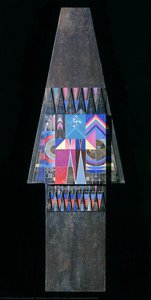
To stand before this untitled work by Karl Schmid is to encounter a vibrant dialogue between raw emotion and meticulous structure. Executed in 1998, this piece transcends mere decoration; it functions as a visual treatise on form, color theory, and the inherent beauty found within abstraction. The immediate impact of the composition is one of energetic collision—a carefully orchestrated chaos where distinct geometric shapes vie for attention against a rich, underlying field of red and brown tones. It speaks to an artist deeply engaged with the interplay between the tangible and the conceptual.
Technique and Material Dialogue
Schmid’s approach here suggests a masterful handling of collage or mixed media, giving the illusion that disparate elements have been layered upon one another over time. The visible juxtaposition of the large red square, the assertive pink triangle, the grounded brown diamond, and the ethereal white circle creates a palpable sense of depth. These primary shapes are not merely placed; they interact. Notice the subtle gleam of the gold accents—the delicate gold triangle nestled near the bold forms, and the structural gold square—these metallic touches catch the light, suggesting an added layer of preciousness or perhaps a nod to ancient mosaic work. The technique itself is a celebration of boundaries, where sharp edges meet soft gradients, inviting the viewer's eye to trace the invisible lines connecting each segment.
Symbolism and Emotional Resonance
Given Schmid’s background—a life marked by observation and an apprenticeship in craftsmanship—this abstract work likely draws its symbolic weight from foundational principles. The geometry itself can be interpreted as a mapping of human experience: the solid red might represent passion or vitality; the white circle, purity or wholeness; while the contrasting angles suggest tension or necessary change. It is a visual rhythm. For the collector or designer, this piece offers more than just color; it offers a focal point for contemplation—a place where one can pause and consider the balance between order (the defined shapes) and impulse (the vibrant colors). The overall effect is invigorating, suggesting that beauty often arises from the successful negotiation of opposing forces.
Integrating Art into Living Space
For those considering bringing this piece home, remember that its power lies in its versatility. Because it is so self-contained in its visual narrative, it acts as a magnificent anchor for any room's décor. It complements both minimalist modernism—allowing the shapes to speak volumes against clean lines—and richly textured spaces, where its collage nature can harmonize with antique furnishings. Reproducing this work allows one to own a piece of Schmid’s late-career brilliance, capturing that unique moment when rigorous artistic discipline meets unrestrained chromatic joy.
Preguntas y respuestas
¿Es Sin título una obra pintada a mano o una impresión?
Pintado a mano: un pintor profesional recrea Sin título al óleo sobre lienzo de lino.
¿Qué tamaño debo elegir para Sin título?
La obra original mide 50 x 50 cm. Los tamaños van desde 31.6 x 31.7 cm (€178) hasta 239.3 x 239.9 cm (€1843); la tabla de esta página detalla las opciones principales y sus precios.
¿Cuánto tarda el envío?
El plazo de entrega es de 4 a 5 semanas, con envío exprés gratuito a todo el mundo; en esta página se ofrece una opción de producción urgente. Puede realizar la devolución en un plazo de 100 días para obtener un reembolso completo, sin condiciones.
¿Dónde se encuentra la obra original Sin título?
La obra original forma parte de la colección del USI Università della Svizzera italiana, Lugano.
¿Qué técnica utilizó Karl Schmid para Sin título?
Técnica mixta
 Ver en contexto

 Enviar
 Compartir
 Detalles
 Ficha técnica


 Descargar
 Similares
 Radiografía
 Presentación de diapositivas
 Preguntas y respuestas

 Estadísticas