
 Vista previa
 Compartir
 Compartir
 Ver detalles
 Guía
Guía

 Descargar
 Ver artículos similares
 Radiografía
 Presentación de diapositivas
 Estadísticas
Mrs. Herbert Duckworth
 Acrylic On Canvas
- WallArt
- Pre-Raphaelite Romanticism
 1867
1867 34.0 x 24.0 cm
 Museo J. Paul Getty
 Leer más
Giclée / Impresión de arte
Impresiones giclée o en lienzo de calidad de museo con producción rápida y opciones de acabado flexibles. ( Encargar reproducción pintada a mano Ver versión en imagen digital)




P118B $10

P118H $10

P118W $10

P438Z $10

P508JH $12

P508YH $12

P805H $10

P805Z $10

P919BZ $10

P919G $10

P919XJ $10

P959ZH $10

P968JZ $12

W106C $8

W218G $10

W218JH $8

W218Y $10

W307PJ $10

W316G $10

W316PJ $8

W316Y $10

W398PJ $8

W4111J $10

W500HY $15

W500JH $15

W692G $12

W849H $8

W940BG $15

W953PJ $8




Elija entre nuestros tamaños predefinidos que respetan las proporciones originales de la obra.

Puede introducir sus propias dimensiones para adaptarse a un marco o espacio específico. Si el tamaño seleccionado no coincide con las proporciones de la imagen original, recortaremos la obra de arte o extenderemos la imagen con un borde con efecto espejo o de color sólido. Se enviará una maqueta digital para su aprobación antes de que comience la producción.
Tenga en cuenta que la vista previa en pantalla no refleja el recorte o la extensión real. Solo la maqueta mostrará con precisión la composición final.
Aunque existen tamaños personalizados, recomendamos seleccionar una dimensión de la lista predefinida para preservar las proporciones originales.
Envío a todo el mundo () en 2 semanas en lugar de las 4/5 semanas estándar. (26 septiembre)

Envío exprés gratuito a todo el mundo

Lienzo de lino de alta calidad

Seguro de envío completo

Garantía de reembolso de impuestos aduaneros

Garantía de fidelidad cromática exacta

Política de devolución de 100 días (solo por defectos)

Garantía de devolución del 100% del dinero

Oferta por volumen
 La opción de vidrio solo está disponible en tamaños inferiores a 110 cm.

Mrs. Herbert Duckworth
Giclée / Impresión de arte
Tamaño de la reproducción
-


Precio total
$ 80
The Enigmatic Beauty of Julia Jackson
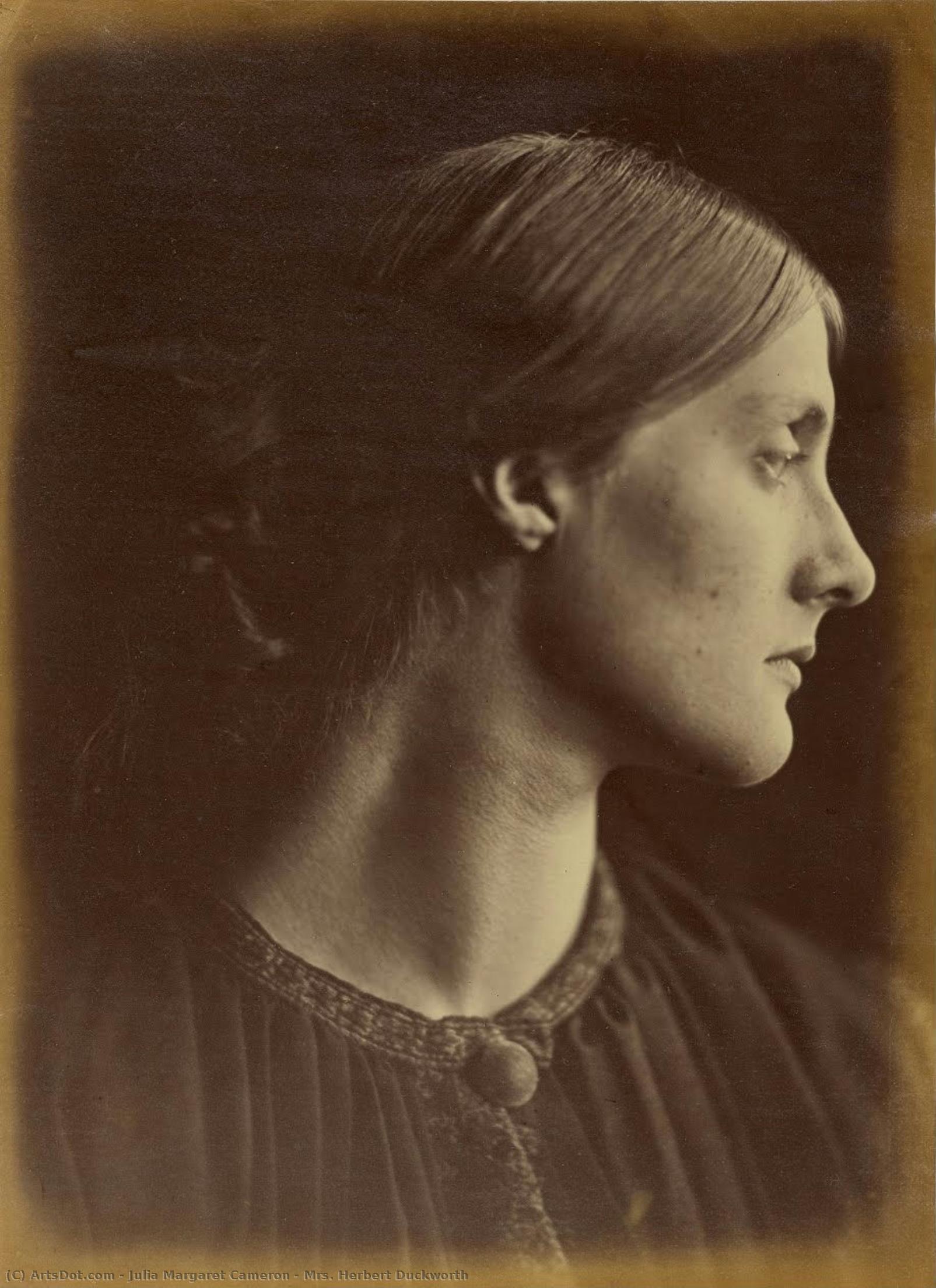
Julia Margaret Cameron’s 1867 portrait of Mrs. Herbert Duckworth, a young woman poised with an almost unnerving composure, is far more than a simple likeness; it's a carefully constructed embodiment of Victorian ideals – strength, beauty, and a subtle hint of melancholy. The subject, Julia Jackson, was the daughter of Mia, Julia Margaret Cameron’s youngest sister, and John Jackson, a physician who had practiced in Calcutta. Her striking appearance immediately drew attention, prompting numerous marriage proposals, most notably from the renowned Pre-Raphaelite painter William Holman Hunt and sculptor Thomas Woolner. This particular portrait, one of several commissioned during her brief engagement with Hunt, captures a pivotal moment – a poised young woman on the cusp of a new life, radiating an aura of quiet dignity.

Image: Mrs. Herbert Duckworth by Julia Margaret Cameron
The Alchemy of Soft Focus and Light
Cameron’s mastery lies not in photographic realism, but in her manipulation of light and shadow to evoke mood and character. Employing the wet collodion process – a notoriously demanding technique requiring immediate development – she created images characterized by their soft focus, almost dreamlike quality. This deliberate blurring wasn't a flaw; it was a conscious choice designed to capture the essence of her subjects rather than their precise details. Notice how the light falls across Mrs. Duckworth’s face, highlighting the delicate curve of her cheekbone and the subtle shadows that deepen the expression in her eyes. The background is deliberately dark, drawing all attention to the sitter's head and shoulders – a technique reminiscent of ancient portraiture, particularly Roman busts, lending an air of timelessness and gravitas.
The composition itself is strikingly symmetrical, mirroring the Victorian emphasis on order and balance. The careful framing, with the bust presented in perfect proportion, speaks to Cameron’s meticulous approach and her desire to elevate her subjects to a level of heroic beauty. This deliberate arrangement elevates Mrs. Duckworth beyond a mere portrait; she becomes an emblem of refined womanhood.
A Victorian Ideal: Grace, Strength, and Quiet Resolve
Mrs. Herbert Duckworth embodies the complex ideals of Victorian femininity – strength tempered with grace, intellect alongside beauty, and a quiet resolve beneath a composed exterior. The portrait isn’t overtly romantic; there's no overt display of emotion. Instead, it conveys a sense of inner resilience, a subtle suggestion of sadness perhaps, or simply the weight of expectation placed upon women of her era. Cameron skillfully captures this duality, presenting a woman who is both vulnerable and formidable.
Her gaze, directed slightly off-camera, creates an intimate connection with the viewer, inviting us to contemplate her thoughts and feelings. The carefully chosen attire – a dark dress that emphasizes her figure while remaining understated – further reinforces this sense of quiet dignity. The portrait is not merely a representation of appearance; it’s a psychological study, revealing the inner life of a woman poised on the threshold of marriage and motherhood.
Legacy and Influence
Julia Margaret Cameron's work profoundly influenced subsequent generations of photographers and artists. Her pioneering use of soft focus and her ability to capture the emotional depth of her subjects paved the way for modern portraiture. Her influence extends beyond photography, inspiring painters like Edward Burne-Jones, who famously used her likeness as a model for the Virgin in his Annunciation painting. The image’s enduring appeal lies not only in its aesthetic beauty but also in its ability to evoke a sense of nostalgia for a bygone era – a time when portraiture was considered an art form capable of capturing not just appearances but also the very soul of its subject.
Biografía del artista
Primeros años y trasfondo
Julia Margaret Cameron, una fotógrafa británica, nació el 11 de junio de 1815 en Calcuta, India, hija de Adeline de l'Etang y James Pattle. Su linaje aristocrático, con su tataranieta siendo la renombrada autora Virginia Woolf, sentó las bases para sus futuros esfuerzos artísticos.Carrera fotográfica (1864-1875)
El viaje fotográfico de Cameron comenzó a los 48 años, cuando recibió una cámara como regalo. Esto marcó el inicio de una carrera de once años que dejaría una huella imborrable en la fotografía británica. Su obra se caracterizó por:- Retratos de celebridades, mostrando su habilidad para capturar la esencia de sus sujetos.
- Temas arturianos y legendarios, que reflejaban su fascinación por la mitología y el folclore.
Estilo y técnica
El enfoque innovador de Cameron a la fotografía implicó:- Enfoque suave: Su uso deliberado de esta técnica resultó en retratos íntimos y cercanos que humanizaban a sus sujetos.
- Manipulación del proceso húmedo de colodión: Esto le permitió tratar la fotografía tanto como un arte como una ciencia, diferenciándola de sus contemporáneos.
Obras notables y legado
Algunas de las obras más destacadas de Cameron incluyen:-
Alfred, Lord Tennyson (1865) - un testimonio de su capacidad para capturar la esencia de las figuras literarias británicas.
- Influencia en la fotografía moderna: Los retratos de Cameron con enfoque suave han influenciado a generaciones de fotógrafos.
Museos y colecciones
La obra de Cameron se puede encontrar en varios museos, incluyendo:- The Ingram Collection of Modern British and Contemporary Art - un renombrado museo de arte británico moderno en Londres, con una diversa gama de arte británico moderno.
- Plymouth Museum and Art Gallery - una institución cultural en Plymouth, Reino Unido, que alberga una impresionante colección de obras de arte.
Influencias y desarrollo artístico
Cameron no recibió una formación formal en fotografía, pero se inspiró en pioneros como Oscar Gustav Rejlander y Lewis Carroll. Experimentó con técnicas innovadoras, a menudo rechazando la nitidez técnica en favor de una estética más suave y evocadora. Su trabajo estuvo influenciado por el movimiento prerrafaelita, buscando capturar belleza idealizada y temas literarios y mitológicos. Su capacidad para crear retratos íntimos y atmosféricos la distinguió de sus contemporáneos.Significado histórico
Julia Margaret Cameron fue una figura pionera en la fotografía británica del siglo XIX. Su enfoque artístico y experimental desafió las convenciones fotográficas de su época, elevando el medio a un nivel de arte superior. Su trabajo ayudó a establecer la fotografía como una forma de expresión artística legítima y sentó las bases para futuras generaciones de fotógrafos que exploraron la subjetividad y la emoción en sus imágenes. Su legado perdura hoy en día, inspirando a artistas y fotógrafos por igual.
Julia Margaret Cameron
1815 - 1879 , India
Datos clave
- Artistas Influyentes:
- Oscar Gustav Rejlander
- Lewis Carroll
- Fecha De Fallecimiento: 26 de enero de 1879
- Fecha De Nacimiento: 11 de junio de 1815
- Influenciados Por El Artista:
- Diane Arbus
- Dorothea Lange
- Sally Mann
- Lugar De Nacimiento: Kolkata, India
- Movimiento Artístico: Fotografía victoriana
- Nacionalidad: Británica
- Nombre Completo: Julia Margaret Cameron
- Obras Notables: ['Alfred, Lord Tennyson (1865)']
Artículos relacionados
The Lens of Truth: A Comprehensive History and Legacy of Documentary Photography
Explore the profound history of documentary photography. From early daguerreotypes to social reform movements, discover how the lens captures truth, preserves vanishing cultures, and shapes our global visual narrative through an expert art-historical lens.

Beyond the Lens: Photography's Enduring Influence on Modern & Contemporary Art
Explore photography's pivotal role in shaping modern & contemporary art. Discover key movements, influential artists like Stieglitz, and expert collecting advice from OriginalUniqueArt.
Pictorialismo: La Búsqueda del Alma de la Fotografía Artística – Estética, Técnicas y Legado
Descubre el Pictorialismo, un movimiento clave en la historia de la fotografía artística. Explora sus técnicas, figuras emblemáticas y su legado perdurable. Guía experta para coleccionistas y amantes del arte.
Witnessing History Through Lens & Light: Documentary Photography's Enduring Legacy
Explore the powerful history of documentary photography – from its origins to contemporary masters like Gordon Parks & W. Eugene Smith. Discover how this art form shapes our understanding of society and witness pivotal moments in time.

Monochrome Visions: Exploring the Aesthetic & Historical Significance of Black & White Photography
Explore the rich history & artistic power of black and white photography. From early techniques to iconic masters like Ansel Adams, discover why monochrome continues to captivate art lovers today. Expert insights for collectors.


![[Julia Jackson]](/media/artworks/images-thumb/38/f1/38f1667da1e9e5ced766b2acd175f4c6.jpg)