

 Ver en contexto
 Enviar
 Compartir
 Detalles

 Descargar
 Similares
 Radiografía
 Presentación de diapositivas
El Lissitzky, Dessau


 Ver más
Giclée / Impresión de arte
Impresiones giclée o en lienzo de calidad de museo con producción rápida y opciones de acabado flexibles. ( Comprar pintura hecha a mano Comprar imagen)




P118B $10

P118H $10

P118W $10

P438Z $10

P508JH $12

P508YH $12

P805H $10

P805Z $10

P919BZ $10

P919G $10

P919XJ $10

P959ZH $10

P968JZ $12

W106C $8

W218G $10

W218JH $8

W218Y $10

W307PJ $10

W316G $10

W316PJ $8

W316Y $10

W398PJ $8

W4111J $10

W500HY $15

W500JH $15

W692G $12

W849H $8

W940BG $15

W953PJ $8




Elija entre nuestros tamaños predefinidos que respetan las proporciones originales de la obra.

Puede introducir sus propias dimensiones para adaptarse a un marco o espacio específico. Si el tamaño seleccionado no coincide con las proporciones de la imagen original, recortaremos la obra de arte o extenderemos la imagen con un borde con efecto espejo o de color sólido. Se enviará una maqueta digital para su aprobación antes de que comience la producción.
Tenga en cuenta que la vista previa en pantalla no refleja el recorte o la extensión real. Solo la maqueta mostrará con precisión la composición final.
Aunque existen tamaños personalizados, recomendamos seleccionar una dimensión de la lista predefinida para preservar las proporciones originales.
Envío a todo el mundo () en 2 semanas en lugar de las 4/5 semanas estándar. (27 agosto)

Envío exprés gratuito a todo el mundo

Lienzo de lino de alta calidad

Seguro de envío total

Garantía de reembolso de impuestos aduaneros

Garantía de fidelidad cromática exacta

Política de devolución de 60 días (solo por defectos)

Garantía de devolución del 100% del dinero

Descuento por cantidad
 La opción de vidrio solo está disponible en tamaños inferiores a 110 cm.

El Lissitzky, Dessau
Giclée / Impresión de arte
Dimensiones de la reproducción
-


Precio total final
$ 80
Descripción de la pieza
El Lissitzky, Dessau: A Dialogue of Form and Function
The photograph presented here – “El Lissitzky, Dessau” – isn’t merely a portrait; it's a carefully constructed distillation of the spirit of early 20th-century artistic experimentation. Captured around 1930-1932 by Josef Albers, this image offers a glimpse into the world of El Lissitzky, a pivotal figure in the Russian avant-garde who bridged the gap between Suprematism and Constructivism. It’s a document of a man grappling with the fundamental questions of form, space, and communication – concerns that resonate powerfully even today.
Lissitzky, a visionary designer and artist, was deeply influenced by Malevich's radical exploration of pure geometric abstraction. However, Lissitzky moved beyond purely formal exercises, recognizing the potential of art to serve practical purposes—designing exhibition spaces, propaganda posters, and even furniture. Albers’ photograph captures this duality: Lissitzky is both an intellectual explorer and a craftsman, his gaze suggesting a thoughtful engagement with the world around him. The composition itself – two square portraits side-by-side – immediately evokes the principles of Constructivism, emphasizing clarity, order, and geometric relationships. The stark contrast between the black and white tones further amplifies this sense of precision and intellectual rigor.
A Study in Light, Line, and Gesture
Albers’ technical mastery is evident in every detail. The photograph utilizes a classic gelatin silver print process, resulting in a rich tonal range that subtly defines Lissitzky's features. The lighting is soft and diffused, minimizing harsh shadows and allowing the textures of his clothing – a crisp white shirt and dark tie – to emerge with clarity. Notice how Albers has employed fine lines to delineate the contours of Lissitzky’s face, capturing not just his likeness but also the subtle gestures that convey his personality. The sharp edges of the portraits create a sense of immediacy, drawing the viewer into the scene.
The photograph's composition is deceptively simple. The two square images are arranged symmetrically within a rectangular frame, creating a balanced and harmonious visual experience. However, this apparent simplicity belies a deeper level of intentionality. Lissitzky’s profile view – a pose that suggests contemplation or perhaps even conversation – contrasts sharply with his frontal portrait, offering a dynamic interplay between stillness and movement. The subtle smile in the first image hints at an approachable nature, while the profile invites introspection.
Historical Context: Bauhaus and Beyond
To fully appreciate “El Lissitzky, Dessau,” it’s crucial to understand its historical context. Albers himself was a key figure at the Bauhaus school in Germany, where he developed his groundbreaking theories of color interaction and geometric abstraction. The Bauhaus sought to unify art, craft, and technology, believing that design could improve people's lives. Lissitzky, who spent time at the Bauhaus before emigrating to Russia, carried these principles with him, influencing his work as a designer and artist.
Following the Russian Revolution, Lissitzky became involved in creating propaganda for the new Soviet state. He designed posters, book layouts, and exhibition spaces—all aimed at promoting socialist ideals through innovative visual communication. His work reflected the dynamism and optimism of the era, but also the challenges of building a new society from scratch. The photograph captures a moment of quiet reflection amidst this period of intense social and political change.
Symbolism and Emotional Resonance
Beyond its technical merits, “El Lissitzky, Dessau” possesses a subtle symbolic power. The geometric composition—the squares, the lines—represents the rational order that Lissitzky sought to impose on the world. The portrait itself can be interpreted as an exploration of identity and representation – how we perceive ourselves and how others perceive us. Lissitzky’s gaze is direct and unwavering, suggesting a confidence in his own vision.
Ultimately, this photograph transcends its documentary value. It's a testament to the power of art to capture not just appearances but also ideas, emotions, and historical moments. It invites viewers to contemplate the relationship between form and function, intellect and emotion, and the enduring legacy of El Lissitzky’s artistic vision.
Biografía del artista
Primeros Años y Educación
- Nacimiento: 19 de marzo de 1888, Bottrop, Alemania
- Fallecimiento: 25 de marzo de 1976, New Haven, Connecticut, EE. UU.
- Josef Albers creció en una familia de artesanos, fomentando una temprana apreciación por los materiales y las técnicas.
- Inicialmente trabajó como maestro de escuela desde 1908 hasta 1913 antes de formarse como profesor de arte en la Königliche Kunstschule de Berlín (1913-1915).
- Las primeras exploraciones artísticas incluyeron grabado, vidrieras y pintura. Su primera comisión pública fue una ventana de vidrio emplomado, "Rosa Mystica Ora Pro Nobis", en 1918.
Período Bauhaus y Desarrollo de la Teoría
- En 1922, Albers se unió a la facultad del Bauhaus, inicialmente enseñando en el curso preliminar 'Werklehre' (práctica del taller) dentro del departamento de diseño.
- Su tiempo en el Bauhaus fue fundamental para dar forma a su filosofía artística y enfoque de la teoría del color.
- Comenzó a investigar sistemáticamente los efectos perceptuales de las relaciones de color, alejándose del arte representacional hacia la abstracción.
- La influencia de artistas como Paul Klee y Wassily Kandinsky es evidente en sus primeros trabajos, aunque desarrolló una metodología única centrada en la observación empírica en lugar de la interpretación metafísica.
Homenaje al Cuadrado e Investigaciones Cromáticas
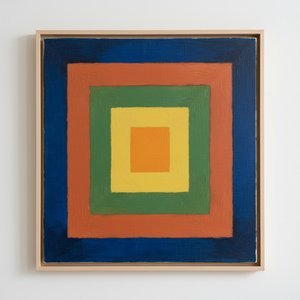
- En 1949, Albers comenzó su serie más famosa, "Homenaje al Cuadrado". Este proyecto continuo consistió en pinturas que presentaban cuadrados anidados dentro de cuadrados, explorando cómo interactúan y se influyen los colores.
- La serie no pretendía ser una celebración de la geometría, sino más bien una investigación sistemática sobre la percepción del color y su naturaleza engañosa.
- Albers documentó meticulosamente sus experimentos con el color en su libro seminal, "Interacción del Color" (1963), que presentaba su teoría sobre cómo los colores se gobiernan mutuamente a través de una lógica interna y a menudo engañosa.
Legado Docente e Influencia
- Después de dejar el Black Mountain College en 1950, Albers dirigió el departamento de diseño de la Universidad de Yale hasta su jubilación en 1958.
- Fue un maestro muy influyente que enfatizaba la experimentación práctica y la observación crítica.
- Entre sus alumnos destacados se encuentran Ruth Asawa, Ray Johnson, Robert Rauschenberg, Cy Twombly y Susan Weil, todos ellos influenciados por su enfoque de la creación artística.
Significado Histórico
- Josef Albers es reconocido como una figura clave en el desarrollo del arte abstracto y la teoría del color.
- Su serie "Homenaje al Cuadrado" sigue siendo icónica por su exploración de los fenómenos perceptuales y su estética minimalista.
- “Interacción del Color” continúa siendo un texto fundamental para artistas, diseñadores y educadores interesados en comprender las complejidades de las relaciones de color.
- El énfasis de Albers en la observación empírica y la experimentación sistemática influyó en generaciones de artistas y solidificó su lugar como pionero del arte abstracto.

Josef Albers
1888 - 1976 , Alemania
Datos clave
- Artistas Que Influyeron:
- Matisse
- Cézanne
- Klee
- Kandinsky
- Fecha De Fallecimiento: 25 de marzo de 1976
- Fecha De Nacimiento: 19 de marzo de 1888
- Influenciado A Artistas:
- Robert Rauschenberg
- Cy Twombly
- Lugar De Nacimiento: Bottrop, Alemania
- Movimiento Artístico: Arte abstracto
- Nacionalidad: Alemán-estadounidense
- Nombre Completo: Josef Albers
- Obras Notables: ['Homenaje al cuadrado']
Artículos relacionados

El Greco: Las 25 Obras Maestras que Definen un Genio del Arte y la Fe
Descubre las 25 obras maestras de El Greco, el genio del Renacimiento español. Explora su arte religioso, manierismo y la historia detrás de cuadros icónicos como 'El Entierro del Conde de Orgaz'. Encuentra reproducciones de alta calidad en OriginalUniqueArt.com.

Monochrome Visions: Exploring the Aesthetic & Historical Significance of Black & White Photography
Explore the rich history & artistic power of black and white photography. From early techniques to iconic masters like Ansel Adams, discover why monochrome continues to captivate art lovers today. Expert insights for collectors.

Beyond the Lens: Photography's Enduring Influence on Modern & Contemporary Art
Explore photography's pivotal role in shaping modern & contemporary art. Discover key movements, influential artists like Stieglitz, and expert collecting advice from OriginalUniqueArt.
Josef Albers: A Homage to Color Interaction & the Foundations of Visual Perception
Explore Josef Albers's groundbreaking color theory & the 'Homage to the Square' series. Discover how his work revolutionized visual perception and influenced modern art movements like Minimalism & Op Art. Learn about his Bauhaus roots & lasting legacy.

Pictorialismo: La Búsqueda del Alma de la Fotografía Artística – Estética, Técnicas y Legado
Descubre el Pictorialismo, un movimiento clave en la historia de la fotografía artística. Explora sus técnicas, figuras emblemáticas y su legado perdurable. Guía experta para coleccionistas y amantes del arte.



