
 Ver en contexto
 Enviar
 Compartir
 Detalles
 Guía
Guía

 Descargar
 Similares
 Radiografía
 Presentación de diapositivas
 Preguntas y respuestas
 Estadísticas
Kul-e Farah open-air sanctuary


 Ver más
La obra de arte que se muestra en esta página está protegida por las leyes de propiedad intelectual, lo que significa que no podemos crear ni vender legalmente una reproducción idéntica. Esta protección se hace cumplir en virtud de acuerdos internacionales como el Convenio de Berna y por las leyes nacionales, incluidas aquellas establecidas por el Ley de derechos de autor de los EE. UU. - Título 17.
Este método cumple plenamente con las normativas de derechos de autor, ya que no implica la copia ni la duplicación de la obra protegida. En su lugar, se trata de una reinterpretación creativa: una nueva pintura influenciada por la original, pero que no es idéntica a ella.
Giclée / Impresión de arte
Impresiones giclée o en lienzo de calidad de museo con producción rápida y opciones de acabado flexibles. ( Comprar pintura hecha a mano Cambiar a imagen digital)




P118B €10

P118H €10

P118W €10

P438Z €10

P508JH €12

P508YH €12

P805H €10

P805Z €10

P919BZ €10

P919G €10

P919XJ €10

P959ZH €10

P968JZ €12

W106C €8

W218G €10

W218JH €8

W218Y €10

W307PJ €10

W316G €10

W316PJ €8

W316Y €10

W398PJ €8

W4111J €10

W500HY €15

W500JH €15

W692G €12

W849H €8

W940BG €15

W953PJ €8




Elija entre nuestros tamaños predefinidos que respetan las proporciones originales de la obra.

Introduzca el ancho y el alto que necesite para adaptarse a su marco o pared. Una impresión solo puede recortarse, nunca hacerse más grande que la imagen original, por lo que un tamaño con una forma distinta perderá parte de la obra. Le enviaremos una maqueta digital para su aprobación antes de realizar cualquier impresión. La imagen que se muestra en esta página no refleja el recorte real; solo la maqueta lo hace.
Envío a todo el mundo () en 2 semanas en lugar de las 4/5 semanas estándar. (8 noviembre)

Envío exprés gratuito a todo el mundo

Lienzo de lino de alta calidad

Seguro de envío total

Garantía de reembolso de aranceles aduaneros

Garantía de fidelidad cromática exacta

Política de devolución de 100 días (solo por defectos)

Garantía de devolución del 100% del dinero

Descuento por cantidad
 La opción de vidrio solo está disponible en tamaños inferiores a 110 cm.

Kul-e Farah open-air sanctuary
Giclée / Impresión de arte
Dimensiones de la reproducción
-


Precio total final
€ 72
A Journey Through Time: The Whispers of Kul-e Farah
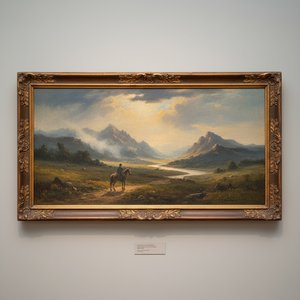
In the evocative masterpiece Kul-e Farah open-air sanctuary, the viewer is not merely looking at a landscape, but is instead transported through a portal into the ancient heart of the Near East. Created by the visionary Javier Álvarez-Mon, this work transcends the boundaries of traditional landscape painting to become a living historical reconstruction. The scene unfolds across a rugged, mountainous expanse where a winding dirt road acts as a silent guide, leading the eye through a tapestry of sun-drenched grassy fields and weathered, rocky terrain. There is a profound sense of movement within the stillness; the presence of figures scattered throughout the composition—some lingering in the foreground, others fading into the hazy distance—suggests a moment captured in the eternal flow of time. The inclusion of an animal near the center-right adds a touch of pastoral intimacy, grounding the vastness of the landscape in the humble, everyday rhythms of ancient life.
The technique employed by Álvarez-Mon is deeply informed by his unique dual identity as both an artist and a scholar of archaeology. Rather than relying solely on aesthetic impulse, he utilizes a meticulous approach that breathes life into the silent relics of the Elamite civilization. The brushwork possesses a textured, organic quality that mimics the very earth it depicts, blending the grit of the mountain paths with the softness of the highland flora. This mastery of texture allows the painting to function as a bridge between the modern observer and the Bronze and Iron Ages. For the collector or interior designer, this piece offers more than just visual beauty; it provides a tactile connection to the dust and grandeur of antiquity, making it a profound focal point for any space dedicated to contemplation and historical depth.
The Symbiosis of Archaeology and Artistry
What distinguishes this work is its deep-seated historical resonance. As a specialist in the Elamite civilization, Álvarez-Mon does not merely paint scenery; he reconstructs lost grandeur. Every element within Kul-e Farah open-air sanctuary serves as a narrative fragment of a forgotten era. The landscape itself becomes a character, embodying the resilience and the spiritual sanctity of an ancient open-air sanctuary. The symbolism of the road is particularly poignant, representing the passage of human history and the interconnectedness of civilizations that once thrived in these very mountains. There is an inherent emotional weight to the piece—a sense of peaceful solitude intertwined with the haunting realization of how much of our past remains shrouded in mystery.
For those seeking to adorn a curated collection or a sophisticated interior, this reproduction offers an unparalleled opportunity to integrate intellectual depth with aesthetic elegance. The painting’s palette, rich with earthy tones and natural light, creates an atmosphere of tranquility that can transform a room into a sanctuary of its own. It invites the viewer to pause, to wander the dirt paths of the mind, and to rediscover the beauty found in the weathered stones and ancient shadows of our shared human heritage.
Preguntas y respuestas
¿Qué sentimiento transmite "Kul-e Farah open-air sanctuary" de Javier Álvarez Mon dentro de Contemporary Realism?
Dentro del movimiento Contemporary Realism, "Kul-e Farah open-air sanctuary" se presenta con un tono Tranquil.
¿Es "Kul-e Farah open-air sanctuary" representativo de la temática habitual de Javier Álvarez Mon?
Entre los temas recurrentes de Javier Álvarez Mon —ancient near east history, elamite civilization reconstruction, archaeological historical narratives, reconstructing lost grandeur, natural landscape settings— "Kul-e Farah open-air sanctuary" aporta su propio enfoque sobre mountains, dirt road, people, animals, grassy fields, rocky terrain.
¿Se puede reproducir legalmente "Kul-e Farah open-air sanctuary" de Javier Álvarez Mon, que se encuentra en Museo de Historia Gale en la Universidad Macquarie?
El estado de los derechos de autor de "Kul-e Farah open-air sanctuary" de Javier Álvarez Mon es claro: la obra es aún protegido por derechos de autor. Su presencia en Museo de Historia Gale en la Universidad Macquarie no cambia dicho estado.
Biografía del artista
Javier Álvarez-Mon es un arqueólogo e historiador español, especializado en el antiguo Cercano Oriente. Nació en Madrid en 1969 y recibió su doctorado en Arqueología por la Universidad Complutense de Madrid en 2001. Actualmente, desempeña su labor como investigador del Consejo Nacional de Investigación (CSIC) y lidera el Grupo de Estudios Elamitas de la Universidad de Barcelona.
Formación y trayectoria profesional
La trayectoria académica de Javier Álvarez-Mon se ha forjado bajo un profundo interés por la arqueología y la historia, con un enfoque magistral en las civilizaciones del antiguo Cercano Oriente. Su labor investigativa ha convergido de manera apasionante en el estudio de la cultura elamita, un esfuerzo que lo ha llevado a publicar obras fundamentales que rescatan la memoria de este pueblo, tales como El mundo elamita (2018) y Elam: historia, arte y arqueología (2021).
Investigaciones y legado editorial
A través de sus minuciosas investigaciones, Álvarez-Mon ha logrado desentrañar los misterios de la cultura elamita, consolidando un corpus bibliográfico que es referencia para la disciplina. Entre sus publicaciones más destacadas se encuentran:
- El mundo elamita (2018)
- Elam: historia, arte y arqueología (2021)
- La cultura elamita (2015)
- Elam: una historia de la región (2012)
Este compromiso con el conocimiento ha sido ampliamente reconocido por la comunidad académica internacional, otorgándole diversos premios y distinciones que avalan su rigor científico.
Colaboraciones y proyectos de exploración
La labor de Javier Álvarez-Mon no es un camino solitario; su carrera se nutre del diálogo con otros investigadores a través de proyectos de gran envergadura. Entre sus contribuciones más significativas resaltan:
- Proyecto Elamita: una ambiciosa investigación sobre la cultura elamita, respaldada por el Consejo Nacional de Investigación (CSIC).
- Proyecto de excavaciones en Irán: una labor de campo arqueológico financiada por la Universidad de Barcelona.
- Proyecto de estudio de la cultura elamita: un esfuerzo dedicado al análisis profundo de este legado, también bajo el amparo de la Universidad de Barcelona.
Estas sinergias han sido vitales para expandir las fronteras del conocimiento sobre el mundo elamita, permitiendo que sus hallazgos se materialicen en publicaciones de gran impacto.
La trascendencia de su obra
El legado de Javier Álvarez-Mon resulta fundamental para comprender la complejidad de la cultura elamita y su papel crucial en la historia del antiguo Cercano Oriente. Su capacidad para interpretar los vestigios del pasado ha permitido un avance sin precedentes en nuestra visión de esta región. Parte de sus investigaciones y obras pueden explorarse en https://OriginalUniqueArt.com, donde se ofrece un acceso más detallado a su producción intelectual. Asimismo, para aquellos interesados en el diálogo entre la historia y las artes, se recomienda visitar los archivos del Museo de la Real Academia de Bellas Artes de San Fernando y el Musée de la Chasse et de la Nature.

Javier Álvarez Mon
1969 - , España
Artículos relacionados

Evocations of Place: A Historical Journey Through Landscape Art
Explore the rich history of landscape art with OriginalUniqueArt. Discover renowned artists, movements like Impressionism & Romanticism, and expert guidance for collecting timeless pieces. Find your perfect serene escape today!

Las 25 mejores obras de John Constable: Un viaje al corazón del paisaje inglés
Descubre las 25 obras maestras de John Constable y su alma romántica. Explora la colección completa en OriginalUniqueArt.com.

Dominando la Gran Ola: Las 25 Obras Maestras de Katsushika Hokusai
Explora las 25 obras maestras de Hokusai y el alma del ukiyo-e. Descubre reproducciones de museo en OriginalUniqueArt.com.

Paisajes Románticos: 10 Obras Maestras que Definieron un Movimiento Artístico
Descubre los 10 paisajes románticos más influyentes de artistas como Caspar David Friedrich y Turner. Explora la belleza, el simbolismo y las técnicas del movimiento romántico. Reproducciones de arte exclusivas en OriginalUniqueArt.com.
Anthony Vandyke Copley Fielding: Rediscovering a Master of Romantic Landscape
Discover the captivating landscapes of Anthony Vandyke Copley Fielding, a master of Romantic watercolour painting. Explore his life, technique, and legacy with OriginalUniqueArt – your source for museum-quality art reproductions & expert appraisal.