

 Ver en contexto
 Enviar
 Compartir
 Detalles
 Guía
Guía

 Descargar
 Similares
 Radiografía
 Presentación de diapositivas
 Estadísticas
Gloucestershire Old Spot
 Oil On Panel
- Romantic Landscape
 1805
1805 30.0 x 38.0 cm
 Yale Center for British Art
 Ver más
Giclée / Impresión de arte
Impresiones giclée o en lienzo de calidad de museo con producción rápida y opciones de acabado flexibles. ( Comprar pintura hecha a mano Cambiar a imagen digital)




P118B €10

P118H €10

P118W €10

P438Z €10

P508JH €12

P508YH €12

P805H €10

P805Z €10

P919BZ €10

P919G €10

P919XJ €10

P959ZH €10

P968JZ €12

W106C €8

W218G €10

W218JH €8

W218Y €10

W307PJ €10

W316G €10

W316PJ €8

W316Y €10

W398PJ €8

W4111J €10

W500HY €15

W500JH €15

W692G €12

W849H €8

W940BG €15

W953PJ €8




Elija entre nuestros tamaños predefinidos que respetan las proporciones originales de la obra.

Introduzca el ancho y el alto que necesite para adaptarse a su marco o pared. Una impresión solo puede recortarse, nunca hacerse más grande que la imagen original, por lo que un tamaño con una forma distinta perderá parte de la obra. Le enviaremos una maqueta digital para su aprobación antes de realizar cualquier impresión. La imagen que se muestra en esta página no refleja el recorte real; solo la maqueta lo hace.
Envío a todo el mundo () en 2 semanas en lugar de las 4/5 semanas estándar. (25 octubre)

Envío exprés gratuito a todo el mundo

Lienzo de lino de alta calidad

Seguro de envío total

Garantía de reembolso de aranceles aduaneros

Garantía de fidelidad cromática exacta

Política de devolución de 100 días (solo por defectos)

Garantía de devolución del 100% del dinero

Descuento por cantidad
 La opción de vidrio solo está disponible en tamaños inferiores a 110 cm.

Gloucestershire Old Spot
Giclée / Impresión de arte
Dimensiones de la reproducción
-


Precio total final
€ 70
James Ward’s Gloucestershire Old Spot: A Romantic Vision of Rural England
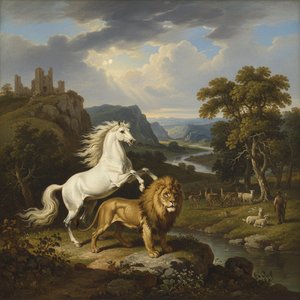
James Ward (1769-1859) stands as a pivotal figure in British Romantic landscape painting, often overshadowed by his more celebrated contemporaries yet undeniably influential in shaping the aesthetic sensibilities of his era. This monumental oil on panel depiction – “Gloucestershire Old Spot” – exemplifies Ward’s distinctive approach: capturing not merely visual beauty but also an idealized representation of pastoral life and imbued with subtle symbolic resonance. Let's delve into what makes this artwork so remarkable.A Masterstroke of Genre Painting
Initially, Ward’s artistic trajectory mirrored that of his brother-in-law George Morland, focusing on genre scenes depicting everyday rural life – farmers tending their livestock, bustling market squares, and convivial gatherings around hearth fires. However, by the early 1800s, Ward decisively shifted towards a grander scale, embracing monumental landscapes inspired by Rubens’ masterful compositions. This stylistic evolution is powerfully evident in “Gloucestershire Old Spot,” where Ward abandons Morland's intimate perspective for a panoramic vista that commands attention and invites contemplation. The painting skillfully blends observation with imagination, presenting a scene brimming with activity yet underpinned by an overarching sense of serenity.Technique and Composition: Rubensian Influence
Ward’s technique owes considerable debt to Rubens—a conscious decision reflecting his admiration for the Flemish master's ability to convey emotion through dramatic lighting and masterful brushwork. Notice the thick impasto – heavily textured paint application – particularly prominent in the pig’s coat, creating a palpable physicality that transcends mere representation. This textural richness contributes significantly to the painting’s atmospheric depth, simulating the hazy light of a Gloucestershire afternoon. The composition is carefully balanced, guiding the viewer's eye across the canvas from left to right, punctuated by figures and dogs strategically positioned within the landscape. The placement of the central pig amidst the expansive field underscores its importance as both subject matter and symbolic emblem—representing fertility, prosperity, and the harmonious relationship between humanity and nature.Symbolism Within Pastoral Beauty
Beyond its technical prowess, “Gloucestershire Old Spot” resonates with deeper symbolic meanings characteristic of Romantic art. The idyllic setting – a sunlit Gloucestershire meadow populated by livestock and people – embodies the Romantic ideal of unspoiled wilderness untouched by industrial progress. The pig itself is not merely an animal; it symbolizes abundance and fecundity—a visual shorthand for the promise of future generations. Furthermore, the presence of dogs adds to the narrative complexity, representing loyalty, guardianship, and companionship. They serve as silent witnesses to the unfolding drama of rural life, reinforcing Ward’s overarching message about the beauty and sanctity of the natural world.A Legacy Enduring Through Reproduction
Today, “Gloucestershire Old Spot” resides in the Yale Center for British Art's collection, a testament to Ward’s enduring artistic legacy. Reproductions offer an opportunity to experience this masterpiece firsthand—to appreciate its textural brilliance and immerse oneself in the evocative atmosphere of Victorian England. OriginalUniqueArt.com presents exceptional quality reproductions that faithfully capture the essence of Ward’s vision, allowing art lovers everywhere to bring a piece of Romantic landscape painting into their homes.Preguntas y respuestas
¿Qué tamaño se recomienda para "Gloucestershire Old Spot" en un Living Room?
Para un Living Room, se recomienda imprimir "Gloucestershire Old Spot" en un tamaño de Large.
¿"Gloucestershire Old Spot" de James Ward utiliza contrastes fuertes o armonías suaves?
La composición cromática de "Gloucestershire Old Spot" de James Ward combina un contraste Balanced con una armonía Strong Color Unity.
¿Dónde puedo comprar una reproducción pintada a mano de "Gloucestershire Old Spot" de James Ward?
"Gloucestershire Old Spot" está disponible como una reproducción al óleo pintada a mano sobre lienzo de lino. Puede realizar su pedido en la página de Reproducción al óleo pintada a mano, con una variedad de tamaños disponibles.
Biografía del artista
James Ward: Una Vida en el Arte Británico
James Ward (1769-1859) fue un prominente pintor británico reconocido por sus cautivadoras pinturas de animales, paisajes románticos e introspectivos retratos. Aunque a menudo eclipsado por sus contemporáneos, su estilo y habilidad únicos impactaron significativamente el desarrollo del arte británico durante el siglo XIX.
Primeros Años y Formación
Nacido el 23 de octubre de 1769 en Londres, Reino Unido, James Ward era el hermano menor del grabador William Ward. Sus primeras inclinaciones artísticas fueron fomentadas dentro de un entorno familiar creativo. Si bien recibió algo de formación formal, su desarrollo fue en gran medida autodirigido e influenciado fuertemente por la observación y la práctica.
Desarrollo Artístico & Influencias
La carrera de Ward se divide convencionalmente en dos períodos distintos con respecto a la influencia. Inicialmente, hasta alrededor de 1803, su obra guardaba un fuerte parecido al de su cuñado, George Morland, caracterizada por escenas de género y un enfoque en la vida cotidiana. Tras este período, se inspiró profundamente en el maestro barroco Peter Paul Rubens, adoptando una composición más dinámica, una rica paleta de colores y un uso dramático de la luz y la sombra.
Obras Notables & Estilo Artístico
El estilo singular de Ward lo distinguió de muchos contemporáneos. Se destacó en varios géneros, incluyendo pintura histórica, retrato, paisaje y arte animal. Algunas de sus obras más celebradas incluyen:
- Gordale Scar (1814/15): Considerada su obra maestra, esta dramática representación de una garganta del Yorkshire ejemplifica las cualidades sublimes del Romanticismo inglés.
- The Deer Stealer (1823): Encargado por Theophilus Levett, este cuadro muestra la habilidad de Ward en la narrativa y la representación animal.
- John Levett Hunting at Wychnor, Staffordshire (1817): Un retrato de uno de sus mecenas, que demuestra su capacidad para capturar tanto el parecido como la atmósfera.
Sus pinturas se caracterizan por una meticulosa atención al detalle, particularmente en la representación de animales, combinada con una sensibilidad romántica que enfatiza la belleza y el poder de la naturaleza.
Comisiones & Exposiciones
Ward disfrutó del patrocinio de figuras prominentes como Theophilus Levett, lo que llevó a numerosas comisiones. Exhibió regularmente su obra en la Royal Academy, obteniendo reconocimiento por su habilidad y originalidad. Su admisión como miembro en 1811 consolidó su posición dentro del establecimiento artístico británico.
Últimos Años & Legado
Ward continuó pintando prolíficamente hasta que un derrame cerebral en 1855 truncó su carrera. Falleció el 17 de noviembre de 1859, en relativa pobreza a pesar de su éxito anterior.
A pesar de enfrentar dificultades financieras más adelante en la vida, la influencia de James Ward en el arte británico sigue siendo innegable. Su mezcla única de realismo y romanticismo allanó el camino para futuras generaciones de pintores de animales y artistas paisajistas. Sus obras ahora se conservan en prestigiosas colecciones como Tate Britain y el Yale Center for British Art.
Significado Histórico
James Ward ocupa una posición significativa dentro de la transición de la era Neoclásica a la Romántica en el arte británico. Cerró la brecha entre la pintura de género tradicional y el creciente interés por el paisaje y el naturalismo, dejando atrás un legado de obras cautivadoras que continúan inspirando y deleitando.

James Ward
1769 - 1859 , Reino Unido
Datos clave
- Artistic Movement Or Style: Romanticismo
- Artists Or Movements Influenced By This Artist:
- James Cook University Hospital
- La Fundación James H.W. Thompson
- Artists Who Influenced This Artist:
- George Morland
- Rubens
- Date Of Birth: 23 octubre 1769
- Date Of Death: 17 noviembre 1859
- Full Name: James Ward
- Nationality: Británico
- Notable Artworks:
- Gordale Scar
- El Venado Cazado
- Place Of Birth: Londres, Reino Unido
Artículos relacionados

James Abbott McNeill Whistler: Las 25 Obras Maestras del Maestro del Arte y la Atmósfera | OriginalUniqueArt
Descubre las 25 obras maestras de James Abbott McNeill Whistler, el maestro del impresionismo y la armonía en arte. Explora retratos icónicos, nocturnos evocadores y su innovadora paleta de colores. Reproducciones de arte exclusivas en OriginalUniqueArt.com.

Alfred Munnings: Las 25 Obras Maestras del Pintor de Caballos | OriginalUniqueArt
Descubre las 25 obras maestras de Alfred Munnings, el pintor británico de caballos por excelencia. Explora su impresionismo inglés, escenas campestres y técnica única. Encuentra reproducciones de arte de alta calidad en OriginalUniqueArt.com.
James Ward: A Study in British Romantic Landscape and Animal Painting
Explore the captivating world of James Ward (1769-1859), a master of British Romantic landscape & animal painting. Discover his iconic 'Gordale Scar' and exquisite portraits – a timeless art investment. Learn about his influences, style, and enduring legacy.

Paisajes Románticos: 10 Obras Maestras que Definieron un Movimiento Artístico
Descubre los 10 paisajes románticos más influyentes de artistas como Caspar David Friedrich y Turner. Explora la belleza, el simbolismo y las técnicas del movimiento romántico. Reproducciones de arte exclusivas en OriginalUniqueArt.com.
Animalia: Explorando la Presencia Duradera de los Animales en el Arte y el Diseño de Interiores
Descubre la fascinante historia de los animales en el arte y cómo inspirar tu hogar con su simbolismo. Expertos en reproducciones y asesoramiento artístico.


