- Inicio

- Imagen digital
- Jackson Pollock
- Shimmering Substance
 Comprar impresión Encargar reproducción
 Enviar
 Compartir
 Detalles
 Añadir a favoritos

 Descargar
 Similares
 Radiografía
 Presentación de diapositivas
Shimmering Substance
 Acrílico sobre lienzo
- Arte de pared
- Abstract Expressionism
 1946
1946- Arte moderno
 30.0 x 24.0 cm
 Ver más
Adquiera una imagen digital de alta resolución y optimizada, muy superior a la vista previa en línea.
Cada archivo es preparado meticulosamente por nuestros especialistas internos mediante el uso de herramientas avanzadas y un experto retoque manual. Nos aseguramos de que cada imagen posea una claridad excepcional, una precisión cromática impecable y un detalle minucioso.
El archivo final se entrega por correo electrónico en un plazo de 72 horas, optimizado para su uso inmediato en entornos profesionales, editoriales y de impresión. Esta es la misma calidad en la que confían los estudios de diseño, las editoriales y las galerías de primer nivel.
Imagen Digital
Descarga un archivo de alta resolución para exhibición personal, impresión y proyectos creativos.
Incluido en cada pedido de imagen digital
Entrega digital experta, garantizada.
Al elegir OriginalUniqueArt.com, no solo está adquiriendo una imagen; está recibiendo una obra de arte digital mejorada profesionalmente, elaborada con precisión y respaldada por una garantía de satisfacción. Esto es todo lo que incluye su pedido, automáticamente:

Entrega rápida por email
Recibirá su archivo de imagen digital en alta resolución por correo electrónico en un plazo de 72 horas tras realizar su pedido, listo para su uso inmediato.

Archivo digital optimizado con IA
Su obra de arte se optimiza profesionalmente mediante herramientas avanzadas de IA y edición manual, garantizando el máximo detalle, claridad y precisión cromática.

Reenvío gratuito de por vida
¿Has borrado o perdido tu archivo por error? No te preocupes: te lo volveremos a enviar en cualquier momento, sin coste adicional.

Sin cargos de importación - Siempre
Disfrute de su obra de arte al instante sin aduanas, aranceles ni gastos de envío; las descargas digitales siempre están libres de impuestos.

Garantía de fidelidad de color
Garantizamos que su imagen digital refleje los colores originales con la mayor fidelidad posible, mediante el uso de herramientas profesionales y gestión del color.

Garantía de satisfacción de 60 días
Si no está satisfecho con su imagen digital, la revisaremos o le reembolsaremos el 100% en un plazo de 60 días, sin preguntas.

100% Garantía de devolución de dinero
¿No está satisfecho? Obtenga un reembolso completo dentro de los 60 días posteriores a la recepción de su archivo digital, sin preguntas.

Descuentos por pedidos al por mayor
Compra 3 imágenes, ahorra 10% - Compra 5, ahorra 15% - Compra 10+, ahorra 20%. Ideal para proyectos creativos, galerías y agencias.
Descripción del coleccionable
Shimmering Substance: A Dance of Color and Chaos
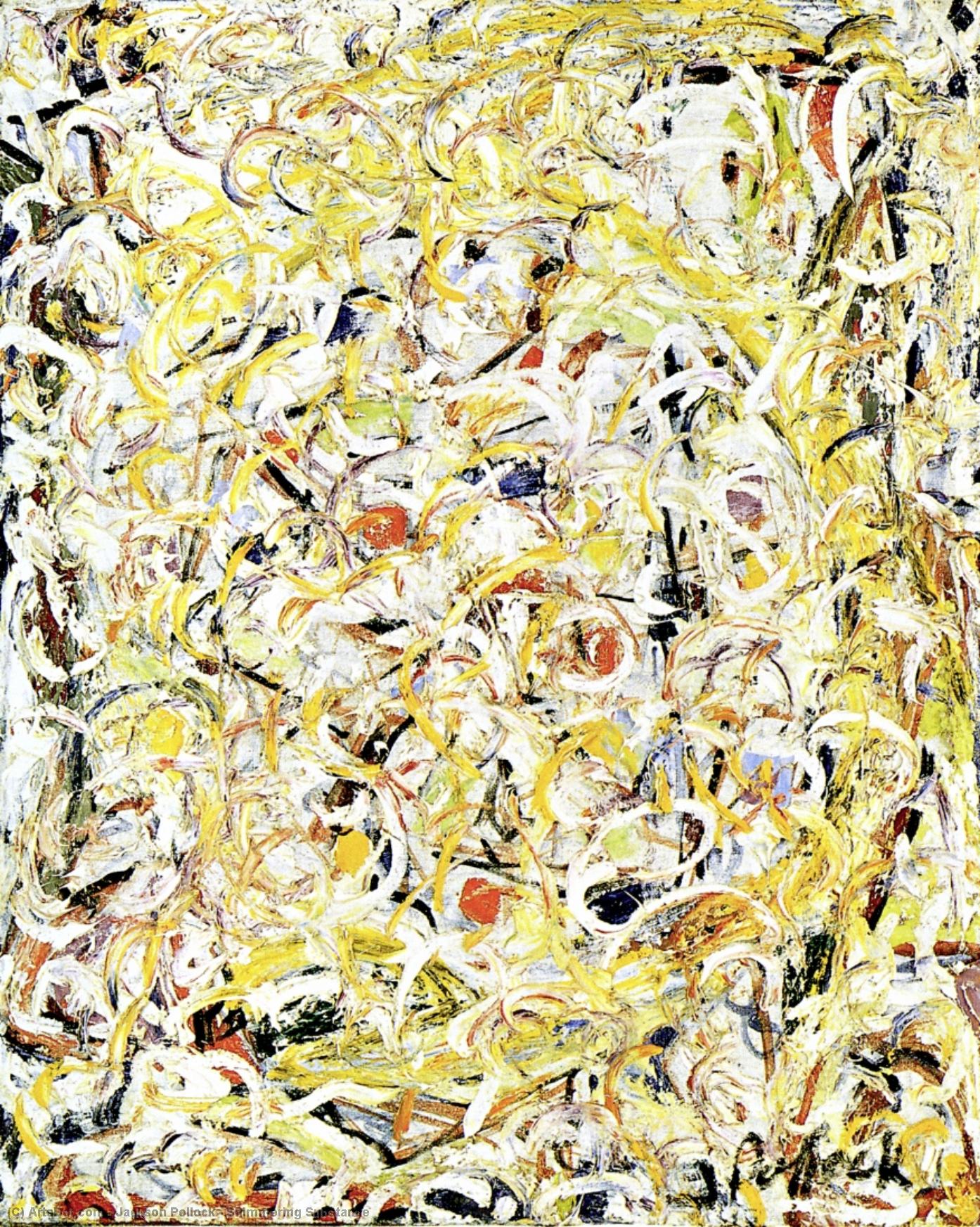
“Shimmering Substance” by Jackson Pollock isn’t merely paint on canvas; it's an embodiment of Abstract Expressionism’s audacious spirit—a defiant rejection of representational art in favor of pure emotion and spontaneous gesture. Executed in 1946, this monumental piece measuring 30 x 24 cm encapsulates the revolutionary approach pioneered by Pollock himself, marking a pivotal moment in twentieth-century artistic history. It stands as a testament to his unwavering belief that painting should be an act of liberation, mirroring the turbulent psychological landscape of its creator.The Genesis of Drip Painting: A Choreographed Revelation
Pollock’s transformation from traditional painter to drip artist began with a radical reimagining of the creative process. Abandoning the easel and palette knife for a floor-based technique—a deliberate act of disruption—he orchestrated a mesmerizing ballet of pigment droplets, splashes, and drips. This method wasn't about meticulous control; it was about embracing chance and allowing the inherent energy of movement to guide the artist’s hand. As Pollock famously declared, “I am nature,” reflecting his profound connection with the natural world and its unpredictable rhythms—a sentiment powerfully conveyed in this artwork.A Palette Born of Light: Color Harmony and Composition
The vibrant hues within "Shimmering Substance" – dominated by brilliant yellows juxtaposed against earthy tones punctuated by flashes of reds, blues, and greens – speak to a conscious effort to capture the radiant warmth of summer days spent in East Hampton. Influenced by Surrealism and Native American art, Pollock sought inspiration beyond conventional artistic boundaries. The composition itself is dynamic and engaging, featuring intricate swirls and patterns that draw the viewer into the painting’s immersive experience. These elements coalesce to create an atmosphere brimming with vitality and conveying a sense of profound contemplation.Order Amidst Chaos: Exploring Gestural Abstraction
Despite its initial appearance of randomness, “Shimmering Substance” reveals Pollock's underlying order—a carefully considered balance between spontaneity and deliberation. The artist’s meticulous manipulation of paint—applying it directly from the tube with a palette knife or even his fingers—produced patterns that defy easy categorization. This technique exemplifies gestural abstraction, prioritizing expressive movement over precise depiction. It’s a stylistic hallmark that distinguishes Pollock's oeuvre from more restrained artistic traditions.A Legacy Etched in Color: Influence and Recognition
“Shimmering Substance” cemented Pollock’s position as one of the foremost figures of Abstract Expressionism, influencing subsequent generations of artists and solidifying his place within the canon of modern art. Its impact can be seen in museums across Europe—particularly the Kunsthalle Mannheim in Germany—where it continues to inspire awe and provoke discussion about the nature of artistic creativity and its ability to communicate profound emotional truths. This artwork remains a captivating symbol of innovation, daring experimentation, and the enduring power of visual expression.Biografía del artista
Early Life and the Seeds of Innovation
Paul Jackson Pollock, born in Cody, Wyoming, in 1912, was a restless spirit from the outset. His early life was marked by frequent relocation as his father pursued work as a land surveyor across the vast landscapes of the American West. This itinerant existence instilled in young Pollock a deep connection to the natural world and an exposure to diverse cultures, particularly through encounters with Native American art during those surveying trips – impressions that would subtly permeate his artistic vision later in life.
Pollock’s formal artistic training began at the Manual Arts High School in Los Angeles, followed by studies at the Art Students League of New York under the tutelage of Thomas Hart Benton. Benton, a prominent figure in the Regionalist movement, emphasized rhythmic composition and narrative themes rooted in American life. While Pollock initially absorbed these lessons, his inherent inclination leaned toward more abstract explorations. He was also profoundly impacted by Mexican muralists like José Clemente Orozco, whose powerful depictions of social struggle resonated deeply with him. These early influences laid a foundation, but it was the burgeoning world of Surrealism that truly unlocked Pollock’s artistic potential.
The Birth of Action Painting and a Revolutionary Technique
The 1930s saw Pollock experimenting with various techniques, seeking alternatives to traditional brushwork. He began pouring paint, exploring its fluidity and unpredictable nature. However, it was around 1947 that his artistic trajectory underwent a radical transformation. Abandoning the easel altogether, Pollock laid canvases directly on the floor, initiating what would become known as his “drip painting.” He then proceeded to drip, splash, and fling paint onto the canvas from above, orchestrating a dynamic dance between artist, medium, and surface.
This wasn’t merely about applying paint; it was about embodying the act of creation itself. Pollock's canvases became arenas for physical expression, capturing the immediacy of his gestures and emotions. The resulting paintings are characterized by their “all-over” composition – a lack of central focus that invites the viewer to explore the entire surface as a unified field of energy. Intricate networks of lines and colors intertwine, creating a visual complexity that is both captivating and challenging. He employed unconventional tools—sticks, knives, even syringes—to manipulate the paint in unpredictable ways, further emphasizing the spontaneous nature of his process.
This innovative approach positioned Pollock as a central figure in the burgeoning Abstract Expressionist movement, which emerged in post-World War II New York City. Abstract Expressionism prioritized spontaneous gesture, large scale, and non-representational imagery, reflecting a broader cultural shift away from traditional artistic conventions. His marriage to fellow artist Lee Krasner was also pivotal; she provided unwavering emotional support and actively encouraged his artistic development, recognizing the groundbreaking nature of his work.
Iconic Works and Lasting Legacy
Pollock’s most celebrated works—such as Number 1, 1950 (Lavender Mist), One: Number 31, 1950, Blue Poles: Number 11, 1952, and Convergence—are testaments to his revolutionary technique. These paintings are not simply images; they are records of a performance, imbued with the artist’s physical presence and emotional intensity. The dynamic energy that emanates from these canvases is palpable, drawing viewers into a world of pure abstraction.
His style transcends mere aesthetics; it's an exploration of process over product. Pollock sought to capture the immediacy of his actions and emotions on canvas, rejecting traditional notions of composition and representation. He delved into Jungian psychology, exploring archetypes and the subconscious in his art, seeking to tap into universal symbols and primal energies.
Pollock’s impact on the history of art is immeasurable. He fundamentally altered the way artists approached painting, breaking free from easel-based methods and embracing a more performative approach. His work helped solidify New York City's position as a global center for modern art, shifting the focus away from European dominance. His influence can be seen in the work of countless artists who followed, including those associated with Color Field painting and later forms of abstract expressionism.
Though initially met with mixed reviews—some critics dismissed his work as chaotic or lacking skill—Pollock’s reputation grew steadily after his untimely death in 1956 at the age of 44. Today, he is universally recognized as one of the most important and influential artists of the 20th century, a visionary who dared to challenge conventions and redefine the boundaries of artistic expression.

Jackson Pollock
1912 - 1956 , Estados Unidos
Información clave
- Artistic Movement Or Style: Abstract Expressionismo
- Artists Or Movements Influenced By This Artist: ['Color Field painting']
- Artists Who Influenced This Artist:
- José Clemente Orozco
- Thomas Hart Benton
- Date Of Birth: 28 enero 1912
- Date Of Death: 11 agosto 1956
- Full Name: Paul Jackson Pollock
- Nationality: American
- Notable Artworks: ['Número 1, 1950 (Lavanda Vapor']
- Place Of Birth: Cody, Estados Unidos

