

 Vista previa
 Compartir
 Compartir
 Ver detalles
 Guía
Guía

 Descargar
 Ver artículos similares
 Radiografía
 Presentación de diapositivas
 Estadísticas
New York


 Leer más
La obra de arte que se muestra en esta página está protegida por las leyes de propiedad intelectual, lo que significa que no podemos crear ni vender legalmente una reproducción idéntica. Esta protección se hace cumplir en virtud de acuerdos internacionales como el Convenio de Berna y por las leyes nacionales, incluidas aquellas establecidas por el Ley de derechos de autor de los EE. UU. - Título 17.
Este método cumple plenamente con las normativas de derechos de autor, ya que no implica la copia ni la duplicación de la obra protegida. En su lugar, se trata de una reinterpretación creativa: una nueva pintura influenciada por la original, pero que no es idéntica a ella.
Giclée / Impresión de arte
Impresiones giclée o en lienzo de calidad de museo con producción rápida y opciones de acabado flexibles. ( Encargar reproducción pintada a mano Ver versión en imagen digital)




P118B €10

P118H €10

P118W €10

P438Z €10

P508JH €12

P508YH €12

P805H €10

P805Z €10

P919BZ €10

P919G €10

P919XJ €10

P959ZH €10

P968JZ €12

W106C €8

W218G €10

W218JH €8

W218Y €10

W307PJ €10

W316G €10

W316PJ €8

W316Y €10

W398PJ €8

W4111J €10

W500HY €15

W500JH €15

W692G €12

W849H €8

W940BG €15

W953PJ €8




Elija entre nuestros tamaños predefinidos que respetan las proporciones originales de la obra.

Introduzca el ancho y el alto que necesite para adaptarse a su marco o pared. Una impresión solo puede recortarse, nunca hacerse más grande que la imagen original, por lo que un tamaño con una forma distinta perderá parte de la obra. Le enviaremos una maqueta digital para su aprobación antes de realizar cualquier impresión. La imagen que se muestra en esta página no refleja el recorte real; solo la maqueta lo hace.
Envío a todo el mundo () en 2 semanas en lugar de las 4/5 semanas estándar. (23 octubre)

Envío exprés gratuito a todo el mundo

Lienzo de lino de alta calidad

Seguro de envío completo

Garantía de reembolso de impuestos aduaneros

Garantía de fidelidad cromática exacta

Política de devolución de 100 días (solo por defectos)

Garantía de devolución del 100% del dinero

Oferta por volumen
 La opción de vidrio solo está disponible en tamaños inferiores a 110 cm.

New York
Giclée / Impresión de arte
Tamaño de la reproducción
-


Precio total
€ 70
A Window Into the Soul of Abstract Expressionism
In the heart of the mid-century artistic explosion, Hedda Sterne’s “New York,” completed in 1956, emerges as a profound meditation on perception and the urban experience. Rather than offering a literal postcard of the Manhattan skyline, Sterne invites us to peer through a fractured lens, where the city is not merely seen but felt. The artwork focuses on a window frame, meticulously rendered with geometric lines and intersecting diagonals that act as a conduit for the dynamism of postwar life. It is a work that captures the very essence of Abstract Expressionism, moving beyond mere representation to explore the interplay between light, shadow, and the structural complexity of the modern world.
The technique employed in this masterpiece is a masterful blend of Impressionistic sensitivity and the bold formalism characteristic of the New York School. Utilizing oil on canvas, Sterne creates a heavily worked surface where visible brushstrokes contribute to a rich, tactile texture. This deliberate layering allows for a fascinating duality; parts of the composition suggest a smooth, glass-like clarity, while other areas evoke a rugged, weathered roughness. Through this textured approach, the artist engages the viewer's senses, making the act of looking a physical experience. The muted color palette—dominated by sophisticated shades of grey, yellow, and black—enhances the atmospheric depth, casting long, natural shadows that dance across the architectural elements.
Symbolism and the Fragmented Reality
Beyond its structural beauty, “New York” is steeped in deep symbolic resonance. The fractured reflections caught within the window glass serve as a powerful metaphor for the subjective nature of reality. Much like the Surrealist ideas that influenced Sterne, these distortions suggest that our view of the world is often fragmented and filtered through our own perceptions. The geometric lines of the window frame provide a sense of order amidst this visual chaos, symbolizing the human attempt to find structure within the overwhelming energy of the urban landscape. It is a poignant reflection of the cultural anxieties of 1956, capturing a moment of transformation and reconstruction in the wake of global upheaval.
For the discerning collector or interior designer, this painting offers more than just aesthetic appeal; it provides an emotional anchor. The composition’s flattened perspective and close-up view create an intimate atmosphere of quiet contemplation. Whether placed in a contemporary gallery setting or as a focal point in a sophisticated modern living space, the artwork brings a sense of intellectual depth and historical gravity. It is a piece that rewards prolonged study, offering new layers of meaning with every glance, making it an incomparable acquisition for those who seek to surround themselves with art that speaks to the complexity of the human spirit.
Preguntas y respuestas
¿A qué etapa de la evolución de Hedda Sterne pertenece "New York"?
Dentro de la trayectoria de Hedda Sterne, "New York" pertenece al Mature Period. Esta etapa permite compararla con otras obras del artista.
¿Para qué se recomienda una reproducción de "New York" de Hedda Sterne?
El uso recomendado de una impresión de "New York" es Reflective.
¿Tiene "New York" una vista previa en realidad aumentada?
"New York" tiene una vista previa en realidad aumentada: la página de Vista previa AR de la obra permite visualizarla en su propio espacio mediante un dispositivo compatible.
Biografía del artista
Hedda Sterne: Bridging Surrealism and Abstract Expressionism
Hedda Sterne (August 4, 1910 – April 8, 2011) was a Romanian-born American artist who stands as an exceptional figure in the history of modern art. Her life’s journey—spanning from her formative years in Bucharest to her triumphant embrace of New York City—represents not merely artistic evolution but also a profound engagement with the intellectual currents shaping the twentieth century, particularly Surrealism and Abstract Expressionism. Sterne's unwavering dedication to exploring complex themes through innovative techniques cemented her place as one of the most distinctive voices within American art during its pivotal moment.Early Life and Artistic Foundations
Born Hedwig Lindenberg in Bucharest, Romania, Sterne’s early life was marked by a rich cultural environment fostered by her Jewish parents. From a young age, she demonstrated an aptitude for music and languages—skills honed under the guidance of Max Hermann Maxy, who had taught her instructor Frederic Storck at the Bucharest National University of Arts. This formative education instilled in her a deep appreciation for nuance and expression, shaping her artistic sensibilities before she embarked on formal training in 1918. Sterne’s decision to pursue art instead of music was driven by an intellectual curiosity that would propel her throughout her life—a desire to transcend prescribed boundaries and delve into the realm of visual exploration. Her studies at the Institutul de Domnişoare Choisy-Mangâru solidified her grounding in European artistic traditions, exposing her to influential figures like Marcel Janco and Victor Brauner—artists deeply immersed in Surrealist thought. These encounters instilled in Sterne a fascination with automatism—a technique that would become central to her artistic practice.Surrealist Influences and Parisian Explorations
The intellectual fervor of Bucharest during the 1920s profoundly impacted Sterne’s artistic development. She absorbed the spirit of Dada and Surrealism, immersing herself in avant-garde circles where she befriended artists like Marcel Janco and Victor Brauner. Her travels to Vienna—where she studied ceramics at the Kunsthistorisches Museum—further broadened her horizons and exposed her to diverse artistic approaches. These experiences weren’t merely technical exercises; they were opportunities to absorb different perspectives on form, color, and composition—all while deepening her understanding of Surrealist principles. Sterne's early collages exemplify this influence, utilizing chance encounters and unexpected juxtapositions to evoke a dreamlike atmosphere—a deliberate departure from representational conventions. Her engagement with André Lhote and Fernand Léger at the École Supérieure des Beaux-Arts in Paris cemented her connection to European Modernism’s core tenets.New York City and Abstract Expressionism
Following World War II, Sterne relocated to New York City—a transformative experience that propelled her into the heart of the burgeoning American Abstract Expressionist movement. Embracing the dynamism of the metropolis as inspiration, she joined forces with fellow artists like Jackson Pollock, Willem de Kooning, Barnett Newman, and Mark Rothko—artists who challenged traditional artistic norms and championed spontaneity and emotional intensity. Sterne’s work during this period reflected her unique position as an outsider looking in—grappling with the complexities of American culture while retaining a distinctly European sensibility. She became associated with “The Irascibles,” a rebellious group of artists who protested against the Metropolitan Museum of Art’s failure to reflect contemporary abstraction in its exhibitions—a bold assertion of artistic freedom and intellectual conviction. Her participation in *First Papers of Surrealism* alongside André Breton and Marcel Duchamp underscored her commitment to pushing boundaries and resisting categorization—a testament to her unwavering dedication to artistic exploration.Legacy and Artistic Significance
Hedda Sterne’s enduring legacy resides not only in her distinctive visual vocabulary but also in her pioneering role as a woman artist within the Abstract Expressionist movement—a realm historically dominated by male figures. Her refusal to conform to prevailing trends, coupled with her profound engagement with philosophical inquiry, established her as one of the most intellectually stimulating voices of her time. Sterne’s art continues to resonate today, inviting viewers to contemplate themes of displacement, memory, and the search for meaning in a rapidly changing world—a testament to her ability to transcend temporal boundaries and communicate universal truths through visual poetry. Her work remains an invaluable contribution to the history of modern art—a beacon of artistic independence and intellectual curiosity that inspires artists and scholars alike.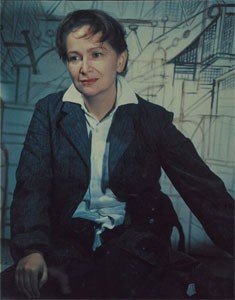
Hedda Sterne
1910 - 2011 , Romania
Datos clave
- Artistic Movement Or Style: Expresionismo Abstracto y Surrealismo
- Artists Or Movements Influenced By This Artist: ['New York School']
- Artists Who Influenced This Artist:
- Marcel Janco
- Victor Brauner
- Date Of Birth: August 4, 1910
- Date Of Death: April 8, 2011
- Full Name: Hedda Sterne
- Nationality: Rumaniana
- Notable Artworks:
- Tondo
- Third Avenue El
- Place Of Birth: Bucharest, Rumanía
Artículos relacionados

Abstracción Geométrica: 10 Obras Maestras que Transformaron el Arte Moderno | OriginalUniqueArt
Descubre las 10 obras maestras de la abstracción geométrica que revolucionaron el arte moderno. Explora a Mondrian, Malevich y Kandinsky en OriginalUniqueArt.com. Reproducciones de alta calidad para tu hogar.
The Visceral Canvas: Exploring the Raw Emotion and Historical Power of Abstract Expressionism
Embark on a profound journey through Abstract Expressionism. Discover the raw emotion, historical significance, and visceral power of the New York School's greatest masters in this expert exploration of mid-century modern art history.

Pure Chaos & Color: The High-Voltage World of Abstract Expressionism
Dive into the high-voltage world of Abstract Expressionism. Explore the raw energy of Action Painting and the legendary masters of the New York School through a visual journey of pure chaos and color. Discover how to bring bold, high-impact abstract art into your modern space.

Expresionismo Abstracto: 10 Obras Maestras que Transformaron el Arte |
Descubre las 10 obras maestras del Expresionismo Abstracto: Pollock, Rothko y más. Explora la historia, técnica y significado de estos lienzos icónicos. Reproducciones de arte exclusivas en .
Más Allá de la Representación: Explorando el Paisaje Emocional del Expresionismo Abstracto
Descubra el Expresionismo Abstracto en profundidad. Análisis de artistas clave como Rothko y Richter, su contexto histórico e inversión en arte. Guía experta para coleccionistas.
