Cambiar a impresiones
 Ver más







































 Para obras de arte o reproducciones que midan más de 105 cm (aproximadamente 41 pulgadas) en cualquiera de sus lados, el marco se enviará como un kit desmontado. Este método garantiza una entrega segura y evita daños durante el transporte.


Death And Life
Death and Life (Tod und Leben), created between 1908 and 1916, is a masterpiece of Art Nouveau that explores the eternal dance between mortality and existence. This painting, measuring 178 x 198 cm, is housed in the Leopold Museum in Vienna, Austria.In 1911 Death and Life received first prize in the world exhibitions in Rome. In 1912 Klimt exhibited the painting at an art exhibition in Dresden.
Further exhibitions of the painting took place e.g. 1913 in Budapest and Mannheim, 1914 in Prague, 1916 in Berlin, 1917 / 1918 in Copenhagen, 1918 in Zurich and from 1923 several times in Vienna, 1958 in Venice and 1965 in New York and London.
Klimt made changes to the painting in 1915, after the first five exhibitions of the painting. He changed the background from gold-colored to grey and added some mosaics.
The Composition
The artwork is divided into two distinct halves. On the left side, a cloaked skeleton representing Death looms over the vibrant scene on the right. This somber figure is depicted with a menacing expression, clutching a staff and gazing intently at the figures embodying Life. The right side features a cluster of intertwined human figures, symbolizing various stages and aspects of life. These figures are portrayed in a tender, almost joyful embrace, exuding warmth and intimacy.
Symbolism and Style
Klimt's style is characterized by intricate patterns and decorative motifs, which breathe life into the composition. The use of gold leaf adds a sense of luxury and mysticism to the painting. The figures in the Life scene are adorned with these ornate details, contrasting starkly with the dark representation of Death.
Artistic Development
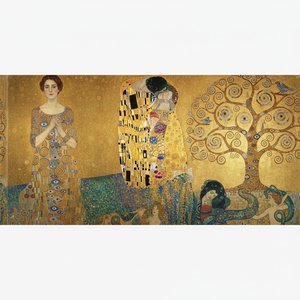
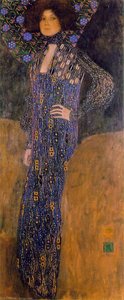
Gustav Klimt was a key figure in the Vienna Secession movement, profoundly impacting art with his focus on the female body and distinct style. His work often incorporated allegorical and portrait elements, as seen in Judith01, Reclining Nude and Lady with Cape.
Art Nouveau Movement
Art Nouveau was an international style that emerged between 1890 and 1910, characterized by sinuous curves inspired by natural forms. It sought to break down the distinction between fine arts and applied arts. Klimt's work was influenced by Japanese art and its methods, as well as the Arts and Crafts movement.
Conclusion
Death and Life is a poignant visualization of the inescapable proximity of death to the vibrancy of life. It highlights the continuation of life despite omnipresent mortality. This masterpiece by Gustav Klimt is a testament to his artistic genius and the enduring legacy of Art Nouveau.
This painting is a powerful reminder of the transience of life and the inevitability of death, yet it also celebrates the beauty and vitality of human existence.
Preguntas y respuestas
¿Dónde debería colgarse una reproducción de "Muerte y Vida" de Gustav Klimt?
Con su formato Cuadrado, se sugiere una reproducción de "Muerte y Vida" para un Salón principal.
¿Dónde puedo descargar "Muerte y Vida" de Gustav Klimt?
Puede descargar "Muerte y Vida" de Gustav Klimt desde la página de Descargar imagen digital de la obra, como descarga de una imagen digital en alta resolución.
¿Qué tan intensos son los colores en "Muerte y Vida" de Gustav Klimt?
La intensidad cromática de "Muerte y Vida" es Monocromático. La intensidad describe la fuerza con la que se perciben los colores.
 Ver en contexto
 Enviar
 Compartir
 Detalles
 Guía
Guía

 Descargar
 Similares
 Radiografía
 Presentación de diapositivas
 Preguntas y respuestas
 Estadísticas