

 Vista previa
 Compartir
 Compartir
 Ver detalles
 Guía
Guía

 Descargar
 Ver artículos similares
 Radiografía
 Presentación de diapositivas
 Estadísticas
Justice
 Oil On Panel
- WallArt
- Baroque
 1542
1542- Renaissance
 79.0 x 188.0 cm
 Galería de la Academia
 Leer más
Reproducción al óleo hecha a mano
Óleo sobre lienzo pintado a mano en el tamaño y marco de su elección, realizado por encargo por nuestros artistas. ( Cambiar a formato impreso Ver versión en imagen digital)




P118B €10

P118H €10

P118W €10

P438Z €10

P508JH €12

P508YH €12

P805H €10

P805Z €10

P919BZ €10

P919G €10

P919XJ €10

P959ZH €10

P968JZ €12

W106C €8

W218G €10

W218JH €8

W218Y €10

W307PJ €10

W316G €10

W316PJ €8

W316Y €10

W398PJ €8

W4111J €10

W500HY €15

W500JH €15

W692G €12

W849H €8

W940BG €15

W953PJ €8




Elija entre nuestros tamaños predefinidos que respetan las proporciones originales de la obra.

Escriba el ancho y el alto que necesite para adaptarse a su marco o a su pared. Al ser una obra pintada a mano, para un tamaño con una forma distinta, el artista puede pintar un poco más alrededor de la imagen o recortar un poco; usted elige. Le enviaremos una maqueta digital para su aprobación antes de comenzar la pintura. La imagen que se muestra en esta página no refleja el resultado real; solo la maqueta lo hace.
Tras realizar el pedido, el equipo de OriginalUniqueArt.com enviará un correo electrónico al cliente para solicitar instrucciones y proporcionarle una vista previa del boceto.
Envío a todo el mundo () en 3-4 semanas en lugar de las 5 semanas estándar. (24 octubre). Sin comprometer la calidad.

Envío exprés gratuito a todo el mundo

Lienzo de lino de alta calidad

Seguro de envío completo

Garantía de reembolso de impuestos aduaneros

Garantía de fidelidad cromática exacta

Política de devolución de 100 días (solo por defectos)

Garantía de devolución del 100% del dinero

Oferta por volumen
 La opción de vidrio solo está disponible en tamaños inferiores a 110 cm.

Justice
Técnica de reproducción
Tamaño de la reproducción
-


Precio total
€ 263
A Symphony of Virtue: The Eternal Resonance of Vasari’s Justice
In the grand tapestry of the Italian Renaissance, few works capture the profound intersection of moral philosophy and visual splendor as exquisitely as Giorgio Vasari’s “Justice.” Completed in 1542, this monumental oil on panel is far more than a mere depiction of a virtue; it is a carefully orchestrated visual sermon. As one gazes upon the central figure, a woman draped in flowing, luminous robes, there is an immediate sense of the profound stability she represents. Her face, serene yet resolute, serves as the emotional anchor for the entire composition. Through Vasari’s masterful hand, the painting transcends its historical moment to become a timeless emblem of human dignity and the pursuit of truth, making it a captivating centerpiece for any collection dedicated to the intellectual depth of the sixteenth century.
The brilliance of this masterpiece lies in its intricate layer of symbolism, where every element serves a higher allegorical purpose. The figure of Justice is famously blindfolded, a poignant reminder of her impartiality and the refusal to be swayed by personal bias. In her left hand, she holds the scales, balanced with delicate precision, while her right hand rests upon a sword—a symbol of the necessary power required to enforce law and maintain order. Beneath her throne, a globe signifies her universal jurisdiction, suggesting that justice is not merely a local concern but a cosmic principle. This symbolic language is further enriched by the presence of three men engaged in earnest conversation; they represent the voices of reason and deliberation, embodying the Renaissance ideal that true justice arises from thoughtful discourse and the weighing of evidence.
The Elegance of Mannerism and Artistic Mastery
To appreciate “Justice” is to witness the height of the Mannerist style. Moving away from the balanced naturalism of the High Renaissance, Vasari embraces a more sophisticated and tension-filled aesthetic. The figures possess an elegant elongation, and their poses are characterized by a dramatic, almost theatrical grace that directs the viewer's eye through the composition in a rhythmic dance. This stylistic choice creates a sense of movement and intellectual energy, preventing the allegorical subject from feeling static or purely instructional. Vasari’s technique is nothing short of virtuosic; his ability to manipulate light and shadow—the chiaroscuro—bestows a remarkable three-dimensionality upon the drapery and the flesh, lending a palpable realism to the otherwise stylized forms.
For the discerning collector or interior designer, a high-quality reproduction of this work offers more than just aesthetic beauty; it brings a sense of historical gravity and intellectual prestige to a space. The painting’s rich textures and complex narrative invite prolonged contemplation, making it an ideal focal point for a library, a formal study, or a sophisticated gallery wall. It serves as a conversation piece that bridges the gap between the classical past and the modern interior, embodying a legacy of wisdom and strength. Owning a tribute to Vasari’s “Justice” is an invitation to surround oneself with the enduring ideals of balance, truth, and the magnificent artistry of the Italian Renaissance.
Preguntas y respuestas
¿Es "Justice" una buena idea para un regalo?
Como regalo, se sugiere "Justice" de Giorgio Vasari para Corporate Gift. También es adecuado para otras ocasiones.
¿Cuál es la técnica y la fecha de creación de "Justice" de Giorgio Vasari?
"Justice" fue realizada en 1542, en Oil On Panel.
¿Es Giorgio Vasari, creador de "Justice", conocido bajo otros nombres?
Giorgio Vasari aparece bajo los nombres alternativos Giorgio di Antonio Vasari, Vasari.
Biografía del artista
Primeros años y formación
Giorgio Vasari, un renombrado pintor, arquitecto, escritor e historiador italiano, nació el 30 de julio de 1511 en Arezzo, Toscana. Comenzó su viaje artístico como discípulo de Guglielmo da Marsiglia, un hábil pintor de vidrieras. A los dieciséis años, Vasari se unió al círculo de Andrea del Sarto y sus alumnos, Rosso Fiorentino y Jacopo Pontormo, en Florencia.Carrera artística
Las propias pinturas manieristas de Vasari fueron muy admiradas durante su vida. En 1529, visitó Roma, donde estudió las obras de Rafael y otros artistas del Alto Renacimiento romano. Algunas de sus obras notables incluyen:- El taller del pintor (fresco, 1548), ubicado en Casa Vasari, Arezzo, Italia (ver en OriginalUniqueArt)
- El Juicio Final (fresco, 1572), en la cúpula de la catedral de Florencia
- La Adoración de los Magos (pintura al óleo, 1566), en la iglesia de Santa Croce, Florencia (más en OriginalUniqueArt)
Contribuciones arquitectónicas
Los logros arquitectónicos de Vasari incluyen:- La logia del Palazzo degli Uffizi, Florencia, que funciona como una plaza pública
- El Corredor de Vasari, que conecta los Uffizi con el Palazzo Pitti en Florencia (explorar en OriginalUniqueArt)
- La renovación de iglesias medievales, como Santa Maria Novella y Santa Croce
Legado
Vasari a menudo se le llama "el primer historiador del arte" debido a su libro Vidas de los más excelentes pintores, escultores y arquitectos italianos, que sigue siendo un texto fundamental en la escritura histórico-artística. Murió el 27 de junio de 1574 en Florencia, Gran Ducado de Toscana, a la edad de 62 años. Descubre más sobre la vida y obra de Giorgio Vasari en OriginalUniqueArt: Giorgio Vasari | 72 obras de arte
Giorgio Vasari
1511 - 1574 , Italia
Datos clave
- Artistas Que Influyeron:
- Rafael
- Miguel Ángel
- Estilo Artístico: Manierismo
- Fecha De Muerte: 27 de junio de 1574
- Fecha De Nacimiento: 30 de julio de 1511
- Lugar De Nacimiento: Arezzo, Italia
- Nacionalidad: Italiana
- Nombre Completo: Giorgio Vasari
- Obras Notables:
- El taller del pintor
- El Juicio Final
- La Adoración de los Magos
Artículos relacionados

Maerten van Heemskerck: Bridging Mannerism & Renaissance Ideals
Explore the captivating world of Maerten van Heemskerck, a pivotal Dutch Renaissance painter bridging Mannerism & Italian influence. Discover his masterpieces and legacy with OriginalUniqueArt.
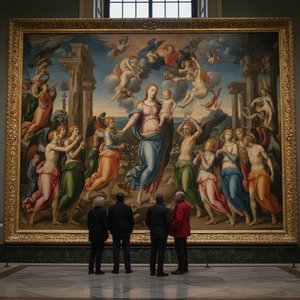
Beyond Perfection: The Elegant Drama and Sophisticated Artifice of Mannerist Masterpieces
Explore the captivating world of Mannerist art. Discover how masters like Parmigianino transitioned from Renaissance harmony to elegant drama, tension, and sophisticated artifice in this deep dive into 16th-century Italian mastery.

Unveiling Hidden Meanings: Allegory in Western Art History
Explore the rich history of allegory in Western art! Discover hidden meanings in masterpieces from Giotto to Bosch & beyond. Expert insights for collectors and enthusiasts at OriginalUniqueArt.
The Weight of Virtue and Vice: Exploring Moral Themes in Art History
Explore the captivating world of moral allegory in art history! Discover how Renaissance masters like Bosch, Botticelli & Lotto depicted virtue & vice. Expert analysis and stunning reproductions at OriginalUniqueArt.
Giorgio de Chirico: Metaphysical Realities & the Poetics of Absence
Explore the captivating world of Giorgio de Chirico and his groundbreaking Metaphysical painting movement. Discover the philosophical depths & surreal imagery that influenced generations of artists. Learn more at OriginalUniqueArt.


