 Vista previa
 Compartir
 Compartir
 Ver detalles

 Descargar
 Ver similares
 Radiografía
 Presentación de diapositivas
Joseph Anthony Jr.
 Acrylic On Canvas
- WallArt
- Romanticism
 1795
1795 76.0 x 62.0 cm
 Museo Metropolitano de Arte
 Leer más
Reproducción al óleo hecha a mano
Óleo sobre lienzo pintado a mano en el tamaño y marco de su elección, realizado por encargo por nuestros artistas. ( Pedir impresión Comprar descarga)




P118B $10

P118H $10

P118W $10

P438Z $10

P508JH $12

P508YH $12

P805H $10

P805Z $10

P919BZ $10

P919G $10

P919XJ $10

P959ZH $10

P968JZ $12

W106C $8

W218G $10

W218JH $8

W218Y $10

W307PJ $10

W316G $10

W316PJ $8

W316Y $10

W398PJ $8

W4111J $10

W500HY $15

W500JH $15

W692G $12

W849H $8

W940BG $15

W953PJ $8




Elija entre nuestros tamaños predefinidos que respetan las proporciones originales de la obra.

Puede ingresar sus propias dimensiones para adaptarse a un marco o espacio específico. Si el tamaño seleccionado no coincide con las proporciones de la imagen original, recortaremos la obra o extenderemos la pintura con elementos adicionales pintados a mano. Se le enviará una maqueta digital para su aprobación antes de comenzar la producción.
Tenga en cuenta que la vista previa en pantalla no refleja el recorte o la extensión reales. Solo la maqueta mostrará con precisión la composición final.
Si bien existen tamaños personalizados, recomendamos seleccionar una dimensión de la lista predefinida para preservar las proporciones originales.
Tras realizar el pedido, el equipo de OriginalUniqueArt.com enviará un correo electrónico al cliente para solicitar instrucciones y proporcionarle una vista previa del boceto.
Envío a todo el mundo () en 3-4 semanas en lugar de las 5 semanas estándar. (18 agosto). Sin comprometer la calidad.

Envío exprés gratuito a todo el mundo

Lienzo de lino de alta calidad

Seguro de envío completo

Garantía de reembolso de aranceles aduaneros

Garantía de fidelidad cromática exacta

Política de devolución de 60 días (solo por defectos)

Garantía de devolución del 100% del dinero

Oferta por volumen
 La opción de vidrio solo está disponible en tamaños inferiores a 110 cm.

Joseph Anthony Jr.
Técnica de reproducción
Tamaño de la reproducción
-


Precio total
$ 300
Descripción de la obra
Joseph Anthony Jr.: A Newport Craftsman’s Confident Portrait
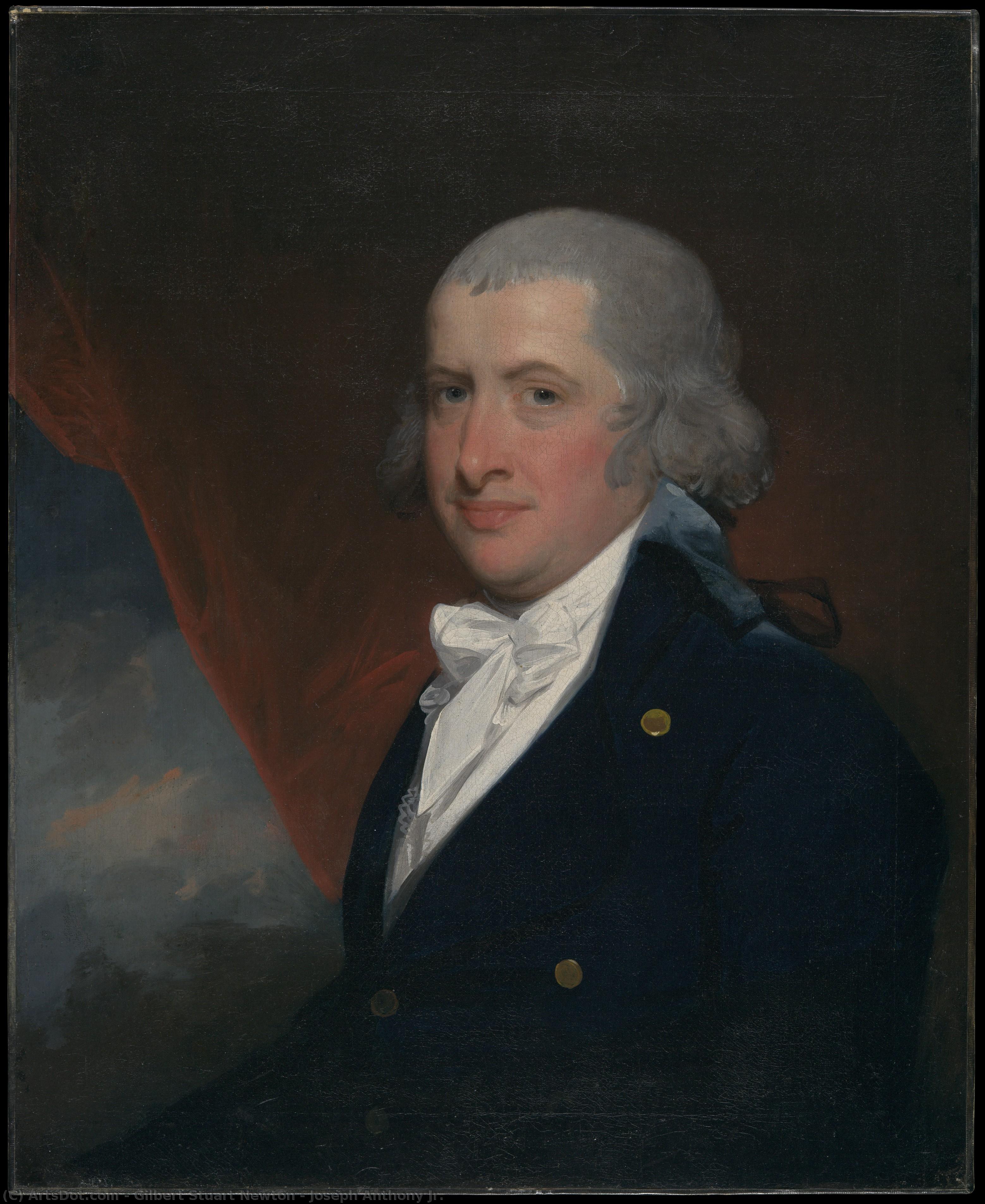
Gilbert Stuart Newton's "Joseph Anthony Jr." is more than just a portrait; it’s a carefully constructed tableau of 18th-century prosperity and quiet self-assurance. Painted in 1795, the artwork captures Joseph Anthony Jr., a native of Newport, Rhode Island, and a direct descendant of Gilbert Stuart, the renowned American portrait painter. Newton, apprenticed to his celebrated uncle, skillfully blends elements of English formal portraiture with a distinctly New England sensibility, creating an image that speaks volumes about its subject’s status and character.
The composition immediately draws the eye to Anthony's figure – a man radiating confidence despite a subtle air of thoughtful contemplation. He is depicted in a richly detailed suit of dark blue velvet, accented with gold embroidery, indicative of his family’s wealth and standing within Newport society. His posture is upright, shoulders squared, conveying an impression of authority and self-possession. The carefully arranged bow tie and the precise cut of his jacket speak to meticulous attention to detail – a hallmark of Newton's artistic approach. The subtle hint of red in his waistcoat adds a touch of warmth and vitality to the otherwise formal attire.
A Window into Newport Society
To fully appreciate “Joseph Anthony Jr.”, it’s crucial to understand the context of 18th-century Newport. The city was a thriving center for trade, shipping, and finance, fueled by the lucrative transatlantic commerce with Britain and France. Families like the Anthony's amassed considerable fortunes through maritime ventures, establishing themselves as prominent figures in the community. Newton’s portrait isn’t merely a likeness; it’s a visual representation of this social hierarchy and the values associated with it – respectability, industry, and familial lineage.
The background subtly reinforces this setting. The red curtains, reminiscent of a gentleman's drawing room, suggest an environment of refinement and leisure. While not explicitly depicted, one can almost imagine the sounds of conversation and music emanating from within, creating a sense of domestic comfort and social engagement. Newton’s use of light is masterful, illuminating Anthony’s face while casting gentle shadows that add depth and dimension to the scene.
Technique and Artistic Style
Newton's style leans heavily toward English portraiture, particularly the work of Thomas Gainsborough and Sir Godfrey Kneller. He employs a meticulous technique, evident in the incredibly detailed rendering of Anthony’s clothing, the subtle play of light and shadow, and the precise brushstrokes that define every feature. The artist skillfully utilizes chiaroscuro – the dramatic contrast between light and dark – to sculpt Anthony's form and create a sense of three-dimensionality.
The painting is executed in oil on canvas, a medium favored by Newton for its ability to capture subtle nuances of color and texture. Newton’s attention to detail extends beyond mere representation; he imbues the portrait with a palpable sense of personality. Anthony's gaze, direct and unwavering, invites the viewer into his world, suggesting an intelligence and quiet dignity.
Symbolism and Emotional Resonance
Beyond its surface appearance, “Joseph Anthony Jr.” is rich in symbolism. The man’s confident posture and carefully chosen attire represent a desire for social acceptance and recognition within Newport society. The subtle smile hints at contentment and self-satisfaction – a reflection of his family's success and his own position within it. Newton masterfully captures not just a likeness, but the essence of a man defined by his heritage and accomplishments.
Ultimately, “Joseph Anthony Jr.” is a testament to Newton’s skill as an artist and his ability to capture the spirit of a bygone era. It offers a captivating glimpse into the world of 18th-century Newport, inviting viewers to contemplate the values, aspirations, and social dynamics that shaped this vibrant community.
Biografía del artista
Gilbert Stuart Newton: Vida y Legado
Primeros Años y Trasfondo Familiar
- Nacimiento y Orígenes: Gilbert Stuart Newton nació el 2 de septiembre de 1795, en Halifax, Nueva Escocia. Fue el menor de doce hermanos.
- Conexiones Familiares: Su padre, Henry Newton, era un oficial de aduanas, mientras que su madre, Ann, poseía un linaje artístico de gran relevancia, al ser hija de Gilbert Stuart, el renombrado pintor de retratos estadounidense.
- Primeros Años y Regreso a América: La familia residió inicialmente en Boston, pero tras la muerte de su padre, regresaron a Charlestown, cerca de Boston, en 1803.
Formación Artística e Influencias
- Camino Inicial y Guía del Tío: Aunque inicialmente se le destinaba a una carrera comercial, Newton fue aprendiz de su tío, Gilbert Stuart, lo que marcó el inicio de su viaje artístico.
- Estudios Europeos: Viajó a Europa junto a un hermano mayor y estudió pintura en Florencia. Sus visitas posteriores a París en 1817 le permitieron conocer a artistas como Charles Robert Leslie, Washington Allston y David Wilkie.
- Royal Academy y Formación Formal: Newton continuó su educación en la Royal Academy de Londres tras un periodo de estancia en los Países Bajos.
Estilo Artístico y Temas Principales
- Sensibilidades Románticas: La obra de Newton se categoriza generalmente dentro del movimiento Romántico, caracterizado por su intensidad emocional y sus narrativas dramáticas.
- Inspiraciones Literarias y Poéticas: Alcanzó especial renombre por sus pinturas inspiradas en la literatura y la poesía. Temas extraídos de obras como Don Quijote y Shakespeare fueron prominentes en su producción artística.
- Retratos y Escenas de Género: Si bien realizó retratos, incluyendo a figuras notables como Washington Irving, Newton también destacó en escenas de género que representaban momentos clave de las narrativas literarias.
Logros Clave y Reconocimiento
- Afiliación a la Royal Academy: Newton fue elegido Académico Honorario de la National Academy of Design (1827), Asociado de la Royal Academy (1829) y Académico de pleno derecho en 1832.
- Exposiciones y Mecenazgo: Expuso regularmente en la Royal Academy a partir de 1818, ganando reconocimiento y atrayendo a mecenas como el Marqués de Lansdowne.
- Colecciones Públicas: Sus obras llegaron a formar parte de importantes colecciones públicas, incluyendo la National Gallery y el South Kensington Museum (actualmente el V&A).
Últimos Años y Legado
- Salud Mental y Años Finales: Poco después de su elección en la Royal Academy, Newton comenzó a padecer enfermedades mentales. Fue ingresado en un asilo en Chelsea, donde continuó pintando hasta su muerte el 5 de agosto de 1835.
- Lugar de Sepultura: Descansa en la iglesia de St Mary en Wimbledon, Londres.
- Significado Histórico: Aunque quedó a la sombra de su tío Gilbert Stuart, Newton logró forjar un lugar propio como un artista hábil e imaginativo del periodo Romántico. Sus pinturas inspiradas en la literatura ofrecen una ventana a los gustos culturales y las tendencias artísticas de la Gran Bretaña del siglo XIX.

Gilbert Stuart Newton
1795 - 1835 , Nueva Escocia
Datos clave
- Movement: Romanticismo
- Name: Gilbert Stuart Newton
- Nationality: Británica
Artículos relacionados
Discover the Divine: Inspiring Saint Anthony Artworks to Elevate Your Home Decor
Transform your home with the profound beauty of Saint Anthony artworks. Explore exquisite Baroque reproductions by Murillo and Zurbarán, hand-painted on 100% cotton canvas to bring divine serenity and timeless elegance to your interior design.
John Graham Gilbert: Rediscovering a Victorian Master of Narrative & Portraiture
Discover the captivating world of John Graham Gilbert, a Victorian master! Explore his portraits, genre scenes & illustrations. Learn about his influences, legacy & find high-quality reproductions at OriginalUniqueArt.

John Gilbert: A Comprehensive Exploration of Technique, Context, and Enduring Legacy in Victorian Genre Painting
Explore the life & art of John Gilbert, a prolific Victorian painter renowned for his captivating genre scenes and Venetian-inspired style. Discover his legacy with OriginalUniqueArt.
Joseph Henry Sharp: Capturing the Spirit of the Plains – Life, Art & Legacy
Explore the life & art of Joseph Henry Sharp, a founding member of the Taos Society of Artists renowned for his realistic depictions of Native American culture and Western landscapes. Discover his legacy with OriginalUniqueArt.
Joseph Kleitsch: Bridging Impressionism & California Regionalism – A Study of Light and Identity
Explore the life & work of Joseph Kleitsch, a pivotal California Impressionist painter. Discover his vibrant landscapes, portraits, and legacy within the Laguna Beach art colony. A comprehensive study for collectors & enthusiasts.