- Inicio

- Reproducción al óleo
- Gerard van Honthorst
- The steadfast philosopher
 Comprar impresión Comprar imagen en alta resolución
 Enviar
 Compartir
 Detalles
 Añadir a favoritos

 Descargar
 Similares
 Radiografía
 Presentación de diapositivas
The steadfast philosopher


 Ver más
Reproducción al óleo hecha a mano
Óleo sobre lienzo pintado a mano en el tamaño y marco de su elección, realizado por encargo por nuestros artistas.




P118B $10

P118H $10

P118W $10

P438Z $10

P508JH $12

P508YH $12

P805H $10

P805Z $10

P919BZ $10

P919G $10

P919XJ $10

P959ZH $10

P968JZ $12

W106C $8

W218G $10

W218JH $8

W218Y $10

W307PJ $10

W316G $10

W316PJ $8

W316Y $10

W398PJ $8

W4111J $10

W500HY $15

W500JH $15

W692G $12

W849H $8

W940BG $15

W953PJ $8




Elija entre nuestros tamaños predefinidos que respetan las proporciones originales de la obra.

Puede ingresar sus propias dimensiones para adaptarse a un marco o espacio específico. Si el tamaño seleccionado no coincide con las proporciones de la imagen original, recortaremos la obra o extenderemos la pintura con elementos adicionales pintados a mano. Se le enviará una maqueta digital para su aprobación antes de comenzar la producción.
Tenga en cuenta que la vista previa en pantalla no refleja el recorte o la extensión reales. Solo la maqueta mostrará con precisión la composición final.
Si bien existen tamaños personalizados, recomendamos seleccionar una dimensión de la lista predefinida para preservar las proporciones originales.
Tras realizar el pedido, el equipo de OriginalUniqueArt.com enviará un correo electrónico al cliente para solicitar instrucciones y proporcionarle una vista previa del boceto.
Entrega mundial () en 3-4 semanas en lugar de las 5 semanas estándar. (23 julio). Sin compromisos con la calidad.

Envío exprés gratuito a todo el mundo

Lienzo de lino de alta calidad

Seguro de envío total

Garantía de reembolso de impuestos aduaneros

Garantía de fidelidad de color

Política de devolución de 60 días (solo por defectos)

Garantía de devolución del 100% del dinero

Descuento por pedido múltiple
 La opción de vidrio solo está disponible en tamaños inferiores a 110 cm.

The steadfast philosopher
Técnica de reproducción
Tamaño de la reproducción
-


Precio total final
-
Descripción de la obra
The Steadfast Philosopher: A Window into Honthorst's Baroque Intimacy
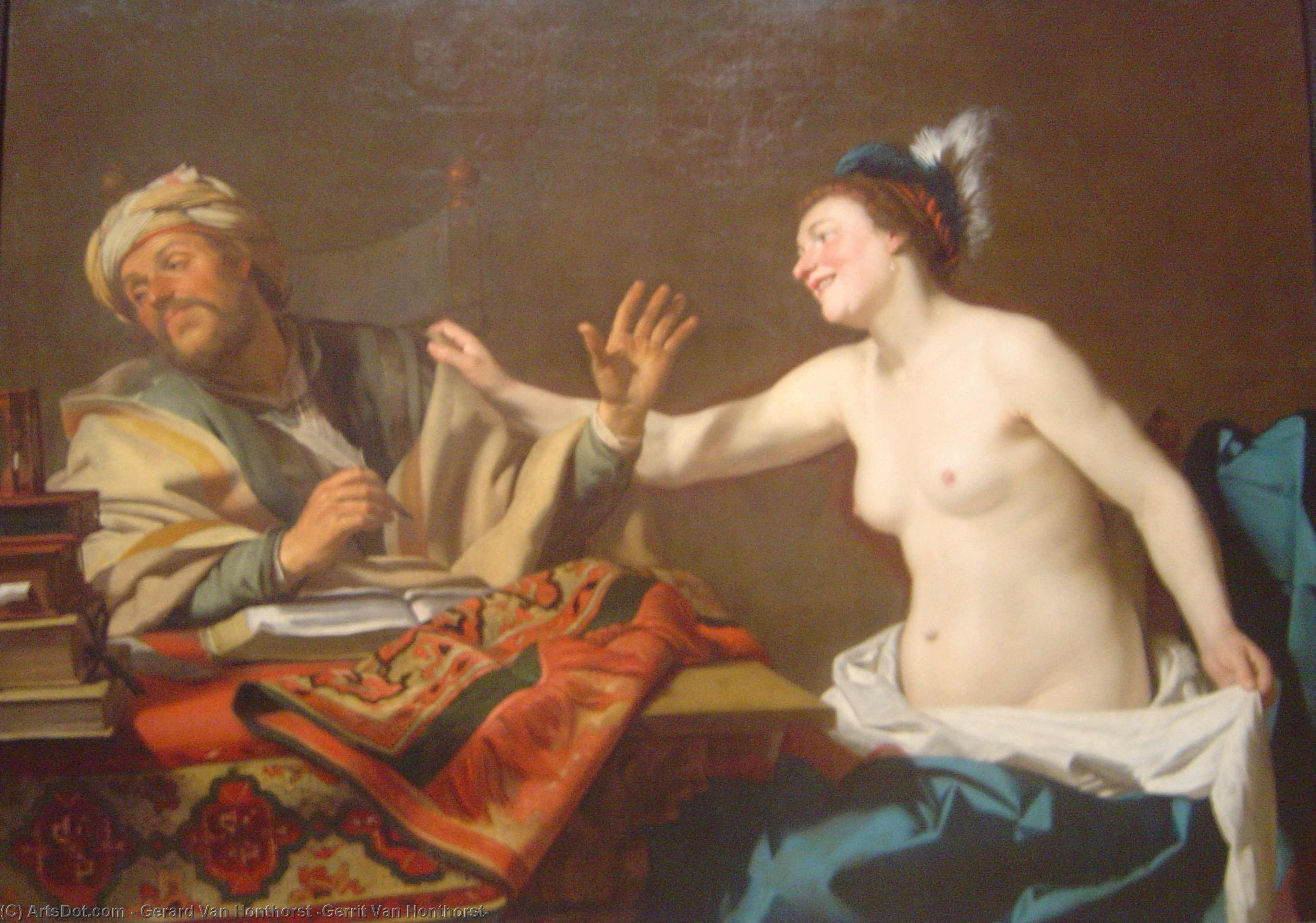
Gerard van Honthorst’s “The Steadfast Philosopher” is not merely a portrait; it’s an immersion into the heart of 17th-century Dutch life, rendered with a dramatic intensity that speaks to the era’s fascination with light and shadow – a hallmark of what became known as ‘Gherardo delle Notti,’ or Gerard of the Nights. This captivating scene depicts a private moment of intellectual exchange between a man and woman, their figures bathed in a carefully orchestrated chiaroscuro that draws the viewer into their intimate world. The painting’s power lies not just in its subject matter – a conversation potentially blossoming into something more – but in Honthorst's masterful manipulation of light to evoke a palpable sense of desire and contemplation.
Honthorst, deeply influenced by Caravaggio’s revolutionary use of tenebrism, employed this technique with precision. Notice how the strong directional light illuminates the man’s turbaned head and beard, drawing immediate attention to his intellectual presence, while simultaneously casting the woman in a softer, more ambiguous glow. This deliberate contrast heightens the scene's dramatic tension and underscores the painting’s sensual undertones. The inclusion of scattered books – open to specific pages – subtly reinforces the theme of knowledge and discourse, suggesting that this is not simply a depiction of physical attraction but also an exchange of ideas.
A Masterclass in Baroque Composition
The composition itself is meticulously constructed, reflecting the prevailing principles of Baroque art. The figures are arranged within a shallow space, creating a sense of immediacy and drawing the viewer into the scene. The table acts as a visual anchor, grounding the composition while simultaneously suggesting a space for interaction and reflection. Honthorst’s use of perspective – subtly employed to create depth – further enhances the illusion of realism, making the figures appear almost tangible. The woman's pose, with her hand resting lightly on the table, invites the viewer into this intimate tableau, fostering a sense of voyeuristic curiosity and admiration for the scene’s quiet drama.
Symbolism and Context: Utrecht Caravaggisti
“The Steadfast Philosopher” is a prime example of Honthorst's work within the Utrecht Caravaggisti school. This group, centered in Utrecht, was profoundly influenced by Caravaggio’s dramatic style, particularly his use of dark backgrounds and intense lighting. Their paintings often depicted scenes of everyday life – brothel scenes, philosophical discussions, and intimate gatherings – imbued with a heightened sense of emotion and realism. The inclusion of the blue cloth covering the woman's breasts is significant; while potentially provocative in its time, it also aligns with Baroque artistic conventions that frequently explored themes of beauty, sensuality, and the human form. The books themselves symbolize knowledge, wisdom, and perhaps even the pursuit of enlightenment – elements central to the philosophical nature of the scene.
Emotional Impact & Reproduction Value
Ultimately, “The Steadfast Philosopher” transcends a simple portrait; it’s an evocative exploration of human connection, intellectual curiosity, and the allure of the unknown. Honthorst's ability to capture such nuanced emotion through light and composition is what makes this painting so enduringly captivating. A hand-painted reproduction of this artwork offers a unique opportunity to bring this Baroque masterpiece into your home or office – a stunning addition that will undoubtedly spark conversation and inspire contemplation, mirroring the original’s profound emotional impact.
Biografía del artista
Primeros años y formación
Gerrit van Honthorst, un destacado pintor del Siglo de Oro neerlandés, nació el 4 de noviembre de 1590 en Utrecht, Países Bajos. Era hijo de un pintor decorativo y inicialmente se formó bajo la tutela de su padre. Posteriormente, continuó su educación artística con Abraham Bloemaert.Carrera e influencias
La carrera temprana de Van Honthorst incluyó una visita a Roma, donde fue fuertemente influenciado por el estilo de Caravaggio. Esta influencia es evidente en sus obras posteriores, particularmente en su uso de escenas iluminadas artificialmente, lo que le valió el apodo de "Gherardo delle Notti" o "Gerard de las noches". Tras su regreso a los Países Bajos, Van Honthorst se convirtió en un retratista líder.Patronazgo y encargos notables
El trabajo de Van Honthorst tuvo una gran demanda, con notables patronos que incluyen a Vincenzo Giustiniani, quien lo encargó para pintar "Cristo ante el sumo sacerdote", ahora alojado en la National Gallery de Londres. También trabajó para Cosimo II de' Medici, Gran Duque de Toscana, y fue un favorito entre la República Neerlandesa y en el extranjero.Legado y vida posterior
En 1620, Van Honthorst regresó a Utrecht, donde construyó una considerable reputación. Para 1623, el año de su matrimonio, se había convertido en presidente del gremio de San Lucas en Utrecht. Su éxito llevó a recomendaciones por parte de Sir Dudley Carleton para el Conde de Arundel y Lord Dorchester.Obras clave y colaboraciones
- "La toma de Cristo", una obra colaborativa inicialmente atribuida a Van Honthorst, ahora reconocida como obra de otro artista.
- "Cristo ante el sumo sacerdote", encargado por Vincenzo Giustiniani, muestra la habilidad de Van Honthorst para capturar escenas iluminadas artificialmente.
- Colaboraciones con otros artistas, como Peter Paul Rubens, demuestran su influencia en el estilo barroco flamenco.
Movimiento artístico y estilo
Van Honthorst formó parte del movimiento de los utrecht caravaggisti, caracterizado por su uso de una iluminación dramática y una profundidad emocional intensa. Su obra refleja la influencia del barroco italiano, al mismo tiempo que contribuye al desarrollo del Siglo de Oro neerlandés.
Gerard van Honthorst
1590 - 1656 , Países Bajos
Datos clave
- Artistas Influenciados:
- Rembrandt van Rijn
- Georges de la Tour
- Artistas Que Influyeron:
- Caravaggio
- Abraham Bloemaert
- Fecha De Nacimiento: 4 de noviembre de 1590
- Lugar De Nacimiento: Utrecht, Países Bajos
- Movimiento Artístico: Caravaggismo Utrechtano
- Nacionalidad: Neerlandés
- Nombre Completo: Gerard van Honthorst
- Obras Notables:
- Cristo ante el sumo sacerdote
- La toma de Cristo
- Escenas nocturnas iluminadas