 Ver en contexto
 Enviar
 Compartir
 Detalles
 Guía
Guía

 Descargar
 Similares
 Radiografía
 Presentación de diapositivas
 Preguntas y respuestas
 Estadísticas
St.Peter Penitent

- 97.0 x 110.0 cm


 Ver más
Giclée / Impresión de arte
Impresiones giclée o en lienzo de calidad de museo con producción rápida y opciones de acabado flexibles. ( Comprar pintura hecha a mano Cambiar a imagen digital)




































Elija entre nuestros tamaños predefinidos que respetan las proporciones originales de la obra.

Introduzca el ancho y el alto que necesite para adaptarse a su marco o pared. Una impresión solo puede recortarse, nunca hacerse más grande que la imagen original, por lo que un tamaño con una forma distinta perderá parte de la obra. Le enviaremos una maqueta digital para su aprobación antes de realizar cualquier impresión. La imagen que se muestra en esta página no refleja el recorte real; solo la maqueta lo hace.
Envío a todo el mundo () en 2 semanas en lugar de las 4/5 semanas estándar. (4 noviembre)

Envío exprés gratuito a todo el mundo

Lienzo de lino de alta calidad

Seguro de envío total

Garantía de reembolso de aranceles aduaneros

Garantía de fidelidad cromática exacta

Política de devolución de 100 días (solo por defectos)

Garantía de devolución del 100% del dinero

Descuento por cantidad
 La opción de vidrio solo está disponible en tamaños inferiores a 110 cm.

St.Peter Penitent
Giclée / Impresión de arte
Dimensiones de la reproducción
-


Precio total final
€ 72
A Study in Shadow and Faith: Gerard van Honthorst’s ‘St. Peter Penitent’
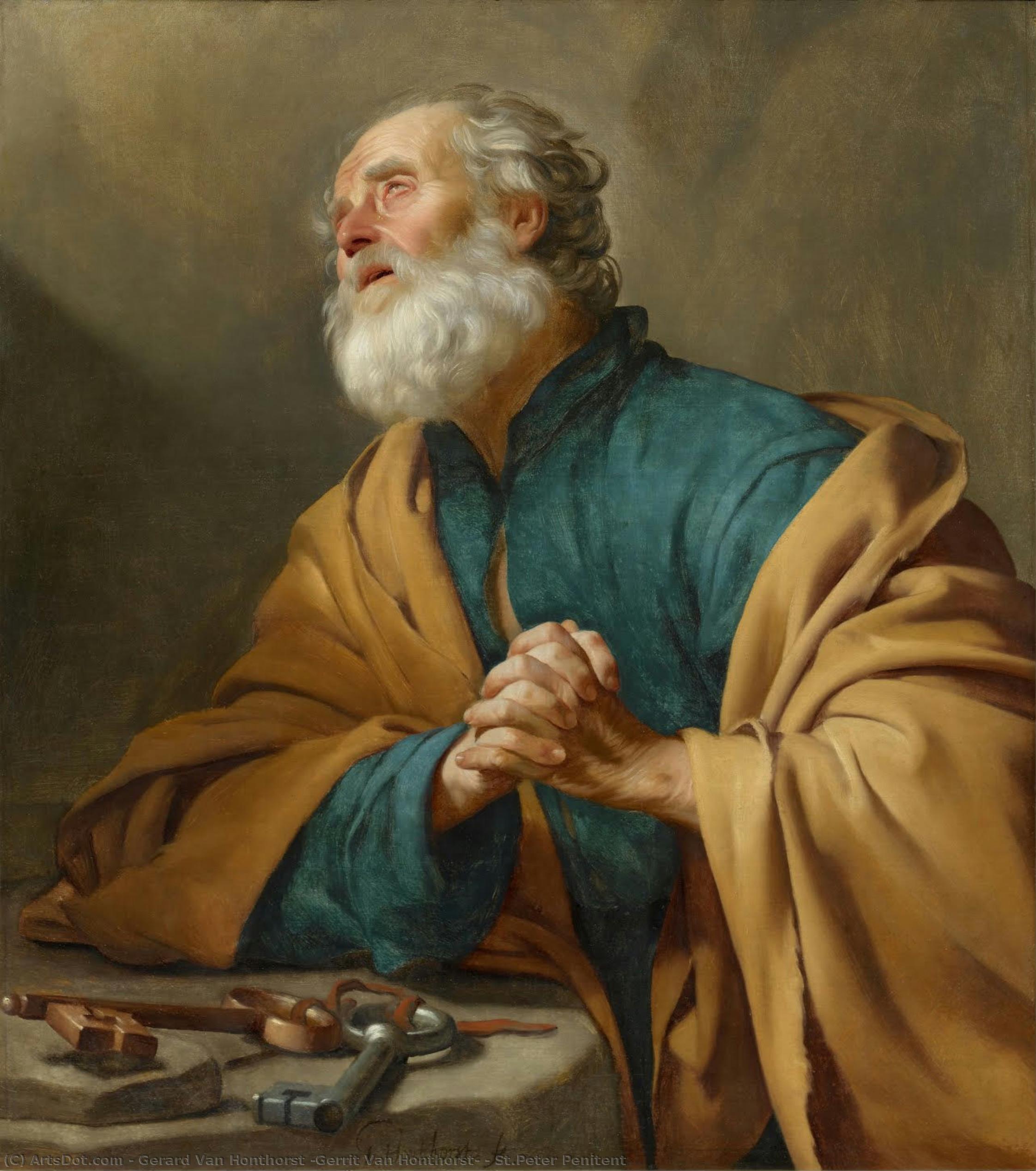
Gerard van Honthorst's “St. Peter Penitent” is more than just a portrait; it’s a profound meditation on faith, repentance, and the dramatic interplay of light and darkness – hallmarks of the artist’s distinctive style forged in the crucible of the Roman Baroque. Painted circa 1618-20, this work offers a rare glimpse into the artistic sensibilities of a master who skillfully blended Caravaggio's revolutionary tenebrism with his own nuanced approach to human emotion.
- The Figure: The central subject is an elderly man, rendered with remarkable realism and sensitivity. His posture – head bowed, hands clasped in prayer – immediately conveys a sense of deep introspection and sorrow. The details of his weathered face, the furrowed brow, and the carefully observed folds of his blue robe speak to a life lived, perhaps one marked by both virtue and regret.
- Caravaggio’s Legacy: Honthorst's debt to Caravaggio is undeniable. Just as Caravaggio used stark contrasts to heighten emotional impact, Honthorst employs dramatic lighting to isolate Peter within a sphere of illumination, drawing the viewer’s eye directly to his face and intensifying the sense of his inner turmoil.
- Technical Mastery: The painting demonstrates a sophisticated understanding of oil paint techniques. Notice the subtle gradations in tone, achieved through meticulous layering and blending, creating a rich texture that adds depth and realism to the figure. The use of impasto – thick application of paint – particularly around the folds of the robe, further enhances the three-dimensional effect.
The Language of Light: Tenebrism and its Impact
Honthorst’s masterful manipulation of light is central to the painting's power. The tenebrist technique, popularized by Caravaggio, isn’t merely a stylistic choice; it’s a deliberate strategy for conveying psychological states. The deep shadows enveloping Peter suggest a hidden world of doubt and remorse, while the single source of illumination – likely from an unseen window – symbolizes divine grace or perhaps the flickering hope of redemption. This contrast creates a palpable tension within the composition, forcing the viewer to confront the complexities of faith and human fallibility.
“The darkness is not merely the absence of light,” Honthorst seems to suggest, “but an active element in the drama of the soul.”Symbolism and Context
Beyond its immediate devotional subject matter, "St. Peter Penitent" resonates with broader symbolic meanings. The tools scattered around the figure – wrenches and screwdrivers – are a striking anomaly, introducing an element of earthly labor and repair into a scene traditionally associated with spiritual contemplation. This juxtaposition could represent the ongoing struggle between faith and worldly concerns, or perhaps the need for constant vigilance against temptation. Painted during a period of intense religious fervor and artistic innovation, the work reflects the broader cultural anxieties and aspirations of its time.
- Historical Context: Honthorst was working in Utrecht during a period of significant artistic change, influenced by the influx of Italian artists and ideas.
- Royal Patronage: The painting’s creation coincided with Honthorst's increasing prominence within European royal circles, including Queen Elizabeth of Bohemia, who commissioned numerous works from him.
A Timeless Masterpiece
"St. Peter Penitent" remains a compelling and emotionally resonant work of art. Its dramatic lighting, meticulous detail, and profound subject matter continue to captivate viewers centuries after its creation. It’s a testament to Gerard van Honthorst's artistic genius – a master of light, shadow, and the human condition.
Preguntas y respuestas
¿Es "St.Peter Penitent" de Gerard van Honthorst una obra de tonos claros u oscuros?
"St.Peter Penitent" presenta un brillo general de shadow y una luminancia de Dark.
¿Existe una ficha informativa sobre "St.Peter Penitent" de Gerard van Honthorst para estudiantes?
Una página de Ficha informativa está disponible para "St.Peter Penitent" de Gerard van Honthorst: una ficha imprimible sobre la obra, diseñada para estudiantes y su uso en el aula.
¿Quién es el artista detrás de "St.Peter Penitent"?
"St.Peter Penitent" fue creada por Gerard van Honthorst. La información en esta página describe la obra original de Gerard van Honthorst.
Biografía del artista
Primeros años y formación
Gerrit van Honthorst, un destacado pintor del Siglo de Oro neerlandés, nació el 4 de noviembre de 1590 en Utrecht, Países Bajos. Era hijo de un pintor decorativo y inicialmente se formó bajo la tutela de su padre. Posteriormente, continuó su educación artística con Abraham Bloemaert.Carrera e influencias
La carrera temprana de Van Honthorst incluyó una visita a Roma, donde fue fuertemente influenciado por el estilo de Caravaggio. Esta influencia es evidente en sus obras posteriores, particularmente en su uso de escenas iluminadas artificialmente, lo que le valió el apodo de "Gherardo delle Notti" o "Gerard de las noches". Tras su regreso a los Países Bajos, Van Honthorst se convirtió en un retratista líder.Patronazgo y encargos notables
El trabajo de Van Honthorst tuvo una gran demanda, con notables patronos que incluyen a Vincenzo Giustiniani, quien lo encargó para pintar "Cristo ante el sumo sacerdote", ahora alojado en la National Gallery de Londres. También trabajó para Cosimo II de' Medici, Gran Duque de Toscana, y fue un favorito entre la República Neerlandesa y en el extranjero.Legado y vida posterior
En 1620, Van Honthorst regresó a Utrecht, donde construyó una considerable reputación. Para 1623, el año de su matrimonio, se había convertido en presidente del gremio de San Lucas en Utrecht. Su éxito llevó a recomendaciones por parte de Sir Dudley Carleton para el Conde de Arundel y Lord Dorchester.Obras clave y colaboraciones
- "La toma de Cristo", una obra colaborativa inicialmente atribuida a Van Honthorst, ahora reconocida como obra de otro artista.
- "Cristo ante el sumo sacerdote", encargado por Vincenzo Giustiniani, muestra la habilidad de Van Honthorst para capturar escenas iluminadas artificialmente.
- Colaboraciones con otros artistas, como Peter Paul Rubens, demuestran su influencia en el estilo barroco flamenco.
Movimiento artístico y estilo
Van Honthorst formó parte del movimiento de los utrecht caravaggisti, caracterizado por su uso de una iluminación dramática y una profundidad emocional intensa. Su obra refleja la influencia del barroco italiano, al mismo tiempo que contribuye al desarrollo del Siglo de Oro neerlandés.
Gerard van Honthorst
1590 - 1656 , Países Bajos
Datos clave
- Artistas Influenciados:
- Rembrandt van Rijn
- Georges de la Tour
- Artistas Que Influyeron:
- Caravaggio
- Abraham Bloemaert
- Fecha De Nacimiento: 4 de noviembre de 1590
- Lugar De Nacimiento: Utrecht, Países Bajos
- Movimiento Artístico: Caravaggismo Utrechtano
- Nacionalidad: Neerlandés
- Nombre Completo: Gerard van Honthorst
- Obras Notables:
- Cristo ante el sumo sacerdote
- La toma de Cristo
- Escenas nocturnas iluminadas
Artículos relacionados
Gerard van Honthorst: Illuminating the Dutch Golden Age with Caravaggism & Courtly Grace
Explore the captivating world of Gerard van Honthorst, a Dutch Golden Age master renowned for his dramatic chiaroscuro & courtly portraits. Discover his life, art, and lasting influence on Baroque painting.

Los 10 Maestros del Primitivo Flamenco: Obras que Definen un Arte Inigualable | OriginalUniqueArt
Descubre los 10 imprescindibles del Primitivo Flamenco: Jan van Eyck, Robert Campin y más. Explora la historia, simbolismo y técnica de estas obras maestras renacentistas tempranas. Encuentra reproducciones de arte de museo en OriginalUniqueArt.com.

Luz y Sombra: Las 25 Mejores Obras Maestras de Rembrandt van Rijn
Explora las 25 obras maestras de Rembrandt y su claroscuro. Encuentra reproducciones de museo en OriginalUniqueArt.com.

Renacimiento Flamenco Temprano: 10 Obras Maestras que Cambiaron la Historia del Arte | OriginalUniqueArt
Descubre las 10 obras maestras del Renacimiento Flamenco Temprano. Explora la historia de Jan van Eyck, Robert Campin y más. Reproducciones de arte en OriginalUniqueArt.com para decorar tu hogar con belleza y elegancia. ¡Explora la colección online!

Las 25 obras maestras imprescindibles de la National Gallery de Londres
Explora 25 joyas de la National Gallery, desde Van Gogh hasta Caravaggio. ¡Descubre estas obras maestras en OriginalUniqueArt.com!