Ver en contexto
 Enviar
 Compartir
 Detalles

 Descargar
 Similares
 Radiografía
 Presentación de diapositivas
Merry Company


 Ver más
Giclée / Impresión de arte
Impresiones giclée o en lienzo de calidad de museo con producción rápida y opciones de acabado flexibles. ( Comprar pintura hecha a mano Comprar imagen)




P118B $10

P118H $10

P118W $10

P438Z $10

P508JH $12

P508YH $12

P805H $10

P805Z $10

P919BZ $10

P919G $10

P919XJ $10

P959ZH $10

P968JZ $12

W106C $8

W218G $10

W218JH $8

W218Y $10

W307PJ $10

W316G $10

W316PJ $8

W316Y $10

W398PJ $8

W4111J $10

W500HY $15

W500JH $15

W692G $12

W849H $8

W940BG $15

W953PJ $8




Elija entre nuestros tamaños predefinidos que respetan las proporciones originales de la obra.

Puede introducir sus propias dimensiones para adaptarse a un marco o espacio específico. Si el tamaño seleccionado no coincide con las proporciones de la imagen original, recortaremos la obra de arte o extenderemos la imagen con un borde con efecto espejo o de color sólido. Se enviará una maqueta digital para su aprobación antes de que comience la producción.
Tenga en cuenta que la vista previa en pantalla no refleja el recorte o la extensión real. Solo la maqueta mostrará con precisión la composición final.
Aunque existen tamaños personalizados, recomendamos seleccionar una dimensión de la lista predefinida para preservar las proporciones originales.
Envío a todo el mundo () en 2 semanas en lugar de las 4/5 semanas estándar. (5 septiembre)

Envío exprés gratuito a todo el mundo

Lienzo de lino de alta calidad

Seguro de envío total

Garantía de reembolso de impuestos aduaneros

Garantía de fidelidad cromática exacta

Política de devolución de 60 días (solo por defectos)

Garantía de devolución del 100% del dinero

Descuento por cantidad
 La opción de vidrio solo está disponible en tamaños inferiores a 110 cm.

Merry Company
Giclée / Impresión de arte
Dimensiones de la reproducción
-


Precio total final
$ 80
A Dance in Shadow: The Luminous Drama of Honthorst’s Merry Company
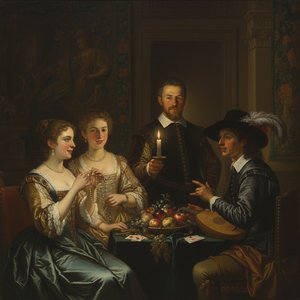
In the quiet, amber-hued corners of the Dutch Golden Age, few works capture the pulse of human connection as viscerally as Gerard van Honthorst’s “Merry Company.” Completed in 1622, this masterpiece is far more than a mere snapshot of a tavern gathering; it is a carefully orchestrated tableau of light, social intimacy, and the subtle, flickering drama inherent in life's fleeting moments. As one gazes upon the canvas, the viewer is immediately pulled into a world where the boundaries between celebration and melancholy blur, held together by the artist’s unparalleled command over chiaroscuro.
The scene unfolds within a richly appointed space, perhaps a well-established tavern, where a group of figures is gathered around a table laden with the remnants of a feast. Wine goblets catch the light, and platters of delicacies sit amidst the conversation, suggesting a recent bout of revelry. At the heart of this composition lies a profound tension; while the title suggests merriment, there is an underlying sense of urgency and perhaps even a touch of sorrow. The figures—an elderly woman, a bearded man, and younger companions—are caught in a moment of intense emotional exchange, their faces illuminated by a theatrical, directional light that seems to emerge from an unseen source, casting deep, velvety shadows that swallow the periphery of the room.
The Mastery of the Night: Technique and Tenebrism
To understand the brilliance of “Merry Company,” one must recognize the influence of the Italian master Caravaggio upon Honthorst. During his formative years in Rome, Honthorst embraced tenebrism, a technique characterized by the bold juxtaposition of intense light against impenetrable darkness. This earned him the evocative nickname “Gherardo delle Notti”—Gerard of the Nights. In this painting, the technique is used not merely for aesthetic flair but to sculpt the very air around the subjects. The light does not simply illuminate; it carves forms out of the gloom, creating a palpable sense of three-dimensional space through masterful foreshortening and delicate glazing.
The artist’s meticulous attention to texture invites a tactile experience for the viewer. One can almost feel the weight of the heavy drapery, the cool smoothness of the pewter goblets, and the warmth of the skin under the candlelight. Through painstaking brushwork, Honthorst achieves a level of realism that transcends mere representation, turning a genre scene into a psychological study. The pyramidal structure of the composition, with figures positioned to draw the eye upward and inward, ensures that the viewer’s gaze wanders through the layers of light and shadow, discovering new details in every corner of this nocturnal feast.
A Timeless Inspiration for the Modern Collector
For the discerning collector or interior designer, a reproduction of “Merry Company” offers much more than a decorative element; it provides a focal point of profound character. The painting’s ability to command attention through its dramatic contrasts makes it an ideal centerpiece for spaces that value depth, history, and atmosphere. Whether placed in a contemporary gallery-style room or a classic study, the work brings with it an aura of sophisticated mystery and the enduring elegance of the Baroque era.
Owning a piece that echoes Honthorst’s vision is an invitation to contemplate the beauty found in the shadows. It serves as a reminder of the Dutch Golden Age's fascination with capturing the ephemeral—the way light hits a glass, the way a face falls into thought, and the way a shared moment can feel both monumental and fleeting. This artwork is not just a window into the 17th century; it is a timeless exploration of the human spirit, rendered in the most magnificent light.
Biografía del artista
Primeros años y formación
Gerrit van Honthorst, un destacado pintor del Siglo de Oro neerlandés, nació el 4 de noviembre de 1590 en Utrecht, Países Bajos. Era hijo de un pintor decorativo y inicialmente se formó bajo la tutela de su padre. Posteriormente, continuó su educación artística con Abraham Bloemaert.Carrera e influencias
La carrera temprana de Van Honthorst incluyó una visita a Roma, donde fue fuertemente influenciado por el estilo de Caravaggio. Esta influencia es evidente en sus obras posteriores, particularmente en su uso de escenas iluminadas artificialmente, lo que le valió el apodo de "Gherardo delle Notti" o "Gerard de las noches". Tras su regreso a los Países Bajos, Van Honthorst se convirtió en un retratista líder.Patronazgo y encargos notables
El trabajo de Van Honthorst tuvo una gran demanda, con notables patronos que incluyen a Vincenzo Giustiniani, quien lo encargó para pintar "Cristo ante el sumo sacerdote", ahora alojado en la National Gallery de Londres. También trabajó para Cosimo II de' Medici, Gran Duque de Toscana, y fue un favorito entre la República Neerlandesa y en el extranjero.Legado y vida posterior
En 1620, Van Honthorst regresó a Utrecht, donde construyó una considerable reputación. Para 1623, el año de su matrimonio, se había convertido en presidente del gremio de San Lucas en Utrecht. Su éxito llevó a recomendaciones por parte de Sir Dudley Carleton para el Conde de Arundel y Lord Dorchester.Obras clave y colaboraciones
- "La toma de Cristo", una obra colaborativa inicialmente atribuida a Van Honthorst, ahora reconocida como obra de otro artista.
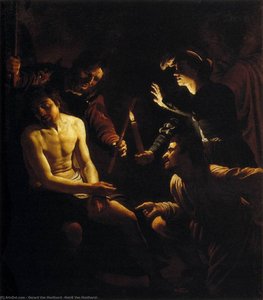
- "Cristo ante el sumo sacerdote", encargado por Vincenzo Giustiniani, muestra la habilidad de Van Honthorst para capturar escenas iluminadas artificialmente.
- Colaboraciones con otros artistas, como Peter Paul Rubens, demuestran su influencia en el estilo barroco flamenco.
Movimiento artístico y estilo
Van Honthorst formó parte del movimiento de los utrecht caravaggisti, caracterizado por su uso de una iluminación dramática y una profundidad emocional intensa. Su obra refleja la influencia del barroco italiano, al mismo tiempo que contribuye al desarrollo del Siglo de Oro neerlandés.
Gerard van Honthorst
1590 - 1656 , Países Bajos
Datos clave
- Artistas Influenciados:
- Rembrandt van Rijn
- Georges de la Tour
- Artistas Que Influyeron:
- Caravaggio
- Abraham Bloemaert
- Fecha De Nacimiento: 4 de noviembre de 1590
- Lugar De Nacimiento: Utrecht, Países Bajos
- Movimiento Artístico: Caravaggismo Utrechtano
- Nacionalidad: Neerlandés
- Nombre Completo: Gerard van Honthorst
- Obras Notables:
- Cristo ante el sumo sacerdote
- La toma de Cristo
- Escenas nocturnas iluminadas
Artículos relacionados

Reflejos de una Época Dorada: La Pintura Barroca Holandesa y la Innovación Cultural
Descubra la riqueza y el detalle de la pintura barroca holandesa del Siglo de Oro. Explore las obras maestras de Rembrandt, Vermeer y otros artistas clave. Análisis experto e historia cultural.

Los 10 Maestros del Siglo de Oro Holandés: Arte, Historia y Decoración Exclusiva
Descubre los 10 imprescindibles del Siglo de Oro Holandés: Rembrandt, Vermeer y más. Explora la historia, técnica y belleza de estos lienzos clásicos. Encuentra reproducciones de arte exclusivas para decorar tu hogar en .
Gerard van Honthorst: Illuminating the Dutch Golden Age with Caravaggism & Courtly Grace
Explore the captivating world of Gerard van Honthorst, a Dutch Golden Age master renowned for his dramatic chiaroscuro & courtly portraits. Discover his life, art, and lasting influence on Baroque painting.

Los 10 Maestros del Barroco Holandés: Obras que Definen una Época | OriginalUniqueArt
Descubre los 10 imprescindibles del Barroco holandés: Rembrandt, Vermeer y más. Explora la historia, técnica y belleza de estas obras maestras. Reproducciones de arte en OriginalUniqueArt.com para decorar tu hogar con elegancia.

Golden Light & Dutch Skies: The Timeless Magic of Dutch Golden Age Landscapes
Discover the breathtaking beauty of Dutch Golden Age landscapes. Explore the mastery of light, chiaroscuro, and 17th-century realism through an expert art history lens, celebrating the enduring legacy of the Dutch Masters for discerning collectors and art lovers.