Vista previa
 Compartir
 Compartir
 Ver detalles
 Guía
Guía

 Descargar
 Ver artículos similares
 Radiografía
 Presentación de diapositivas
 Estadísticas
Merry Company
 Acrylic On Canvas
- WallArt
- Baroque Painting
 1623
1623 125.0 x 157.0 cm
 Staatsgalerie
 Leer más
Giclée / Impresión de arte
Impresiones giclée o en lienzo de calidad de museo con producción rápida y opciones de acabado flexibles. ( Encargar reproducción pintada a mano Ver versión en imagen digital)




P118B €10

P118H €10

P118W €10

P438Z €10

P508JH €12

P508YH €12

P805H €10

P805Z €10

P919BZ €10

P919G €10

P919XJ €10

P959ZH €10

P968JZ €12

W106C €8

W218G €10

W218JH €8

W218Y €10

W307PJ €10

W316G €10

W316PJ €8

W316Y €10

W398PJ €8

W4111J €10

W500HY €15

W500JH €15

W692G €12

W849H €8

W940BG €15

W953PJ €8




Elija entre nuestros tamaños predefinidos que respetan las proporciones originales de la obra.

Puede introducir sus propias dimensiones para adaptarse a un marco o espacio específico. Si el tamaño seleccionado no coincide con las proporciones de la imagen original, recortaremos la obra de arte o extenderemos la imagen con un borde con efecto espejo o de color sólido. Se enviará una maqueta digital para su aprobación antes de que comience la producción.
Tenga en cuenta que la vista previa en pantalla no refleja el recorte o la extensión real. Solo la maqueta mostrará con precisión la composición final.
Aunque existen tamaños personalizados, recomendamos seleccionar una dimensión de la lista predefinida para preservar las proporciones originales.
Envío a todo el mundo () en 2 semanas en lugar de las 4/5 semanas estándar. (12 octubre)

Envío exprés gratuito a todo el mundo

Lienzo de lino de alta calidad

Seguro de envío completo

Garantía de reembolso de impuestos aduaneros

Garantía de fidelidad cromática exacta

Política de devolución de 100 días (solo por defectos)

Garantía de devolución del 100% del dinero

Oferta por volumen
 La opción de vidrio solo está disponible en tamaños inferiores a 110 cm.

Merry Company
Giclée / Impresión de arte
Tamaño de la reproducción
-


Precio total
€ 69
A Dance in Shadow: Gerard van Honthorst’s “Merry Company”
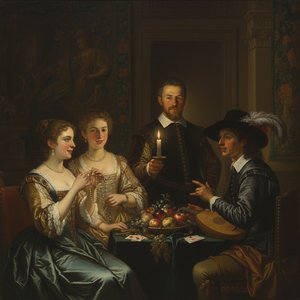
Gerard van Honthorst's "Merry Company," painted in 1623, isn’t merely a depiction of a tavern scene; it’s a carefully orchestrated tableau of light, social interaction, and the subtle drama inherent in human connection. This remarkable work, now residing within the Alte Pinakothek in Munich, offers a captivating glimpse into the vibrant heart of the Dutch Golden Age – a period defined by burgeoning wealth, artistic innovation, and a fascination with capturing the nuances of everyday life.
The painting immediately draws the eye with its masterful use of chiaroscuro, a technique borrowed directly from Caravaggio and central to Honthorst’s signature style. Deep shadows engulf much of the composition, creating an atmosphere of intimacy and drawing attention to the illuminated figures clustered around a table laden with goblets, wine glasses, and platters of food. This dramatic interplay of light and dark isn't simply aesthetic; it serves to heighten the sense of drama and immediacy, as if we are witnessing a fleeting moment frozen in time.
The Setting: A Tavern’s Embrace
The scene unfolds within what appears to be a richly appointed tavern – though the specific location remains somewhat elusive. The details suggest a comfortable, well-established establishment, likely frequented by merchants and members of the local elite. Notice the carefully rendered furniture, the warm glow emanating from unseen candles, and the abundance of drinkware. The composition is deliberately crowded, reflecting the lively atmosphere of a social gathering. Several figures are seated, engaged in conversation or perhaps enjoying music – though the instruments themselves aren’t explicitly visible, their presence is strongly implied.
A key element to note is the inclusion of several women amongst the men. This was relatively uncommon in Dutch genre paintings of this era, and suggests a deliberate attempt by Honthorst to portray a more balanced and inclusive representation of social life. The women are not merely decorative; they actively participate in the conversation and revelry, contributing to the overall sense of merriment.
A Caravaggistic Influence: Light and Emotion
Honthorst’s debt to Caravaggio is undeniable. Like his Italian predecessor, he understood the power of light to shape perception and evoke emotion. The strong directional lighting casts dramatic shadows that sculpt the figures' faces and bodies, emphasizing their expressions and gestures. The use of a single, unseen light source creates a sense of immediacy and realism, as if we are present at this lively gathering ourselves.
Furthermore, Honthorst’s attention to detail is remarkable. From the folds of the clothing to the textures of the furniture, every element contributes to the overall sense of authenticity. The figures themselves are rendered with a subtle psychological depth – their expressions ranging from jovial amusement to quiet contemplation. This level of realism was highly valued by Dutch artists during this period and reflects Honthorst’s skill as a portraitist.
Symbolism and Social Commentary
Beyond its immediate visual appeal, “Merry Company” offers subtle insights into the social dynamics of 17th-century Holland. The painting can be interpreted as a celebration of prosperity and leisure – hallmarks of the Dutch Golden Age. However, it also subtly hints at the potential pitfalls of excess and indulgence. The abundance of drink and merriment serves as a reminder of the importance of moderation and self-control.
The inclusion of figures like the older woman holding a candle is particularly intriguing. Her presence suggests a contemplation on time, beauty, and mortality – themes that were frequently explored in Dutch art during this period. The flickering candlelight symbolizes both love and vanity, highlighting the transient nature of earthly pleasures. “Merry Company” isn’t simply a depiction of a social gathering; it's a carefully constructed meditation on life, death, and the human condition.
A Timeless Masterpiece
Gerard van Honthorst’s “Merry Company” remains a captivating masterpiece – a testament to his artistic skill and his profound understanding of light, emotion, and the complexities of human interaction. Its dramatic chiaroscuro, rich detail, and subtle symbolism continue to resonate with viewers today, offering a glimpse into the vibrant world of 17th-century Holland.
Preguntas y respuestas
¿En qué año se creó "Merry Company" de Gerard van Honthorst?
"Merry Company" data de 1623. La fecha sitúa la obra dentro de la trayectoria de Gerard van Honthorst y de su época.
¿Quién es el autor y en qué año se creó "Merry Company"?
"Merry Company" fue creada por Gerard van Honthorst en 1623.
¿Es "Merry Company" una obra famosa del Baroque Painting?
Dentro del movimiento Baroque Painting, "Merry Company" posee un nivel de popularidad Recognized.
¿Qué representa "Merry Company" de Gerard van Honthorst?
Los temas de "Merry Company" son merry company, dutch golden age, caravaggism, tavern scene, group portrait, chiaroscuro, festive gathering.
¿Es "Merry Company" de Gerard van Honthorst una obra de tonos claros u oscuros?
"Merry Company" de Gerard van Honthorst presenta un nivel de brillo de deep_shadow, con una luminancia de Dark.
¿Qué ubicación se adapta mejor al formato de "Merry Company" de Gerard van Honthorst?
Con su formato Landscape, se sugiere una reproducción de "Merry Company" para un Living Room.
¿Qué espacio se sugiere para "Merry Company" de Gerard van Honthorst?
Una reproducción de "Merry Company" encaja perfectamente en un Living Room.
¿Qué edad tenía Gerard van Honthorst cuando se creó "Merry Company"?
Gerard van Honthorst tenía 33 años cuando creó "Merry Company" en 1623. La edad se calcula a partir del año de nacimiento del artista, 1590.
Biografía del artista
Primeros años y formación
Gerrit van Honthorst, un destacado pintor del Siglo de Oro neerlandés, nació el 4 de noviembre de 1590 en Utrecht, Países Bajos. Era hijo de un pintor decorativo y inicialmente se formó bajo la tutela de su padre. Posteriormente, continuó su educación artística con Abraham Bloemaert.Carrera e influencias
La carrera temprana de Van Honthorst incluyó una visita a Roma, donde fue fuertemente influenciado por el estilo de Caravaggio. Esta influencia es evidente en sus obras posteriores, particularmente en su uso de escenas iluminadas artificialmente, lo que le valió el apodo de "Gherardo delle Notti" o "Gerard de las noches". Tras su regreso a los Países Bajos, Van Honthorst se convirtió en un retratista líder.Patronazgo y encargos notables
El trabajo de Van Honthorst tuvo una gran demanda, con notables patronos que incluyen a Vincenzo Giustiniani, quien lo encargó para pintar "Cristo ante el sumo sacerdote", ahora alojado en la National Gallery de Londres. También trabajó para Cosimo II de' Medici, Gran Duque de Toscana, y fue un favorito entre la República Neerlandesa y en el extranjero.Legado y vida posterior
En 1620, Van Honthorst regresó a Utrecht, donde construyó una considerable reputación. Para 1623, el año de su matrimonio, se había convertido en presidente del gremio de San Lucas en Utrecht. Su éxito llevó a recomendaciones por parte de Sir Dudley Carleton para el Conde de Arundel y Lord Dorchester.Obras clave y colaboraciones
- "La toma de Cristo", una obra colaborativa inicialmente atribuida a Van Honthorst, ahora reconocida como obra de otro artista.
- "Cristo ante el sumo sacerdote", encargado por Vincenzo Giustiniani, muestra la habilidad de Van Honthorst para capturar escenas iluminadas artificialmente.
- Colaboraciones con otros artistas, como Peter Paul Rubens, demuestran su influencia en el estilo barroco flamenco.
Movimiento artístico y estilo
Van Honthorst formó parte del movimiento de los utrecht caravaggisti, caracterizado por su uso de una iluminación dramática y una profundidad emocional intensa. Su obra refleja la influencia del barroco italiano, al mismo tiempo que contribuye al desarrollo del Siglo de Oro neerlandés.
Gerard van Honthorst
1590 - 1656 , Países Bajos
Datos clave
- Artistas Influenciados:
- Rembrandt van Rijn
- Georges de la Tour
- Artistas Que Influyeron:
- Caravaggio
- Abraham Bloemaert
- Fecha De Nacimiento: 4 de noviembre de 1590
- Lugar De Nacimiento: Utrecht, Países Bajos
- Movimiento Artístico: Caravaggismo Utrechtano
- Nacionalidad: Neerlandés
- Nombre Completo: Gerard van Honthorst
- Obras Notables:
- Cristo ante el sumo sacerdote
- La toma de Cristo
- Escenas nocturnas iluminadas
Artículos relacionados

Los 10 Maestros del Barroco Holandés: Obras que Definen una Época | OriginalUniqueArt
Descubre los 10 imprescindibles del Barroco holandés: Rembrandt, Vermeer y más. Explora la historia, técnica y belleza de estas obras maestras. Reproducciones de arte en OriginalUniqueArt.com para decorar tu hogar con elegancia.
Gerard van Honthorst: Illuminating the Dutch Golden Age with Caravaggism & Courtly Grace
Explore the captivating world of Gerard van Honthorst, a Dutch Golden Age master renowned for his dramatic chiaroscuro & courtly portraits. Discover his life, art, and lasting influence on Baroque painting.
Cornelis van Poelenburch: Bridging Mannerism & the Dutch Baroque Landscape
Discover Cornelis van Poelenburch, a pivotal Dutch Baroque landscape painter bridging Mannerism & Italianate styles. Explore his life, key works, and lasting influence on 17th-century art with OriginalUniqueArt.

Rembrandt van Rijn: Las 25 Obras Maestras que Definen un Genio | Arte, Historia y Decoración
Descubre las 25 obras maestras de Rembrandt van Rijn, el genio del barroco holandés. Explora su historia, técnica y simbolismo en retratos icónicos como 'La Ronda Nocturna'. Encuentra reproducciones de arte exclusivas para decorar tu hogar con OriginalUniqueArt.com.

Reflejos de una Época Dorada: La Pintura Barroca Holandesa y la Innovación Cultural
Descubra la riqueza y el detalle de la pintura barroca holandesa del Siglo de Oro. Explore las obras maestras de Rembrandt, Vermeer y otros artistas clave. Análisis experto e historia cultural.