Cambiar a impresiones
 Ver más







































 Para obras de arte o reproducciones que midan más de 105 cm (aproximadamente 41 pulgadas) en cualquiera de sus lados, el marco se enviará como un kit desmontado. Este método garantiza una entrega segura y evita daños durante el transporte.


The Enigmatic Figure of Fra Carnevale and ‘The Crucifixion’
Fra Carnevale remains one of the most stubbornly elusive figures in the history of Quattrocento art, a painter whose legacy is often overshadowed by scarcity and persistent debate. Born around 1420 in Urbino, he entered the Dominican Order, embarking on a life dedicated to both piety and artistic creation – a combination that profoundly shaped his unique approach to painting. While only nine confirmed works definitively bear his name, each piece whispers of an artist deeply influenced by the burgeoning Renaissance spirit, yet simultaneously possessing a distinctly individual vision. ‘The Crucifixion,’ a tempera-on-panel work dating back to approximately 1450-60, housed within the Galleria Nazionale delle Marche in Urbino, serves as a compelling entry point into this fascinating and often perplexing artistic world.
What immediately strikes the viewer is not a conventional depiction of Christ’s suffering, but rather an architectural framework that dominates the composition. The central figure, undeniably Jesus, is framed by a meticulously rendered, almost claustrophobic space – a series of receding planes and geometric forms that seem to press in upon him. This isn't merely background; it’s a deliberate construction, reflecting Carnevale’s deep engagement with architectural principles, an influence heavily documented through his apprenticeship under Filippo Lippi and later, the study of Piero della Francesca. The perspective is subtly skewed, creating a sense of unease and drawing the eye into the depths of the scene, while simultaneously emphasizing the isolation of the central figure.
Technique and Materials: A Study in Tempera
‘The Crucifixion’ exemplifies Carnevale's masterful use of tempera paint on panel. Tempera, a medium combining pigments with egg yolk or other binding agents, offered remarkable durability and color retention – qualities particularly valued by artists working during the Renaissance. Carnevale skillfully layered thin washes of pigment to build up complex textures and gradations of light and shadow, creating an astonishingly realistic effect despite the somewhat flattened appearance characteristic of tempera. The use of gold leaf accents, though subtle, adds a touch of opulence and draws attention to key elements within the composition – notably, the crown of thorns and the folds of Christ’s garment.
The panel itself, likely sourced from a local workshop, provides a sturdy foundation for this intricate work. The surface is prepared with gesso, creating a smooth, receptive layer for the tempera paint. Close examination reveals the artist's meticulous attention to detail, evident in the careful rendering of the textures of the wood and the subtle variations in color within the drapery.
Historical Context: Urbino and Renaissance Innovation
Understanding ‘The Crucifixion’ requires placing it within the context of 15th-century Urbino, a burgeoning center of artistic innovation. The city was experiencing a period of remarkable cultural and economic growth, fueled by the patronage of the Montefeltro family – particularly Federico da Montefeltro, who commissioned numerous works of art to enhance his court’s prestige. Carnevale's work reflects this atmosphere of intellectual curiosity and artistic experimentation, as he engaged with contemporary trends in perspective, architecture, and humanism.
The attribution of ‘The Crucifixion’ to Fra Carnevale has been a subject of scholarly debate for centuries. Initially dismissed by many as a minor artist, recent research – spearheaded by scholars like Giorgio Vasari and Luigi Lanzi – has convincingly established his role as a significant contributor to the artistic landscape of Urbino. His influence on later artists, including Bramante and Raphael, further solidifies his importance within the broader context of Renaissance art.
Symbolism and Emotional Impact
Beyond its technical merits, ‘The Crucifixion’ resonates with profound symbolic weight. The architectural setting serves not merely as a backdrop but as a metaphor for Christ's sacrifice – a structure built to contain and ultimately transcend suffering. The figure of Christ himself is presented with a quiet dignity, devoid of overt emotional display. This restrained portrayal invites contemplation rather than immediate empathy, prompting the viewer to engage in a deeper reflection on the themes of faith, mortality, and redemption.
Despite its somewhat austere appearance, ‘The Crucifixion’ possesses an undeniable power. The carefully constructed space draws the eye inward, creating a sense of intimacy and encouraging a meditative response. It is a work that rewards careful observation and invites repeated viewing – revealing new layers of meaning with each encounter.
Preguntas y respuestas
¿Qué orientación tiene "The Crucifixion" de Fra Carnavale?
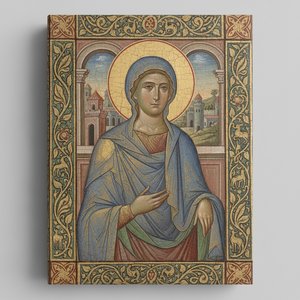
"The Crucifixion" de Fra Carnavale es una composición en Portrait. Se recomienda revisar las proporciones antes de elegir un tamaño de impresión.
¿Qué tono predominante recorre "The Crucifixion" de Fra Carnavale?
"The Crucifixion" se inclina hacia un tono Golden Yellow Range.
¿Qué ambiente aportaría "The Crucifixion" a un espacio?
Con su atmósfera Calm, se sugiere "The Crucifixion" para Living Room.
 Ver en contexto
 Enviar
 Compartir
 Detalles
 Guía
Guía

 Descargar
 Similares
 Radiografía
 Presentación de diapositivas
 Preguntas y respuestas
 Estadísticas