Ver en contexto
 Enviar
 Compartir
 Detalles
 Guía
Guía

 Descargar
 Similares
 Radiografía
 Presentación de diapositivas
 Estadísticas
Millie Smith
 Oil
Oil- WallArt
- Pre-Raphaelite Movement
 1846
1846- 19th Century
 23.0 x 18.0 cm
 Galería de Arte Walker
 Ver más
Giclée / Impresión de arte
Impresiones giclée o en lienzo de calidad de museo con producción rápida y opciones de acabado flexibles. ( Comprar pintura hecha a mano Cambiar a imagen digital)




P118B €10

P118H €10

P118W €10

P438Z €10

P508JH €12

P508YH €12

P805H €10

P805Z €10

P919BZ €10

P919G €10

P919XJ €10

P959ZH €10

P968JZ €12

W106C €8

W218G €10

W218JH €8

W218Y €10

W307PJ €10

W316G €10

W316PJ €8

W316Y €10

W398PJ €8

W4111J €10

W500HY €15

W500JH €15

W692G €12

W849H €8

W940BG €15

W953PJ €8




Elija entre nuestros tamaños predefinidos que respetan las proporciones originales de la obra.

Introduzca el ancho y el alto que necesite para adaptarse a su marco o pared. Una impresión solo puede recortarse, nunca hacerse más grande que la imagen original, por lo que un tamaño con una forma distinta perderá parte de la obra. Le enviaremos una maqueta digital para su aprobación antes de realizar cualquier impresión. La imagen que se muestra en esta página no refleja el recorte real; solo la maqueta lo hace.
Envío a todo el mundo () en 2 semanas en lugar de las 4/5 semanas estándar. (28 octubre)

Envío exprés gratuito a todo el mundo

Lienzo de lino de alta calidad

Seguro de envío total

Garantía de reembolso de aranceles aduaneros

Garantía de fidelidad cromática exacta

Política de devolución de 100 días (solo por defectos)

Garantía de devolución del 100% del dinero

Descuento por cantidad
 La opción de vidrio solo está disponible en tamaños inferiores a 110 cm.

Millie Smith
Giclée / Impresión de arte
Dimensiones de la reproducción
-


Precio total final
€ 70
A Glimpse of Innocence: The Soul of Millie Smith
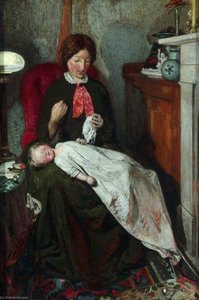
In the quiet, evocative depths of Ford Madox Brown’s 1846 masterpiece, “Millie Smith,” we encounter more than a mere portrait; we step into a profound moment of Victorian psychological realism. This painting captures the likeness of a young girl, the daughter of a local landlady, during Brown's stay in Southend-on-Sea. At first glance, the viewer is met with the striking, direct gaze of a child—a gaze that possesses an unsettling intimacy, as if she is peering directly into the soul of the observer. This confrontation breaks the traditional boundaries of 19th-century portraiture, moving away from the stiff, idealized poses of the era toward a raw, unvarnished naturalism that would become a hallmark of the burgeoning Pre-Raphaelite spirit.
The composition is anchored by a sense of grounded reality. Seated at a simple table, Millie is framed against the rugged texture of a brick wall, a detail that strips away any aristocratic pretension and places her firmly within the everyday world. A single red flower tucked into her hair serves as a poignant focal point, a small burst of vitality amidst a more somber environment. This subtle use of color, paired with the meticulous rendering of her white dress and the delicate skin tones, demonstrates Brown's extraordinary ability to find extraordinary beauty in the mundane.
Technique and the Pre-Raphaelite Vision
To observe “Millie Smith” is to witness a revolutionary departure from the academic conventions of the mid-19th century. While many of his contemporaries sought refuge in the luminous, soft glazes of the Renaissance masters to create an ethereal glow, Brown took a different path. He embraced a darker, more earth-bound palette dominated by rich browns, ochres, and muted tones. This choice was intentional; it mirrored the grit and truth of Victorian life, eschewing superficial prettiness for a deeper, more tactile reality.
His technique is characterized by an almost scientific precision. Every element—from the weave of the tablecloth to the subtle shadows cast by the flower vase—is rendered with a clarity that demands close inspection. This meticulous attention to detail was not merely a display of skill but a philosophical statement. By avoiding excessive shading and prioritizing sharp, direct light, Brown achieved a graphic intensity that makes the scene feel immediate and alive. For the collector or interior designer, this level of detail ensures that a reproduction of this work remains a captivating centerpiece, offering new discoveries with every viewing.
A Legacy of Emotional Resonance
Beyond its technical brilliance, “Millie Smith” carries an emotional weight that transcends time. The painting was created during a period of intense social anxiety and strict moral codes in Britain, yet Brown’s subject offers a sense of vulnerability and pure, unadulterated innocence. There is a haunting quality to the way Millie looks at us—a mixture of curiosity and a quiet, knowing stillness. This emotional depth makes the piece an ideal acquisition for those looking to add character and narrative weight to a curated space.
Whether placed in a sunlit gallery or a sophisticated study, a high-quality hand-painted reproduction of this work serves as a window into the heart of the Pre-Raphaelite movement. It is a piece that invites conversation, prompting viewers to reflect on the intersection of childhood innocence and the heavy realities of the world. For the discerning art lover, owning such a work is not just about decorating a wall; it is about preserving a moment of profound human connection captured forever in oil.
Preguntas y respuestas
¿Quién creó "Millie Smith" y en qué año?
"Millie Smith" es una obra de Ford Madox Brown, realizada en 1846.
¿Cómo se puede integrar "Millie Smith" de Ford Madox Brown en la decoración del hogar?
Se sugiere "Millie Smith" para Accent, y el espacio recomendado es un Living Room.
¿Qué color predomina en la composición de "Millie Smith" de Ford Madox Brown?
El color dominante de "Millie Smith" de Ford Madox Brown es Espresso (#353025).
Biografía del artista
Primeros años y carrera
Ford Madox Brown, pintor británico, nació el 16 de abril de 1821 en Calais, Francia. Su infancia estuvo marcada por frecuentes mudanzas entre alojamientos en Pas-de-Calais y familiares en Kent, lo que limitó sus oportunidades educativas. Sin embargo, demostró talento artístico desde temprana edad, especialmente al copiar grabados de maestros antiguos.Estilo Artístico y Obras Notables
Las pinturas de Brown se caracterizan por sus colores vivos y su realismo, a menudo representando temas históricos y morales. Su obra más destacada es posiblemente Work (1852-1865), una pintura que muestra su estilo distintivamente gráfico y hogarthiano. Los murales de Manchester, una serie de doce obras pintadas para el Ayuntamiento de Manchester, son otro ejemplo notable del arte de Brown. Estos murales representan la historia mancuniana y se consideran algunos de los mejores ejemplos del arte prerrafaelita.- Destacan también sus contribuciones al diseño de vidrieras y muebles para la compañía de artes decorativas de William Morris.
Influencia y Legado
Brown fue un asesor y amigo de los miembros de la Hermandad Prerrafaelita, un grupo que influyó con su estilo artístico. Su trabajo ha sido ampliamente reconocido, y se le considera uno de los pioneros del arte prerrafaelita.- La obra de Thomas Benjamin Kennington, The Pinch of Poverty, muestra la influencia del estilo de Brown en otros artistas.
- El propio trabajo de Brown, como The Last of England, demuestra su capacidad para capturar la esencia de los temas históricos y morales.
Vida Personal y Años Posteriores
Brown se casó dos veces: primero con Elizabeth Bromley en 1841, quien falleció en 1846, y luego con Emily Hill en 1853, quien también murió en 1890. Tuvo cinco hijos, incluyendo a Lucy Madox Brown y Catherine Madox Brown. Su hijo Oliver Madox Brown (1855–1874) mostró grandes dotes como pintor y poeta, pero murió prematuramente. Su nieto fue el famoso novelista Ford Madox Ford.Desarrollo Artístico y Evolución
Brown experimentó una notable evolución en su estilo a lo largo de su carrera. Inicialmente influenciado por las tragedias personales y los problemas sociales de la época, sus primeras obras se caracterizaban por tonos sombríos y colores apagados. Un punto crucial fue su viaje a Roma en 1845-1846, donde conoció a los nazarenos y estudió la pintura italiana, lo que le permitió ampliar su paleta y adoptar un enfoque más realista y vibrante. Su amistad con Dante Gabriel Rossetti y su posterior asociación con William Morris también fueron fundamentales para su desarrollo artístico, llevándolo a explorar nuevas técnicas y temas en el diseño de vidrieras y muebles.
Ford Madox Brown
1821 - 1893 , Francia
Datos clave
- Artistas Que Influyeron:
- Hans Holbein
- Thomas Carlyle
- Fecha De Muerte: 6 de octubre de 1893
- Fecha De Nacimiento: 16 de abril de 1821
- Influencia En Artistas: ['Pre-Rafaelitas']
- Lugar De Nacimiento: Calais, Francia
- Movimiento Artístico: Prerrafaelismo
- Nacionalidad: Británico
- Nombre Completo: Ford Madox Brown
- Obras Notables:
- Work (1852-1865)
- Los murales de Manchester
- El último de Inglaterra
Artículos relacionados

Sir John Everett Millais: Pre-Raphaelite Rebellion & Victorian Narrative Detail
Explore the revolutionary art of Sir John Everett Millais & the Pre-Raphaelite Brotherhood. Discover their radical realism, symbolic narratives, and lasting impact on Victorian aesthetics. A deep dive into 19th-century masterpieces.
Ford Madox Brown: Pre-Raphaelite Visionary & Victorian Social Commentary
Explore the life & art of Ford Madox Brown, a pivotal Pre-Raphaelite painter renowned for his powerful social commentary and masterpiece 'Work'. Discover his lasting influence on British art history.

Dante Gabriel Rossetti: Las 25 Obras Maestras del Prerrafaelismo | OriginalUniqueArt
Descubre las 25 obras maestras de Dante Gabriel Rossetti, el máximo exponente del Prerrafaelismo. Explora su simbolismo, retratos victorianos y la belleza femenina en lienzos inolvidables. Reproducciones de arte exclusivas en OriginalUniqueArt.com.
The Pre-Raphaelite Brotherhood: Reclaiming Beauty, Nature, and Truth in Victorian Art History
Explore the revolutionary Pre-Raphaelite Brotherhood. Discover how these visionary artists rejected academic tradition to reclaim beauty, nature, and truth through luminous detail and literary depth in Victorian art history.

Pre-Raphaelite Romanticism: A Guide to Vivid Detail and Medieval Beauty in Victorian Art
Explore the vivid detail and medieval beauty of Pre-Raphaelite Romanticism. Discover the history of masters like Rossetti and Millais through our expert guide to Victorian art, perfect for collectors and professionals seeking authentic, museum-quality reproductions.