
 Ver en contexto
 Enviar
 Compartir
 Detalles

 Descargar
 Similares
 Radiografía
 Presentación de diapositivas
 Estadísticas
Stalingrad


 Ver más
Reproducción al óleo hecha a mano
Óleo sobre lienzo pintado a mano en el tamaño y marco de su elección, realizado por encargo por nuestros artistas. ( Cambiar a Impresión Cambiar a imagen digital)




P118B $10

P118H $10

P118W $10

P438Z $10

P508JH $12

P508YH $12

P805H $10

P805Z $10

P919BZ $10

P919G $10

P919XJ $10

P959ZH $10

P968JZ $12

W106C $8

W218G $10

W218JH $8

W218Y $10

W307PJ $10

W316G $10

W316PJ $8

W316Y $10

W398PJ $8

W4111J $10

W500HY $15

W500JH $15

W692G $12

W849H $8

W940BG $15

W953PJ $8




Elija entre nuestros tamaños predefinidos que respetan las proporciones originales de la obra.

Puede ingresar sus propias dimensiones para adaptarse a un marco o espacio específico. Si el tamaño seleccionado no coincide con las proporciones de la imagen original, recortaremos la obra o extenderemos la pintura con elementos adicionales pintados a mano. Se le enviará una maqueta digital para su aprobación antes de comenzar la producción.
Tenga en cuenta que la vista previa en pantalla no refleja el recorte o la extensión reales. Solo la maqueta mostrará con precisión la composición final.
Si bien existen tamaños personalizados, recomendamos seleccionar una dimensión de la lista predefinida para preservar las proporciones originales.
Tras realizar el pedido, el equipo de OriginalUniqueArt.com enviará un correo electrónico al cliente para solicitar instrucciones y proporcionarle una vista previa del boceto.
Envío a todo el mundo () en 3-4 semanas en lugar de las 5 semanas estándar. (9 septiembre). Sin comprometer la calidad.

Envío exprés gratuito a todo el mundo

Lienzo de lino de alta calidad

Seguro de envío total

Garantía de reembolso de impuestos aduaneros

Garantía de fidelidad cromática exacta

Política de devolución de 100 días (solo por defectos)

Garantía de devolución del 100% del dinero

Descuento por cantidad
 La opción de vidrio solo está disponible en tamaños inferiores a 110 cm.

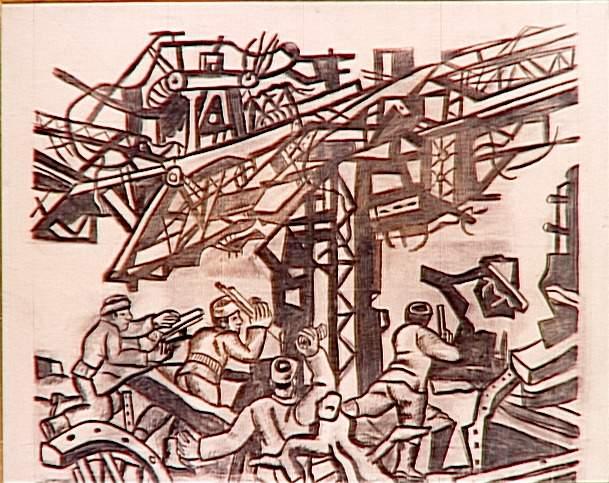
Stalingrad
Técnica de reproducción
Dimensiones de la reproducción
-


Precio total final
$ 300
A Vision of Mechanized Conflict: The Soul of Stalingrad
In the vast landscape of twentieth-century modernism, few works capture the intersection of human tragedy and industrial power as viscerally as Fernand Léger’s Stalingrad. Created in 1954, this masterpiece transcends a mere historical chronicle of one of World War II's most devastating sieges; it serves as a profound meditation on the collision between man and machine. To gaze upon this canvas is to enter a world where the boundaries between organic life and mechanical force blur, creating an experience that is not merely seen through the eyes, but felt within the chest. Léger invites the viewer into a space where the echoes of battle are rendered through a language of pure, unadulterated form.
The artwork stands as a striking embodiment of Naïve Art, a movement that deliberately rejected the polished academic conventions of the past in favor of direct observation and raw emotional honesty. Rather than seeking to replicate the photographic reality of the Soviet battlefield, Léger utilizes a simplified visual vocabulary. He employs bold, decisive lines and flattened planes that strip away the illusion of depth, forcing the viewer to confront the essential geometry of conflict. This technique, heavily influenced by his fascination with industrial aesthetics, transforms the chaos of war into a structured, rhythmic composition of circles, squares, and triangles.
The Rhythm of the Machine Age
Léger’s technical mastery lies in his ability to imbue static shapes with an incredible sense of dynamism. By avoiding traditional shading and the subtle blending of colors, he relies instead on a vibrant palette of primary hues to drive the narrative forward. This lack of chiaroscuro creates a high-contrast environment where every element—from the jagged fragments of destroyed architecture to the silhouettes of advancing vehicles—pops with an urgent, electric energy. The artist’s signature linear style mirrors the relentless, grinding pace of mechanized warfare, where the movement of tanks and the trajectory of artillery become part of a larger, unstoppable mechanical dance.
This aesthetic choice serves a deeper symbolic purpose. In Stalingrad, the machine is not merely a tool of destruction but a central protagonist. Léger explores the complex relationship between humanity and technology, questioning whether the advancements of the industrial age have become inseparable from our capacity for violence. The geometric precision of the vehicles and weaponry contrasts sharply with the desperate human struggle, creating a tension that is both intellectually stimulating and emotionally harrowing. For the collector or designer, this piece offers a sophisticated dialogue between the structured beauty of abstraction and the profound weight of historical memory.
A Legacy of Resilience and Form
To understand the impact of this work, one must consider the historical gravity of its subject. The Siege of Stalingrad was a period of unimaginable hardship, characterized by starvation, bombardment, and an iron will to endure. Léger captures this atmosphere of desperation and determination with remarkable acuity. Amidst the debris of a shattered city, he portrays a landscape where the remnants of civilization are being reshaped by the forces of modern combat. The painting does not offer a literal or sanitized representation; instead, it offers a psychological portrait of a world in flux.
For those seeking to adorn a space with art that commands attention and provokes thought, Stalingrad is an incomparable choice. It brings a sense of historical depth and avant-garde strength to any interior, acting as a focal point that bridges the gap between mid-century modernism and contemporary emotional expression. Owning a high-quality reproduction of this work means possessing a fragment of art history—a piece that celebrates the resilience of the human spirit even when caught within the gears of an indifferent, mechanical age.
Biografía del artista
vida temprana y formación
fernand léger, un pintor, escultor y cineasta francés, nació el 4 de febrero de 1881 en Argentán, Orne, Baja Normandía. Su padre criaba ganado, y Léger inicialmente se formó como arquitecto de 1897 a 1899. Luego se mudó a París en 1900, ganándose la vida como dibujante arquitectónico.desarrollo artístico
El trabajo temprano de Léger estuvo influenciado por el impresionismo, como se ve en le jardin de ma mère (mi madre's garden) (1905). Después de asistir a la escuela de artes decorativas y la academia Julian, comenzó a trabajar seriamente como pintor a los 25 años. Su estilo evolucionó hacia una forma personal del cubismo, que los críticos denominaron "tubismo" por su énfasis en las formas cilíndricas.cubismo y el grupo puteaux
En 1910, Léger expuso en el salón de otoño junto a jean metzinger y henri le fauconnier. Se unió al grupo puteaux, también conocido como la sección dorada (la sección de oro), junto con otros artistas como francis picabia y marcel duchamp.guerra y su influencia en el trabajo de léger
Las experiencias de Léger en la Primera Guerra Mundial impactaron significativamente su obra. Durante su tiempo en el frente, produjo dibujos de piezas de artillería, aviones y soldados compañeros. Su pintura soldier with a pipe (1916) refleja este período.obra posterior y legado
La obra posterior de Léger, caracterizada por formas mecánicas y elegantes, lo vinculó a la tradición de la pintura figurativa francesa. Sus paisajes animados de 1921 mostraron figuras y animales en formas armoniosas y aerodinámicas.- ver obras de fernand léger en OriginalUniqueArt
- más sobre fernand léger en wikipedia
- descubra el musée national fernand léger (francia) con OriginalUniqueArt
- la mujer sentada (100 x 81 cm, tubismo)
- elemento de máquina (cubismo)

Fernand Léger
1881 - 1955 , Francia
Datos clave
- Artistas Influenciados Por: ['Pop Art']
- Artistas Que Influyeron:
- Cézanne
- Impresionismo
- Fecha De Nacimiento: 4 de febrero de 1881
- Lugar De Nacimiento: Argentan, Francia
- Movimiento Artístico:
- Cubismo
- Tubismo
- Nacionalidad: Francés
- Nombre Completo: Fernand Léger
- Obras Notables:
- La Mujer Sentada
- Elemento de Máquina
- El Gran Desfile
- Paisajes Animados
Artículos relacionados
Arte Industrial: 10 Obras Maestras para un Hogar con Carácter | OriginalUniqueArt.com
Descubre 10 obras maestras que capturan la esencia del arte industrial. Explora la historia de Van Gogh, Hopper y Klimt, sus técnicas y paletas. Encuentra lienzos perfectos para un hogar con carácter en OriginalUniqueArt.com.

Angelo Chiacchio: A Mid-Century American Illustration Master & the Rise of Commercial Art
Explore the captivating world of Angelo Chiacchio, a master of mid-century American illustration. Discover his evolution, signature style, and lasting impact on commercial art & design. Learn about his legacy at the Museum of American Illustration.

Kay Rasmus Nielsen: A Golden Age Illustrator's Enchanting Legacy of Symbolism & Narrative
Explore the captivating world of Kay Rasmus Nielsen, a celebrated Golden Age illustrator renowned for his Art Nouveau fairy tale art & Disney contributions. Discover his unique style, enduring legacy, and how to collect his enchanting works.
Fernand Léger: Las 25 Obras Maestras del Tubismo y la Vanguardia Francesa | OriginalUniqueArt
Descubre las 25 obras maestras de Fernand Léger, pionero del tubismo y la vanguardia francesa. Explora su estética industrial, composiciones geométricas y vibrantes colores. Reproducciones de arte exclusivas en OriginalUniqueArt.com.

Modern Geometry & Machine Age Beauty: A Collector's Guide to the Cubist Vision of Fernand Léger
Explore the profound geometric mastery of Fernand Léger. Discover how his 'Tubism' and Machine Age aesthetics redefined modern art, offering timeless inspiration for discerning collectors seeking to integrate Cubist dynamism into sophisticated contemporary interiors.


