Expressionism
Prophet (Emil Nolde)
Emil Nolde (1867–1956) creó Prophet. Pertenece al movimiento Expressionism. Está realizado en Woodcut.
- Woodcut

 Ver en contexto

 Óleo pintado a mano
 Enviar
 Compartir
 Guía


 Descargar
 Similares
 Radiografía
 Presentación de diapositivas
 Preguntas y respuestas

 Estadísticas
Prophet: lo esencial
- Título
- Prophet
- Artista
- Emil Nolde (1867–1956)
- Lugar de nacimiento del artista
- Nolde, Dinamarca
- Técnica
- Woodcut
- Movimiento
- Expressionism
- Época
- Modern
- Tema
- man, face, beard, black and white, portrait, eyes
¿Qué representa Prophet?
The Portrait of Prophet by Emil Nolde
In Prophet, the German Expressionist painter Emil Nolde captures a man who exists between the physical and the divine. The subject is a portrait of a man likely intended to represent a prophet, a figure carved from shadow and light. His beard and hairstyle suggest a man from a distant past or a religious leader, a person shaped by the weight of revelation. The face is a landscape of heavy lines and stark contrasts.
The man’s intense gaze pierces through the grain of the medium. A furrowed brow carries the imprint of deep emotion, perhaps a mixture of sadness, concern, or a singular, driving determination. This is not a likeness of a person in repose, but a study of a soul under pressure. The features are simplified, stripped of unnecessary detail to reveal the raw essence of the subject's internal state.
Emil Nolde uses the starkness of the form to emphasize this spiritual tension. Every line serves the gravity of the man's expression. The eyes do not merely look; they witness. The stillness of the portrait holds a quiet, heavy ache.
Composition and Visual Elements
The man's face occupies the center, a heavy presence that fills most of the frame. His head tilts slightly, caught in a moment of quiet anguish or deep contemplation. Around him, the background remains largely empty, a void that forces the eye back to the subject's features. There is no horizon, only the weight of the gaze.
Bold, thick lines carve the anatomy of the man. They define the coarse texture of his beard, the sharp ridge of his nose, and the deep-set hollows of his eyes. These lines are not smooth; they are angular and sharp, cutting through the space to shape his hair and facial structure. The geometry is simplified, reducing the man to essential, striking forms.
The color palette is stripped of all distraction. It exists in a narrow world of black and white, bridged only by subtle shades of grey. This lack of color heightens the dramatic tension, turning the portrait into a study of light and shadow. The starkness leaves no room for anything but the raw emotion of the expression.
Technique and Artistic Medium
The work emerges from the physical resistance of wood. This woodcut print relies on the deliberate act of carving lines into a solid block to define its form. Each stroke is a subtraction, a removal of material that leaves behind a sharp, angular topography. The artist works with wood, ink, and paper to translate a vision into a permanent, tactile presence.
Ink meets the paper through the pressure of the press. This contact creates a grainy texture across the surface, a subtle roughness that speaks of the material's origin. The depth of the shadows and the brightness of the highlights depend entirely on the variation of the lines. Thicker cuts hold more ink to create heavy shadows, while thinner, delicate lines allow the paper to breathe through the composition. The result is a stark, high-contrast landscape of light and dark.
The medium demands a directness of hand. There is no blending here, only the immediate impact of the carved edge. The grain of the wood and the weight of the ink settle into the fibers of the paper, creating a surface that feels both raw and finished. It is a quiet collision of tool and grain.
Prophet en alta resolución
Emil Nolde, Prophet. Dominio público
Un experto digital coteja los colores con la pintura original y retoca el archivo, respetando fielmente la pincelada del artista.
Comprar la imagen en alta resoluciónPreguntas sobre Prophet
¿Qué color predomina en la composición de "Prophet" de Emil Nolde?
El color que más destaca en "Prophet" es el Espresso (#3d3d3d). El color dominante resulta muy útil a la hora de combinar una obra de arte con un espacio interior.
¿Quién es el artista detrás de "Prophet"?
"Prophet" fue creada por Emil Nolde. La información en esta página describe la obra original de Emil Nolde.
¿Cómo se combinan la técnica y el movimiento en "Prophet"?
"Prophet" está realizada en Woodcut, con el estilo Expressionism.
¿Qué tan armoniosa es la combinación de colores en "Prophet"?
Los colores de "Prophet" de Emil Nolde presentan una armonía Unified Palette. La armonía describe la relación entre los colores.
¿Cuál es el tono predominante de "Prophet" de Emil Nolde?
Un tono Green to Violet Spectrum recorre "Prophet" de Emil Nolde.
¿Para qué se recomienda una reproducción de "Prophet" de Emil Nolde?
Se recomienda una reproducción de "Prophet" de Emil Nolde para Conversation, basándose en el tema, la atmósfera y los colores de la obra.
¿Qué emoción transmite "Prophet" de Emil Nolde?
El tono emocional registrado para "Prophet" de Emil Nolde es Dramatic. Este resume el sentimiento que expresa la obra.
¿A qué periodo pertenece "Prophet" de Emil Nolde?
"Prophet" pertenece a la época Modern.
¿A qué estilo pertenece "Prophet"?
"Prophet" es una obra de Expressionism. El movimiento indica la tradición artística a la que pertenece la obra.
Sobre el artista, Emil Nolde
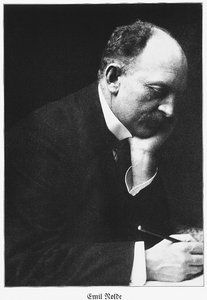
1867–1956, Dinamarca
Emil Nolde
La vida y la identidad de Emil Nolde Nacido como Hans Emil Hansen el 7 de agosto de 1867, el hombre que llegaría a ser conocido como Emil Nolde creció cerca de la aldea de Nolde, en el ducado de Schleswig. Sus primeros años estuvieron moldeados por la vida rural y agraria de su familia. Con el tiempo, se alejó de ese camino, optando en su lugar por trabajar como tallador de madera y decorador de muebles. Este trabajo físico y táctil precedió su transición hacia la pintura y el grabado.
Otras obras de Emil Nolde
 Atardecer
 Mar con cielo rojo
 Pareja en la playa1903
 Máscaras1911
Ensayos sobre Prophet
 Las 25 obras maestras de Egon Schiele: Emoción pura y expresionismoExplora las 25 obras maestras de Egon Schiele y el expresionismo. Descubre su legado en OriginalUniqueArt.com.
 Emile Nolde: A Journey into Expressionist Nature & the Primal SelfExplore the powerful Expressionism of Emile Nolde – a pioneer of emotive landscapes & spiritual themes. Discover his journey, influences, a…
 Maestro de la Emoción: Las 25 Mejores Obras de Rogier van der WeydenExplora las 25 obras maestras de Rogier van der Weyden y su pathos flamenco. ¡Descubre toda la colección en OriginalUniqueArt.com!