Vista previa
 Compartir
 Compartir
 Ver detalles
 Guía
Guía

 Descargar
 Ver artículos similares
 Radiografía
 Presentación de diapositivas
 Estadísticas
Four (arithmetic) actions


 Leer más
Giclée / Impresión de arte
Impresiones giclée o en lienzo de calidad de museo con producción rápida y opciones de acabado flexibles. ( Encargar reproducción pintada a mano Ver versión en imagen digital)




P118B €10

P118H €10

P118W €10

P438Z €10

P508JH €12

P508YH €12

P805H €10

P805Z €10

P919BZ €10

P919G €10

P919XJ €10

P959ZH €10

P968JZ €12

W106C €8

W218G €10

W218JH €8

W218Y €10

W307PJ €10

W316G €10

W316PJ €8

W316Y €10

W398PJ €8

W4111J €10

W500HY €15

W500JH €15

W692G €12

W849H €8

W940BG €15

W953PJ €8




Elija entre nuestros tamaños predefinidos que respetan las proporciones originales de la obra.

Introduzca el ancho y el alto que necesite para adaptarse a su marco o pared. Una impresión solo puede recortarse, nunca hacerse más grande que la imagen original, por lo que un tamaño con una forma distinta perderá parte de la obra. Le enviaremos una maqueta digital para su aprobación antes de realizar cualquier impresión. La imagen que se muestra en esta página no refleja el recorte real; solo la maqueta lo hace.
Envío a todo el mundo () en 2 semanas en lugar de las 4/5 semanas estándar. (22 octubre)

Envío exprés gratuito a todo el mundo

Lienzo de lino de alta calidad

Seguro de envío completo

Garantía de reembolso de impuestos aduaneros

Garantía de fidelidad cromática exacta

Política de devolución de 100 días (solo por defectos)

Garantía de devolución del 100% del dinero

Oferta por volumen
 La opción de vidrio solo está disponible en tamaños inferiores a 110 cm.

Four (arithmetic) actions
Giclée / Impresión de arte
Tamaño de la reproducción
-


Precio total
€ 70
El Lissitzky’s “Four (Arithmetic) Actions”: A Constructivist Meditation on Form and Number
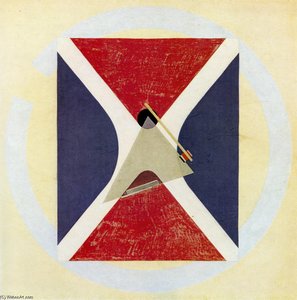
El Lissitzky's "Four (Arithmetic) Actions," painted in 1928, is more than just a depiction of four stacked figures; it’s a potent distillation of the core tenets of Russian Constructivism. This striking black-and-white image, born from Lissitzky’s revolutionary vision, embodies his belief that art could be a tool for social and intellectual transformation – a concept deeply rooted in the burgeoning modernist movement of the time. The painting's stark simplicity belies its complex engagement with mathematical principles, presenting them not as abstract concepts but as tangible forms demanding rigorous investigation.
Constructivist Principles and Geometric Abstraction
Created during a period of intense artistic experimentation following the Russian Revolution, “Four (Arithmetic) Actions)” exemplifies Constructivism’s rejection of traditional representational art. Lissitzky, along with other key figures like Vladimir Tatlin, sought to build a new visual language based on geometric abstraction and industrial forms. The painting's composition – the deliberate layering of the red figures – is a direct manifestation of this approach. Each figure isn't merely a representation of an action; it’s a carefully constructed element contributing to a larger, dynamic whole. The use of bold, primary colors—a conscious choice reflecting the era’s embrace of industrial materials and machine aesthetics—further emphasizes this geometric sensibility.
Symbolism Within the Structure
The numerical markings associated with each figure are crucial to understanding the artwork's deeper meaning. These aren’t arbitrary additions; they represent fundamental mathematical operations – addition, subtraction, multiplication, and division. Lissitzky was interested in exploring how visual forms could embody abstract concepts, transforming mathematics from a theoretical discipline into an accessible and engaging aesthetic experience. The larger figure, visually dominant, can be interpreted as representing the culmination of these actions—the result or outcome of the mathematical process. This layering creates a sense of progression and hierarchy, mirroring the sequential nature of calculation itself.
Historical Context and Artistic Legacy
"Four (Arithmetic) Actions)" was created in 1928, a pivotal year for Lissitzky’s career. It reflects his growing interest in exploring the relationship between art, architecture, and technology – themes that would become central to his later work. The painting's influence extends far beyond its immediate historical context. Lissitzky’s pioneering use of geometric abstraction paved the way for subsequent developments in modern art, including Suprematism and De Stijl. Today, “Four (Arithmetic) Actions)” remains a powerful example of Constructivism’s ambition – a testament to the idea that art can be both intellectually stimulating and profoundly beautiful.
Preguntas y respuestas
¿Qué espacio se sugiere para "Four (arithmetic) actions" de El Lissitzky?
Una reproducción de "Four (arithmetic) actions" encaja perfectamente en un Living Room.
¿Cómo se encuentran el movimiento y la época en "Four (arithmetic) actions" de El Lissitzky?
"Four (arithmetic) actions" de El Lissitzky se sitúa en el movimiento Constructivism, dentro de la era Edad Moderna de su creador.
¿A qué etapa de la carrera de El Lissitzky pertenece "Four (arithmetic) actions"?
"Four (arithmetic) actions" representa el Early Period de El Lissitzky.
Biografía del artista
vida temprana y educación
El Lissitzky, un reconocido artista, diseñador, fotógrafo, tipógrafo, polémico y arquitecto ruso, nació el 23 de noviembre de 1890 en Pochinok, Rusia. Su vida temprana estuvo marcada por un interés innato en dibujar, lo que le llevó a recibir instrucción de Yehuda Pen, un artista judío local, a los 13 años.carrera e influencias
La carrera de Lissitzky se caracterizó por su colaboración con Kazimir Malevich en el desarrollo del suprematismo, influyendo significativamente en los movimientos Bauhaus y constructivista. Su obra, que abarcaba diversos medios, desempeñó un papel fundamental en la configuración del diseño gráfico del siglo XX.- Contribuciones clave:
- Desarrolló el grupo artístico suprematista Unovis con Kazimir Malevich
- Creó la serie Proun, una variante de la serie suprematista
- Sirvió como embajador cultural ruso a Weimar, Alemania, influyendo en las figuras clave del movimiento Bauhaus y De Stijl.
- Innovaciones:
- Tipografía
- Diseño de exposiciones
- Fotomontaje
- Diseño de libros
obras notables y legado
Algunas de las obras notables de Lissitzky incluyen:- El Constructor (1924), un fotomontaje autorretrato que presenta temas recurrentes como la mano de Dios, vinculando su herencia judía con los movimientos artísticos contemporáneos.
- Un cartel de propaganda soviético (1941), una de sus últimas obras, instando a la gente a construir más tanques para luchar contra la Alemania nazi.
museos y colecciones
La obra de Lissitzky se puede encontrar en varios museos, incluyendo:- Museo de Arte de Taganrog, Rusia /es/art/show/art-d3bb5m-es/
- Museo de Arte de Novokuznetsk, Rusia /es/art/show/art-d3akex-es/
fundación y catálogo razonado
En 2014, se estableció la Fundación Lissitzky en colaboración con el Museo Van Abbemuseum y académicos líderes de todo el mundo para preservar el legado del artista y preparar un catálogo razonado de su obra.- Para obtener más información sobre El Lissitzky, visite: https://OriginalUniqueArt.com/@/el-lissitzky
- Explore las obras expuestas en el Museo de Arte de Taganrog: /es/art/show/to-explore-the-artworks-exhibited-in-taganrog-art-museum/
referencias:
- https://en.wikipedia.org/wiki/el_lissitzky
- https://OriginalUniqueArt.com/@/el-lissitzky

El Lissitzky
1890 - 1941 , Rusia
Datos clave
- Artistas Influenciados Por Este Artista:
- Bauhaus
- De Stijl
- Artistas Que Influyeron: ['Kazimir Malevich']
- Fecha De Muerte: 1941
- Fecha De Nacimiento: 23 de noviembre de 1890
- Lugar De Nacimiento: Pochinki, Rusia
- Movimiento Artístico: Suprematismo, Constructivismo
- Nacionalidad: Ruso
- Nombre Completo: El Lissitzky
- Obras Notables:
- El Constructor (1924)
- Serie Proun
- Cartel de propaganda soviético
Artículos relacionados

Constructivismo Ruso: Ideología, Forma y el Impacto Revolucionario en el Arte del Siglo XX
Descubra el constructivismo ruso: su ideología revolucionaria, figuras clave y legado en el arte y diseño del siglo XX. Análisis experto y obras maestras imperdibles.

El Greco: Las 25 Obras Maestras que Definen un Genio del Arte y la Fe
Descubre las 25 obras maestras de El Greco, el genio del Renacimiento español. Explora su arte religioso, manierismo y la historia detrás de cuadros icónicos como 'El Entierro del Conde de Orgaz'. Encuentra reproducciones de alta calidad en OriginalUniqueArt.com.

Las 10 Pinturas Más Famosas Dominadas por el Negro | Arte y Decoración
Descubre las 10 pinturas más impactantes dominadas por el negro. Explora obras maestras de Rembrandt, Goya y Rothko, su historia y significado. Encuentra reproducciones de arte exclusivas para transformar tu hogar en .
Kazimir Malevich: Las 25 Obras Maestras del Suprematismo para Inspirar tu Hogar
Descubre las 25 obras maestras de Kazimir Malevich, pionero del Suprematismo. Explora la historia, el significado y la belleza del arte abstracto moderno. Reproducciones de alta calidad para inspirar tu hogar en OriginalUniqueArt.com.

La Edad Dorada Reinterpretada: Explorando los Principios Estéticos y el Legado Duradero del Art Déco
Descubre la elegancia atemporal del Art Déco. Explora su historia, características clave y artistas emblemáticos. Encuentra inspiración y obras exclusivas para decorar con estilo en OriginalUniqueArt.