 Ver en contexto
 Enviar
 Compartir
 Detalles

 Descargar
 Similares
 Radiografía
 Presentación de diapositivas
Monte Sinaí
 Óleo sobre tabla
- Late Renaissance
 1570
1570- Renacimiento
 41.0 x 47.0 cm
 Museo Histórico de Creta
 Ver más
Giclée / Impresión de arte
Impresiones giclée o en lienzo de calidad de museo con producción rápida y opciones de acabado flexibles. ( Comprar pintura hecha a mano Comprar imagen)




P118B $10

P118H $10

P118W $10

P438Z $10

P508JH $12

P508YH $12

P805H $10

P805Z $10

P919BZ $10

P919G $10

P919XJ $10

P959ZH $10

P968JZ $12

W106C $8

W218G $10

W218JH $8

W218Y $10

W307PJ $10

W316G $10

W316PJ $8

W316Y $10

W398PJ $8

W4111J $10

W500HY $15

W500JH $15

W692G $12

W849H $8

W940BG $15

W953PJ $8




Elija entre nuestros tamaños predefinidos que respetan las proporciones originales de la obra.

Puede introducir sus propias dimensiones para adaptarse a un marco o espacio específico. Si el tamaño seleccionado no coincide con las proporciones de la imagen original, recortaremos la obra de arte o extenderemos la imagen con un borde con efecto espejo o de color sólido. Se enviará una maqueta digital para su aprobación antes de que comience la producción.
Tenga en cuenta que la vista previa en pantalla no refleja el recorte o la extensión real. Solo la maqueta mostrará con precisión la composición final.
Aunque existen tamaños personalizados, recomendamos seleccionar una dimensión de la lista predefinida para preservar las proporciones originales.
Envío a todo el mundo () en 2 semanas en lugar de las 4/5 semanas estándar. (6 septiembre)

Envío exprés gratuito a todo el mundo

Lienzo de lino de alta calidad

Seguro de envío total

Garantía de reembolso de impuestos aduaneros

Garantía de fidelidad cromática exacta

Política de devolución de 100 días (solo por defectos)

Garantía de devolución del 100% del dinero

Descuento por cantidad
 La opción de vidrio solo está disponible en tamaños inferiores a 110 cm.

Monte Sinaí
Giclée / Impresión de arte
Dimensiones de la reproducción
-


Precio total final
$ 80
El Greco’s Mount Sinai: A Vision of Divine Encounter
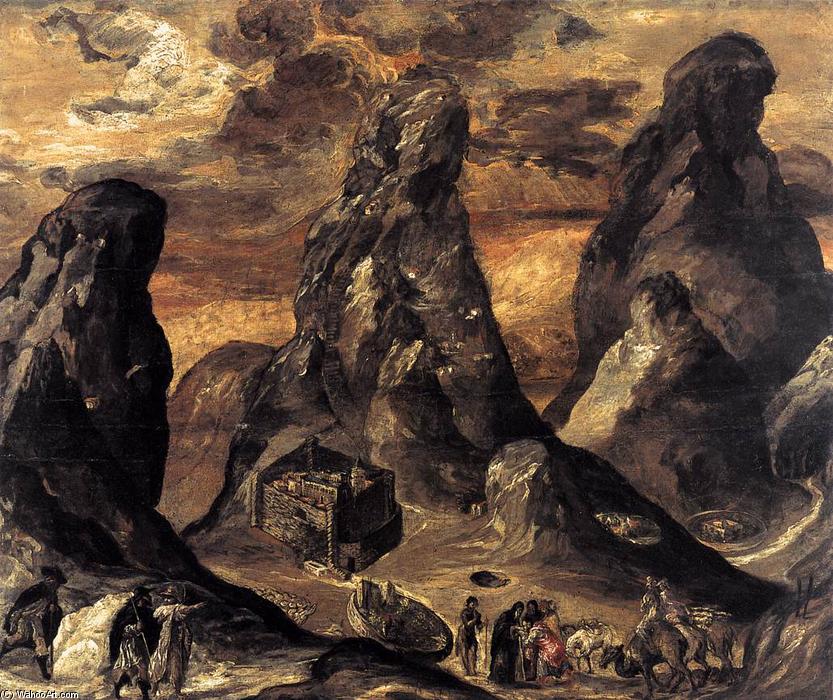
El Greco’s Mount Sinai stands as a profoundly moving testament to the artist's singular vision—a convergence of Byzantine spirituality and burgeoning Renaissance realism. Completed around 1570, this oil-on-panel painting, measuring just 41 x 47 cm and currently housed in the Historical Museum of Crete in Iraklion, transcends mere landscape depiction; it’s a visceral portrayal of a pivotal religious event, imbued with an intensely personal and emotionally charged atmosphere. The work immediately captivates with its dramatic lighting, the elongated figures that define El Greco's signature style, and the unsettling presence of those anthropomorphic rocks dominating the foreground – elements that invite prolonged contemplation and reveal layers of symbolic meaning.
At first glance, the scene presents a rugged, almost desolate landscape. Three colossal boulders, each bearing a human-like face, command immediate attention. These aren’t simply geological formations; they are potent symbols, often interpreted as representations of the divine presence at Mount Sinai – a tangible manifestation of God’s authority and engagement with humanity. The composition is carefully orchestrated to draw the viewer into this otherworldly space. The figures scattered throughout the scene—some standing in reverence near the rocks, others seemingly lost in contemplation—suggest a diverse group of pilgrims or witnesses to this momentous event. Two horses, rendered with a surprising degree of naturalism for El Greco’s style, add depth and movement to the composition, anchoring the scene within a tangible reality while simultaneously hinting at the epic scale of the narrative.
A Synthesis of Styles: Byzantine Roots, Renaissance Influence
El Greco's artistic lineage is complex and fascinating. Trained in the rigorous traditions of Cretan icon painting—characterized by meticulous detail, vibrant colors, and a focus on religious iconography—he nevertheless embraced innovations emerging from Italy. Mount Sinai exemplifies this synthesis perfectly. The use of gold leaf, a hallmark of Byzantine art, is subtly incorporated into the background and highlights, lending an ethereal quality to the scene. However, the painting also reveals a sophisticated understanding of Renaissance techniques, particularly in the precise rendering of the rocks—a departure from the more generalized forms often found in his earlier works. The horses, with their detailed musculature and realistic proportions, demonstrate this influence, grounding the mystical elements within a believable naturalistic framework.
The Weight of History: Moses and the Ten Commandments
The subject matter itself—Mount Sinai—holds immense religious significance. It is here, according to both the Torah and the Quran, that Moses received the Ten Commandments from God, an event that fundamentally shaped Jewish and Christian theology. El Greco’s painting doesn't simply depict this historical moment; it captures its profound emotional weight. The scene resonates with a sense of awe and reverence, reflecting the gravity of receiving divine law. The inclusion of human figures—and even the unsettling faces on the rocks—underscores the connection between the sacred and the mundane, a recurring theme in El Greco’s oeuvre – a reminder that the divine is not distant but actively engaged within the world.
Beyond the Canvas: Exploring El Greco's Legacy
El Greco was a prolific artist whose work continues to fascinate and inspire. Beyond Mount Sinai, his other notable paintings include “Christ Healing the Blind” (available at /art/list/?Filter=8XX6SM-El-Greco-(Domenikos-Theotokopoulos)-Christ-Healing-the-Blind), a poignant depiction of Christ’s miraculous healing, and a series of apostles—"Apostle St Peter" and "Apostle St Simon" /art/list/?Filter=8XZGDE-El-Greco-(Domenikos-Theotokopoulos)-Apostle-St-Peter and /art/list/?Filter=8XZGDG-El-Greco-(Domenikos-Theotokopoulos)-Apostle-St-Simon)—each rendered with a dramatic intensity that is uniquely El Greco’s. OriginalUniqueArt specializes in meticulously crafted, hand-painted oil reproduction reproductions of these masterpieces, ensuring that the spirit and artistry of El Greco's vision are faithfully preserved for generations to come.
For those seeking an authentic representation of this iconic work, OriginalUniqueArt offers high-quality reproductions of Mount Sinai, capturing the painting’s dramatic lighting, symbolic details, and emotional depth with unparalleled accuracy. Visit https://OriginalUniqueArt.com to discover more about El Greco's works and explore our collection of exquisite art reproductions.
Biografía del artista
**vida temprana y formación**
El Greco (Doménikos Theotokopoulos), un pintor, escultor y arquitecto griego reconocido, nació en 1541 en Creta, entonces bajo gobierno veneciano. Su nombre de nacimiento era Doménikos Theotokopoulos. La formación temprana de El Greco como pintor de iconos de la escuela cretense, un centro líder del arte bizantino post-byzantino, sentó las bases para sus futuras empresas artísticas.**evolución artística e influencias**
El estilo artístico de El Greco se vio moldeado por sus viajes a Venecia y Roma, donde absorbió estilos manieristas y renacentistas, influenciado notablemente por Tintoretto y Tiziano. Su traslado a Toledo, España en 1577 marcó un período de creación prolífica, resultando en obras maestras como Vista de Toledo y La apertura del quinto sello.**obras notables y estilo**
* La alegoría de la orden de los Camaldoleses (manierismo, óleo) - un testimonio de la mezcla única de El Greco entre las tradiciones bizantinas y los elementos estilísticos occidentales. * Fábulas (manierismo, óleo) – demuestra su uso de coloridos y poco comunes. * Giacomo Bosio (manierismo, óleo) – muestra la maestría de El Greco en el estilo manierista.**legado e influencia**
El estilo dramático y expresionista de El Greco, caracterizado por figuras alargadas y pigmentación fantástica, ha sido una fuente de inspiración para poetas y escritores. Se le considera un precursor del expresionismo y cubismo. Para más información sobre la vida y obra de El Greco, visite [https://OriginalUniqueArt.com/@/el-greco-(domenikos-theotokopoulos)](https://OriginalUniqueArt.com/@/el-greco-(domenikos-theotokopoulos)).- **visualice las pinturas de El Greco** en [https://OriginalUniqueArt.com/@@/85fr95-el-greco-(domenikos-theotokopoulos)-allegory-of-the-camaldolite-order](https://OriginalUniqueArt.com/@@/85fr95-el-greco-(domenikos-theotokopoulos)-allegory-of-the-camaldolite-order)
- **aprenda más sobre la vida y obra de El Greco** en [https://en.wikipedia.org/wiki/el_greco](https://en.wikipedia.org/wiki/el_greco)
- **explore el Instituto Helénico de Estudios Bizantinos y Post-Bizantinos**, que presenta una amplia gama de artefactos que reflejan la rica herencia artística del bizantismo, en /es/art/show/art-d3b8bv-es/

El Greco
1541 - 1614 , Grecia
Datos clave
- Artistas Que Influyeron:
- Tintoretto
- Tiziano
- Estilo Artístico: Manierismo, Renacimiento Español
- Fecha De Muerte: 1614
- Fecha De Nacimiento: 1541
- Influencia En Artistas:
- Expresionismo
- Cubismo
- Lugar De Nacimiento: Creta, Grecia
- Nacionalidad: Griego-Español
- Nombre Completo: El Greco (Doménikos Theotokópulos)
- Obras Notables:
- Vista de Toledo
- El entierro del Conde Orgaz
- Alegoría de la Orden Camaldulense
Artículos relacionados

El Greco: Las 25 Obras Maestras que Definen un Genio del Arte y la Fe
Descubre las 25 obras maestras de El Greco, el genio del Renacimiento español. Explora su arte religioso, manierismo y la historia detrás de cuadros icónicos como 'El Entierro del Conde de Orgaz'. Encuentra reproducciones de alta calidad en OriginalUniqueArt.com.
El Greco: Spirituality, Style & Innovation – A Renaissance Master's Legacy
Explore the captivating world of El Greco! Discover his unique style, spiritual intensity, and lasting impact on art history. Learn about this Renaissance master's life, iconic paintings & legacy.
Mannerism Unveiled: The Dramatic Evolution of Renaissance Art and the Visionary Legacy of El Greco
Explore the dramatic transition from High Renaissance harmony to Mannerist tension. Discover how masters like El Greco redefined art through distortion and spiritual intensity. An expert guide for art enthusiasts seeking deep historical context and museum-quality inspiration.

The Enduring Legacy of Oil on Canvas: Technique, History & Aesthetic Impact
Explore the rich history & techniques of oil painting – from Renaissance masters to Impressionism. Discover pigments, layering methods, and why this timeless medium endures. Expert insights for artists & art enthusiasts.

El Óleo sobre Lienzo: Historia, Técnica y la Persistencia de un Medio Artístico Atemporal
Descubre la historia y técnica del óleo sobre lienzo. Explora reproducciones fieles hechas a mano, personalización artística y consejos de expertos con OriginalUniqueArt. ¡Colecciona arte con confianza!