

 Vista previa
 Compartir
 Compartir
 Ver detalles
 Guía
Guía

 Descargar
 Ver artículos similares
 Radiografía
 Presentación de diapositivas
 Estadísticas
Flute Player
 Oil On Panel
- Taos Society of Artists
 1931
1931 31.0 x 41.0 cm
 Colección privada
 Leer más
Reproducción al óleo hecha a mano
Óleo sobre lienzo pintado a mano en el tamaño y marco de su elección, realizado por encargo por nuestros artistas. ( Cambiar a formato impreso Ver versión en imagen digital)




P118B $10

P118H $10

P118W $10

P438Z $10

P508JH $12

P508YH $12

P805H $10

P805Z $10

P919BZ $10

P919G $10

P919XJ $10

P959ZH $10

P968JZ $12

W106C $8

W218G $10

W218JH $8

W218Y $10

W307PJ $10

W316G $10

W316PJ $8

W316Y $10

W398PJ $8

W4111J $10

W500HY $15

W500JH $15

W692G $12

W849H $8

W940BG $15

W953PJ $8




Elija entre nuestros tamaños predefinidos que respetan las proporciones originales de la obra.

Puede ingresar sus propias dimensiones para adaptarse a un marco o espacio específico. Si el tamaño seleccionado no coincide con las proporciones de la imagen original, recortaremos la obra o extenderemos la pintura con elementos adicionales pintados a mano. Se le enviará una maqueta digital para su aprobación antes de comenzar la producción.
Tenga en cuenta que la vista previa en pantalla no refleja el recorte o la extensión reales. Solo la maqueta mostrará con precisión la composición final.
Si bien existen tamaños personalizados, recomendamos seleccionar una dimensión de la lista predefinida para preservar las proporciones originales.
Tras realizar el pedido, el equipo de OriginalUniqueArt.com enviará un correo electrónico al cliente para solicitar instrucciones y proporcionarle una vista previa del boceto.
Envío a todo el mundo () en 3-4 semanas en lugar de las 5 semanas estándar. (26 septiembre). Sin comprometer la calidad.

Envío exprés gratuito a todo el mundo

Lienzo de lino de alta calidad

Seguro de envío completo

Garantía de reembolso de impuestos aduaneros

Garantía de fidelidad cromática exacta

Política de devolución de 100 días (solo por defectos)

Garantía de devolución del 100% del dinero

Oferta por volumen
 La opción de vidrio solo está disponible en tamaños inferiores a 110 cm.

Flute Player
Técnica de reproducción
Tamaño de la reproducción
-


Precio total
$ 300
The Serene Contemplation: Eanger Irving Couse’s “Flute Player”
Eager Irving Couse's "Flute Player," painted in 1931, isn’t merely a portrait; it’s a portal into the heart of Native American culture and spirituality. This oil-on-panel masterpiece, currently residing in a private collection in Akron, Ohio, captures a moment of profound stillness – a man deeply immersed in his music beneath the warm glow of what appears to be a desert sunset. Couse, a pivotal figure in the Taos Society of Artists, dedicated much of his career to respectfully portraying the lives and traditions of the Pueblo people, and “Flute Player” stands as a testament to that commitment.
The painting immediately draws the eye with its harmonious blend of realism and romanticism. Couse’s signature style—characterized by a high finish and an intense focus on capturing the quiet dignity of Native American life—is evident in every brushstroke. He masterfully employs strong sidelight, reminiscent of the dramatic lighting found in Western landscapes, to sculpt the subject's form and imbue him with a sense of both strength and vulnerability. The meticulous detail in the rendering of his traditional attire – the intricately woven headdress adorned with feathers, the beaded necklace, and the flowing garment – speaks volumes about the artistry and cultural significance embedded within each element.
A Symphony of Symbolism
Beyond its aesthetic beauty, “Flute Player” is rich in symbolic meaning. The flute itself—a central instrument in Native American ceremonies and storytelling—represents connection to the spirit world, a conduit for communication with ancestors and deities. The man’s posture, seated on the ground and completely absorbed in his music, suggests a meditative state, a deliberate disconnection from the everyday concerns of life. The carefully placed bowls, both near the bottom left corner and further back on the right side, aren't simply decorative; they subtly evoke themes of sustenance, community, and domesticity – elements deeply intertwined with Native American culture.
The choice of a solitary figure playing in what appears to be an open space is particularly significant. It speaks to the individual’s relationship with nature, with spirituality, and with the timeless rhythms of life. The absence of other figures reinforces this sense of introspection and communion with something larger than oneself.
The Artist's Vision: Couse and the Taos Society
Eanger Irving Couse’s work is inextricably linked to his involvement with the Taos Society of Artists, a group that played a crucial role in shaping the artistic landscape of the American Southwest. Founded in 1912, the society sought to capture the essence of Southwestern life and culture through authentic representation. Couse's deep respect for the Native Americans he depicted is palpable in “Flute Player,” reflecting his desire to portray their lives with dignity and understanding – a rare approach for an artist of his time.
His artistic training in Europe, particularly under Adolphe Bouguereau and Tony Robert-Fleury, provided him with the technical skills to translate his vision onto canvas. However, it was his immersion in the culture of Taos that truly informed his work, allowing him to capture not just a likeness but also the spirit and soul of its subjects.
A Legacy of Quiet Reverence
“Flute Player” is more than just a beautiful painting; it’s a window into a vanished world. It's a poignant reminder of the importance of cultural preservation, artistic integrity, and the power of art to connect us to our shared human heritage. Couse’s ability to capture both the physical details and the emotional essence of Native American life is truly remarkable, solidifying “Flute Player” as a timeless masterpiece that continues to resonate with viewers today.
Size: 31 x 41 cm
Date: 1931
Biografía del artista
Primeros Años y Educación
- Nacido: 3 de septiembre de 1866, Saginaw, Michigan
- Fallecido: 26 de abril de 1936
- Origen: Saginaw, Estados Unidos de América
- Un temprano interés en las culturas nativas americanas se desarrolló mientras crecía cerca de tribus Chippewa.
- Asistió brevemente al Instituto de Arte de Chicago y luego a la Academia Nacional de Diseño en Nueva York.
- Estudió en la École des Beaux-Arts y Académie Julian bajo William-Adolphe Bouguereau en París durante diez años. Pintó principalmente paisajes de la costa de Normandía.
Carrera Artística y Desarrollo
- Después de regresar a los Estados Unidos, pasó tiempo en Nueva York y veranos pintando en varios lugares.
- Comenzó a pasar veranos en Taos, Nuevo México, alrededor de 1898.
- Estudió y pintó las vidas y la cultura de los indios Taos.
- Se convirtió en miembro fundador y primer presidente de la Sociedad de Artistas de Taos en 1915.
- Desarrolló un estilo distintivo que retrataba la vida nativa americana, a menudo enfatizando escenas pacíficas e idílicas.
- Su obra estuvo influenciada por su formación académica en París y sus observaciones de la cultura nativa americana.
Obras Principales y Reconocimiento
- Elk-foot of the Taos Tribe: Considerada su obra maestra, adquirida para la colección nacional de arte de los Estados Unidos.
- The Captive: Obra temprana que representa un tema nativo americano, expuesta en el Salón de París en 1892.
- Numerosas pinturas encargadas por Santa Fe Railway entre 1914 y 1936, utilizadas como material publicitario.
- Recibió premios de varias instituciones, incluyendo la Academia Nacional de Diseño (Premio Altman), Salmagundi Club (Premio Isidor), Academia de Bellas Artes de Pensilvania (Premio Lippincott).
- Sus obras se encuentran en muchos museos de los Estados Unidos y a nivel internacional.
Significado Histórico y Legado
- Contribuyó significativamente al desarrollo del arte occidental americano, particularmente las representaciones de nativos americanos.
- Ayudó a establecer Taos como un centro artístico destacado.
- Su retrato de la vida nativa americana ofreció una perspectiva que difería de las representaciones más estereotipadas comunes en ese momento.
- La Casa y Estudio de Eanger Irving Couse—Estudios de Joseph Henry Sharp está incluida en el Registro Nacional de Lugares Históricos, preservando su legado para futuras generaciones.
- Su obra continúa siendo expuesta y estudiada, proporcionando información sobre la historia del arte americano y la representación cultural.
Vida Personal
- Se casó con Virginia Walker en 1889.
- Tuvo un hijo, Kibbey Couse.
- Virginia jugó un papel significativo en apoyar su carrera artística y proporcionar retroalimentación crítica.
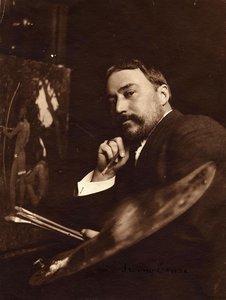
Eanger Irving Couse
1866 - 1936 , Estados Unidos de América
Datos clave
- Artistas Que Influyeron:
- William-Adolphe Bouguereau
- Tony Robert Fleury
- Fecha De Fallecimiento: 26 de abril de 1936
- Fecha De Nacimiento: 3 de septiembre de 1866
- Lugar De Nacimiento: Saginaw, Estados Unidos
- Movimiento Artístico: Impresionismo
- Nacionalidad: Estadounidense
- Nombre Completo: Eanger Irving Couse
- Obras Notables:
- Elk-foot of the Taos tribe
- Taos pueblo - moonlight
- The captive
Artículos relacionados
James Otto Lewis: Navigating American Modernism Through Regional Identity & Stylistic Innovation
Explore the captivating portraits of James Otto Lewis, a pivotal figure bridging 19th-century realism & American Modernism. Discover his groundbreaking work documenting Native American culture and regional identity.

Grant Wood & American Regionalism: Identity, Myth & the Rural Landscape
Explore the world of Grant Wood & American Regionalism with OriginalUniqueArt. Discover the symbolism behind 'American Gothic', recurring themes, and the movement's lasting impact on art history. High-quality reproductions available.
Henry Farny: Romantic Visions of the American West & Indigenous Life
Explore the evocative paintings of Henry Farny, renowned for his romantic realism & depictions of Native American life in the 19th-century West. Discover his legacy and key artworks at OriginalUniqueArt.

Realismo Estadounidense: 10 Obras Maestras que Cambiaron el Arte y la Decoración
Descubre 10 obras maestras del Realismo Estadounidense: Winslow Homer, Edward Hopper y más. Explora la historia, técnica y emoción de estos icónicos cuadros. Encuentra reproducciones de arte de museo en OriginalUniqueArt.com.
Eanger Irving Couse: Bridging Tradition & Modernity in American Southwest Art
Explore the life & art of Eanger Irving Couse, a pivotal figure in Southwestern Impressionism and founder of the Taos Society of Artists. Discover his captivating paintings & legacy.

