

 Vista previa
 Compartir
 Compartir
 Ver detalles
 Guía
Guía

 Descargar
 Ver artículos similares
 Radiografía
 Presentación de diapositivas
 Estadísticas
Raploch, Stirling


 Leer más
Reproducción al óleo hecha a mano
Óleo sobre lienzo pintado a mano en el tamaño y marco de su elección, realizado por encargo por nuestros artistas. ( Cambiar a formato impreso Ver versión en imagen digital)




P118B €10

P118H €10

P118W €10

P438Z €10

P508JH €12

P508YH €12

P805H €10

P805Z €10

P919BZ €10

P919G €10

P919XJ €10

P959ZH €10

P968JZ €12

W106C €8

W218G €10

W218JH €8

W218Y €10

W307PJ €10

W316G €10

W316PJ €8

W316Y €10

W398PJ €8

W4111J €10

W500HY €15

W500JH €15

W692G €12

W849H €8

W940BG €15

W953PJ €8




Elija entre nuestros tamaños predefinidos que respetan las proporciones originales de la obra.

Puede ingresar sus propias dimensiones para adaptarse a un marco o espacio específico. Si el tamaño seleccionado no coincide con las proporciones de la imagen original, recortaremos la obra o extenderemos la pintura con elementos adicionales pintados a mano. Se le enviará una maqueta digital para su aprobación antes de comenzar la producción.
Tenga en cuenta que la vista previa en pantalla no refleja el recorte o la extensión reales. Solo la maqueta mostrará con precisión la composición final.
Si bien existen tamaños personalizados, recomendamos seleccionar una dimensión de la lista predefinida para preservar las proporciones originales.
Tras realizar el pedido, el equipo de OriginalUniqueArt.com enviará un correo electrónico al cliente para solicitar instrucciones y proporcionarle una vista previa del boceto.
Envío a todo el mundo () en 3-4 semanas en lugar de las 5 semanas estándar. (5 octubre). Sin comprometer la calidad.

Envío exprés gratuito a todo el mundo

Lienzo de lino de alta calidad

Seguro de envío completo

Garantía de reembolso de impuestos aduaneros

Garantía de fidelidad cromática exacta

Política de devolución de 100 días (solo por defectos)

Garantía de devolución del 100% del dinero

Oferta por volumen
 La opción de vidrio solo está disponible en tamaños inferiores a 110 cm.

Raploch, Stirling
Técnica de reproducción
Tamaño de la reproducción
-


Precio total
€ 258
A Highland Harmony: David Gauld’s “Raploch, Stirling”
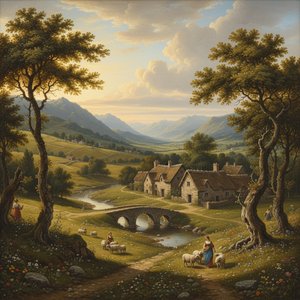
David Gauld's "Raploch, Stirling," painted in 1931, is more than just a depiction of a Scottish village; it’s a poignant meditation on rural life, the relationship between humanity and nature, and the enduring spirit of a community nestled within a dramatic landscape. This oil-on-canvas masterpiece, now meticulously reproduced for discerning collectors, transports the viewer to a tranquil corner of Perthshire, capturing not just the visual beauty but also a profound sense of place and time.
The scene unfolds with remarkable detail – a cluster of modest dwellings, rendered in earthy ochres and browns that seamlessly blend into the surrounding terrain. These humble homes, punctuated by glimpses of barns and workshops, speak to a life rooted in agriculture and craftsmanship. Beyond them stretches a rolling expanse of verdant fields, dotted with grazing livestock—cows, sheep, and horses—that contribute to the painting’s overall feeling of pastoral serenity. Dominating the background is the imposing silhouette of Stirling Castle, its ancient stones rising majestically against the backdrop of a rugged mountain range. The light, diffused and soft, suggests either early morning or late afternoon, casting long shadows that add depth and drama to the composition.
The Glasgow Boys and Pre-Raphaelite Echoes
David Gauld’s artistic journey is inextricably linked to the vibrant art scene of Glasgow during the late 19th century. As a member of the Glasgow Boys, a group of young artists who challenged the established academic style, Gauld embraced a more expressive and emotionally charged approach to painting. His early work was heavily influenced by Japanese prints – particularly their bold compositions, flattened perspectives, and emphasis on decorative elements – a trend he skillfully integrated into his own distinctive style. However, beneath this Eastern influence lies a strong resonance with the Pre-Raphaelite Brotherhood, evident in Gauld’s meticulous attention to detail, his romanticized portrayal of rural life, and his use of rich, saturated colors.
The Pre-Raphaelites, who rejected the conventions of academic art, sought inspiration from medieval and Renaissance sources, often depicting scenes from mythology, literature, and folklore. Gauld’s “Raploch” shares this fascination with storytelling and symbolism, inviting viewers to contemplate the lives and experiences of those who inhabit this remote corner of Scotland. The inclusion of animals, for instance, is not merely decorative; they represent a deep connection between humanity and the natural world – a theme central to both Japanese and Pre-Raphaelite art.
Technique and Composition: A Masterclass in Detail
Gauld’s technical skill is immediately apparent in the painting's remarkable level of detail. He employs a meticulous layering technique, building up the image through numerous thin glazes of oil paint, creating a luminous surface that captures the subtle nuances of light and shadow. The artist’s brushwork is both precise and expressive, conveying a sense of texture and movement – from the rough bark of the trees to the flowing robes of the figures. Notice particularly the way he renders the textures of the sheep's wool or the weathered stone of Stirling Castle.
The composition itself is carefully balanced, drawing the eye through a series of converging lines that lead the viewer’s gaze from the foreground dwellings towards the distant mountains. The strategic placement of elements – the castle, the livestock, and the village – creates a harmonious whole, reflecting the interconnectedness of human life and the natural environment. The use of atmospheric perspective—the subtle blurring of details in the distance—further enhances the sense of depth and scale.
Symbolism and Emotional Resonance
"Raploch, Stirling" is not simply a picturesque landscape; it’s imbued with symbolic meaning. The village represents resilience, community, and a connection to the land – values that have long been central to Scottish identity. The imposing presence of Stirling Castle serves as a reminder of Scotland's rich history and its enduring spirit. The painting evokes a sense of nostalgia for a simpler time, a longing for the tranquility of rural life, and a deep appreciation for the beauty of the natural world.
Reproduced with meticulous attention to detail, this artwork offers a captivating glimpse into a bygone era. It’s an ideal addition to any collection, bringing a touch of Highland charm and timeless elegance to your home or office. Whether you are an art enthusiast, a collector seeking investment pieces, or simply someone who appreciates the beauty of Scottish landscape painting, “Raploch, Stirling” is sure to captivate and inspire.
Preguntas y respuestas
¿A qué edad creó David Gauld "Raploch, Stirling"?
Cuando se creó "Raploch, Stirling" en 1931, David Gauld —nacido/a en 1865— tenía 66 años.
¿Cómo se recomienda imprimir "Raploch, Stirling": qué tamaño y qué orientación?
Para "Raploch, Stirling", la configuración de impresión recomendada es un tamaño de Medium y una orientación Landscape.
¿Quién creó "Raploch, Stirling"?
"Raploch, Stirling" se atribuye a David Gauld.
¿Qué tan intensos son los colores de "Raploch, Stirling"?
Los colores de "Raploch, Stirling" de David Gauld muestran una saturación Subtle Color con una intensidad Balanced.
¿En qué año se creó "Raploch, Stirling" de David Gauld?
"Raploch, Stirling" de David Gauld fue creada en 1931.
¿Hay una presentación de diapositivas para "Raploch, Stirling" de David Gauld?
Hay una presentación de diapositivas disponible: la página Presentación de diapositivas de "Raploch, Stirling" de David Gauld.
¿En qué año y bajo qué movimiento se realizó "Raploch, Stirling"?
"Raploch, Stirling" fue creada en 1931 como una obra del movimiento Glasgow Style. La fecha y el movimiento sitúan la obra en la historia del arte.
Biografía del artista
El visionario de Glasgow: La vida y el arte de David Gauld
En el vibrante y cambiante paisaje de la Escocia de finales del siglo XIX, pocos artistas capturaron la intersección entre la tradición y la modernidad con tanta gracia como David Gauld. Nacido en Glasgow en 1865, Gauld emergió no solo como un pintor, sino como un pionero que tendió un puente entre las delicadas intrincaciones del diseño gráfico y la presencia monumental de la vidriería. Su trayectoria fue una de profunda evolución estética, profundamente arraigada en el fermento artístico del movimiento Glasgow Boys, un grupo que buscaba liberarse del rígido academicismo de la época en favor de enfoques más naturalistas, emotivos y experimentales.
Los primeros impulsos creativos de Gauld fueron moldeados por un ojo meticuloso para el detalle, un rasgo perfeccionado durante sus años formativos como litógrafo. Cuando ingresó en la Glasgow School of Art en 1882, trajo consigo una creciente fascinación por la estética de Oriente. Este periodo estuvo marcado por un intenso compromiso con los grabados japoneses, cuyas perspectivas planas y líneas caligráficas audaces perseguirían para siempre sus composiciones. Su primer reconocimiento público llegó a través de sus evocadores dibujos a pluma y tinta para The Glasgow Weekly Citizen, obras que demostraron un dominio magistral de la línea y una sensibilidad rítmica y orgánica que insinuaba la revolución del Art Nouveau que aún se vislumbraba en el horizonte.
Una síntesis de luz y línea
A medida que la carrera de Gauld progresaba, su medio artístico se expandió desde la delicada superficie del papel hacia el medio luminoso y traslúcido de la vidriería. Esta transición le permitió explorar el juego entre la luz y el color de una manera que pocos de sus contemporáneos podrían igualar. Durante su estancia en Kirkcudbright, entre 1891 y 1894, Gauld emprendió encargos significativos para Guthrie y Wells, creando vitrales que eran mucho más que meros ornamentos arquitectónicos. Estas obras eran tapices de luz, donde las formas orgánicas y fluidas del estilo Art Nouveau se encontraban con la profundidad simbólica y conmovedora de la tradición Prerrafaelita.
Su técnica en el trabajo con vidrio se caracterizó por una comprensión profunda de cómo el color interactúa con la iluminación natural. Al manipular la textura y el pigmento, lograba evocar una atmósfera que se sentía tanto etérea como terrenal. Este dominio del medio reflejaba su filosofía artística más amplia: la creencia de que el arte no solo debe representar el mundo, sino también transformar el espacio que habita. Ya fuera trabajando con óleo, tinta o vidrio, Gauld buscaba capturar la esencia de sus sujetos —ya fuera la dignidad silenciosa de un retrato o la belleza agreste del paisaje escocés— a través de una lente de elegancia estilizada.
Legado y trascendencia histórica
La trayectoria de la vida de David Gauld estuvo marcada tanto por la colaboración como por el refinamiento solitario. Sus vínculos con otros luminarios de la Escuela de Glasgow, como William Stewart Shirreffs y Harrington Mann, lo situaron en el corazón de un periodo transformador en la historia del arte escocés. Incluso cuando sus relaciones profesionales cambiaron y se trasladó entre Glasgow, Kirkcudbright y North Berwick, su compromiso con la innovación permaneció inalterable. Se erigió como un vínculo vital entre la fascinación del siglo XIX por el naturalismo y la adopción del modernismo decorativo en el siglo XX.
Hoy en día, Gauld es recordado como un artista de inmensa versatilidad y visión. Su capacidad para sintetizar diversas influencias —desde la precisión de los grabados japoneses hasta el romanticismo de los prerrafaelitas— le permitió aportar una voz única al Glasgow Style. Su legado perdura en la belleza imperecedera de su obra en vidrio y en la presencia silenciosa y poderosa de sus pinturas, las cuales continúan resonando con un profundo aprecio por la artesanía, la luz y el espíritu perdurable de la innovación escocesa.

David Gauld
1865 - 1936 , Reino Unido
Datos clave
- Artistic Movement Or Style: Glasgow Boys; Art Nouveau; Pre-Raphaelites; Japanese influence
- Artists Or Movements Influenced By This Artist: ['Japanese art']
- Artists Who Influenced This Artist: ['William Stewart Macgeorge']
- Date Of Birth: Glasgow, United Kingdom (1865)
- Date Of Death: 1936
- Full Name: David Gauld
- Nationality: Scottish
- Notable Artworks:
- St Agnes
- Music
- Place Of Birth: Glasgow
Artículos relacionados
Evoking Arcadia: A Historical & Aesthetic Exploration of Rural Landscape Art
Explore the rich history of pastoral landscape art, from classical Arcadia to Impressionism & beyond. Discover key artists, movements, and how to collect serene rural scenes for your home. Expert insights at OriginalUniqueArt.

Cultivating Visions: A Historical Journey Through Rural Landscapes in Art
Explore the rich history of rural landscape painting with OriginalUniqueArt. Discover Impressionist masterpieces, key artists & movements. Find your perfect serene artwork and bring nature's beauty home.

David Cox the Elder: Landscape, Light & the Romantic Vision of Rural England
Explore the captivating landscapes of David Cox the Elder, a pivotal figure in British Romanticism. Discover his masterful watercolour techniques, enduring legacy & find timeless art for your home at OriginalUniqueArt.

Paisajes Románticos: 10 Obras Maestras que Definieron un Movimiento Artístico
Descubre los 10 paisajes románticos más influyentes de artistas como Caspar David Friedrich y Turner. Explora la belleza, el simbolismo y las técnicas del movimiento romántico. Reproducciones de arte exclusivas en OriginalUniqueArt.com.

John Constable: Las 25 Obras Maestras del Paisaje Inglés | OriginalUniqueArt
Descubre las 25 obras maestras de John Constable, el pintor romántico inglés que capturó la belleza del paisaje. Explora su técnica, historia y significado en OriginalUniqueArt.com. Reproducciones de arte de alta calidad para tu hogar.
