Cambiar a impresiones
 Ver más







































 Para obras de arte o reproducciones que midan más de 105 cm (aproximadamente 41 pulgadas) en cualquiera de sus lados, el marco se enviará como un kit desmontado. Este método garantiza una entrega segura y evita daños durante el transporte.


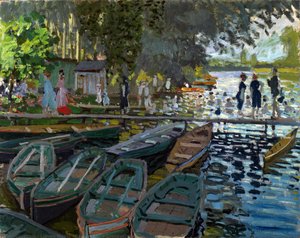
Riverbank at Argenteuil: A Snapshot of Impressionism's Dawn
Claude Monet’s “Riverbank at Argenteuil,” painted in 1877, isn’t merely a depiction of a riverside scene; it’s arguably the quintessential embodiment of Impressionism itself. Created during a pivotal moment in artistic history—the burgeoning challenge to academic conventions—this canvas captures not just what Monet *saw*, but how he *felt* about seeing it.
The painting transports us back to Argenteuil, a charming village nestled along the Seine River near Paris. Monet’s intention wasn't to meticulously recreate reality with precise detail; instead, he sought to convey the fleeting effects of light and atmosphere—a core principle championed by Impressionist artists like Renoir and Sisley.
- Composition: The scene unfolds horizontally, dominated by a tranquil riverbank dotted with lush vegetation. A sailboat glides gracefully across the water’s surface, while figures stroll along the shore, adding a sense of human presence to the idyllic landscape.
- Color Palette: Monet employed a vibrant palette—greens, blues, yellows—that prioritize color over tonal accuracy. These hues blend seamlessly together, creating an illusion of shimmering light and reflecting the nuances of the natural world.
- Technique: Monet’s brushstrokes are loose and visible, characteristic of Impressionist painting. He applied paint in short dashes and strokes, allowing the colors to mingle on the canvas and capturing the ephemeral quality of sunlight.
More than just a beautiful landscape, “Riverbank at Argenteuil” symbolizes the liberation from artistic dogma that defined the Impressionist movement. It represents a conscious rejection of idealized representations favored by earlier generations, opting instead for an honest portrayal of sensory experience.
Considered one of Monet’s earliest masterpieces, it foreshadows his later explorations into capturing the subtleties of light and color—a legacy that continues to inspire artists today. Its serene atmosphere invites contemplation and evokes a feeling of peacefulness, reminding us of the transformative power of nature and the beauty of fleeting moments.
The Artist and His Vision
Claude Monet (1840-1926) was born Oscar Claude Monet in Paris, France. He possessed an innate fascination for art from a young age, nurtured by his mother’s encouragement and influenced profoundly by Eugène Boudin, who instilled in him the revolutionary concept of “plein air” painting—capturing scenes directly from nature.
Monet's artistic journey began with meticulous studies of anatomy and drawing, followed by formative experiences at the Académie Suisse and under Charles Gleyre. These early influences shaped his understanding of artistic technique and established a foundation for his groundbreaking Impressionist style.
Beyond Technique: Symbolism and Emotion
“Riverbank at Argenteuil” transcends mere visual representation; it communicates an emotional resonance that speaks to the viewer’s senses. The dappled sunlight filtering through the foliage creates a sense of warmth and vibrancy, mirroring Monet's own appreciation for the beauty of the natural world.
The sailboat drifting across the river symbolizes movement and freedom—themes central to Impressionist ideals. Simultaneously, the figures strolling along the shore represent human connection with nature and the pleasures of everyday life. These elements combine to produce a painting that is both aesthetically captivating and intellectually stimulating.
Monet's Legacy: Influence on Modern Art
Claude Monet’s unwavering dedication to capturing light and color revolutionized artistic practice, establishing Impressionism as one of the most influential movements in modern art. His pioneering approach paved the way for subsequent artists—including Vincent van Gogh and Georges Seurat—to explore new expressive possibilities.
“Riverbank at Argenteuil” stands as a testament to Monet’s genius—a timeless masterpiece that continues to inspire admiration and contemplation across generations of art lovers. Its enduring appeal lies in its ability to convey not only what Monet saw but also how he felt, cementing his place as one of the greatest painters of all time.
Preguntas y respuestas
¿Qué elementos de la obra de Claude Monet se encuentran en "Riverbank at Argenteuil"?
"Riverbank at Argenteuil" comparte con otras obras de Claude Monet su estilo Impressionismo y sus temas recurrentes: inspired by boudin’s plein air technique., reflects french impressionist aesthetics., captures serene riverside tranquility., part of his extensive landscape series..
¿De dónde provienen los visitantes de "Riverbank at Argenteuil" de Claude Monet?
La página Estadísticas de "Riverbank at Argenteuil" de Claude Monet presenta las estadísticas de visitas públicas: visitas mensuales de esta obra, una comparación con las obras más vistas del artista y el origen de sus visitantes.
¿Qué sensación transmite "Riverbank at Argenteuil" de Claude Monet?
"Riverbank at Argenteuil" de Claude Monet transmite una sensación Sereno dentro de un ambiente general Serenidad.
 Ver en contexto
 Enviar
 Compartir
 Detalles
 Guía
Guía

 Descargar
 Similares
 Radiografía
 Presentación de diapositivas
 Preguntas y respuestas
 Estadísticas