Cambiar a impresiones
 Ver más







































 Para obras de arte o reproducciones que midan más de 105 cm (aproximadamente 41 pulgadas) en cualquiera de sus lados, el marco se enviará como un kit desmontado. Este método garantiza una entrega segura y evita daños durante el transporte.


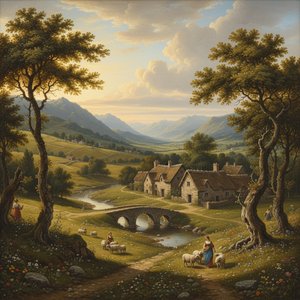
Un Quiet Moment Capturado en Watercolor: Betty Lane’s “Virgil”
Betty Lane's watercolor painting, "Virgil," embodies the spirit of Impressionism—a movement that sought to capture fleeting impressions of light and color rather than striving for photographic accuracy. Created sometime between 1930 and 1940, this unassuming landscape depicts two figures traversing a rural path, offering a glimpse into a serene tableau of everyday life. The artist’s masterful use of watercolor lends itself beautifully to conveying the subtle nuances of atmosphere and emotion.- Subject Matter: The painting centers around a man and woman walking along a dirt road, bathed in diffused sunlight. Their presence anchors the scene within a recognizable domestic setting—a rural landscape populated by rolling hills and scattered trees.
- Style & Technique: Lane’s approach aligns perfectly with Impressionistic principles. Loose brushstrokes dominate the composition, prioritizing tonal variation over meticulous detail. Notice how the artist skillfully blends hues to create an illusion of depth and luminosity—particularly evident in the depiction of the sky and vegetation. This technique isn't merely decorative; it’s a deliberate effort to represent how the human eye perceives reality – prioritizing feeling and sensation over precise representation.
- Historical Context: “Virgil” emerged during a period of significant artistic experimentation following World War I. Impressionism, championed by artists like Monet and Renoir, reacted against academic conventions, prioritizing subjective experience and capturing the immediacy of sensory perception. Lane’s work reflects this broader trend toward embracing emotion and atmosphere; it represents a conscious departure from the rigid formalism that had characterized art for decades prior.
- Color Palette: The artist utilizes a restrained color palette, favoring earthy tones to evoke the tranquility of the countryside. The dominant hues are muted yellows and greens, reflecting the sunlight filtering through the trees and grasses.
- Brushwork & Texture: Lane’s brushstrokes are loose and expressive, capturing the movement of light and air. This technique creates a palpable sense of texture—particularly noticeable in the depiction of the hillside vegetation—enhancing the painting's visual richness. The artist avoids sharp lines or harsh contrasts, opting instead for soft edges that blend seamlessly together, furthering the impression of natural beauty and serenity.
Preguntas y respuestas
¿"Virgil" de Betty Lane utiliza contrastes fuertes o armonías suaves?
El análisis cromático de "Virgil" de Betty Lane presenta un Suave contraste y una Gran unidad cromática armonía.
¿A qué artista se le atribuye "Virgil"?
"Virgil" fue creada por Betty Lane. La información en esta página describe la obra original de Betty Lane.
¿Dónde puedo ver la obra original "Virgil" de Betty Lane?
Puede ver la obra original "Virgil" en el Museo de la Sociedad Histórica de Niagara-on-the-Lake, Niagara-on-the-Lake, Canadá.
 Ver en contexto
 Enviar
 Compartir
 Detalles
 Guía
Guía

 Descargar
 Similares
 Radiografía
 Presentación de diapositivas
 Preguntas y respuestas
 Estadísticas