Edición al óleo
 Todo sobre Pipe







































 Para obras de arte o reproducciones que midan más de 105 cm (aproximadamente 41 pulgadas) en cualquiera de sus lados, el marco se enviará como un kit desmontado. Este método garantiza una entrega segura y evita daños durante el transporte.


The Quietude of Clay
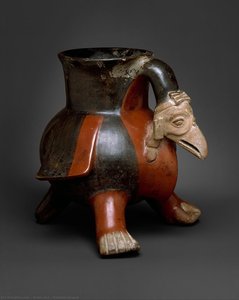
In the dim light of a private collection, this ceramic pipe from 1521 reveals itself through its deep, dark tones. It is a somber object, rendered in shades of brown and black that suggest the earth from which it was shaped. The surface is not merely colored but deeply worked, with geometric patterns carved directly into the clay. These lines—zigzags, curves, and circles—wrap around the body of the pipe, creating a rhythmic texture that catches the light softly. It is a piece of functional art, designed for the ritual of smoking, yet it carries a weight that transcends its utility.
Form and Symbolism
The craftsmanship speaks to a specific moment in the final years of the Aztec Empire. The artisan used hand-carving and burnishing to achieve a surface that is smooth to the touch, despite the intentional roughness of the incised patterns. There is a deliberate precision in the way the shapes repeat, reflecting a worldview where geometry and cosmology were inseparable.
- Material: Ceramic or terracotta
- Technique: Hand-carving and burnishing
- Motifs: Repeating zigzags, curves, and circles
- Color: Limited palette of brown and black
The patterns likely held ritualistic significance, perhaps connecting the user to the cosmic order through the very act of inhalation. The angularity of the shapes reflects the aesthetic conventions of Mesoamerican craftsmanship, where every line serves a purpose.
A Fragment of History
To hold such an object is to touch the edge of a vanished era. Created in 1521, this pipe belongs to the twilight of the Aztec civilization in Tenochtitlan, Mexico. It exists as a physical remnant of a culture that expressed its complex social and religious hierarchies through material objects. The simplicity of its composition—a single object against a neutral void—forces a direct encounter with the hand of the maker. It is a quiet, heavy presence that speaks of the rituals of the past without the need for ornament.
Preguntas y respuestas
¿Es Pipe una obra pintada a mano o una impresión?
Pintado a mano: un pintor profesional recrea Pipe al óleo sobre lienzo de lino.
¿Qué tamaño debo elegir para Pipe?
Los tamaños van desde 24.2 x 41.3 cm (€179) hasta 141.6 x 241.7 cm (€1168); la tabla de esta página detalla las opciones principales y sus precios.
¿Cuánto tarda el envío?
El plazo de entrega es de 4 a 5 semanas, con envío exprés gratuito a todo el mundo; en esta página se ofrece una opción de producción urgente. Puede realizar la devolución en un plazo de 100 días para obtener un reembolso completo, sin condiciones.
¿Dónde se encuentra la obra original Pipe?
La obra original forma parte de la colección del Metropolitan Museum of Art, Nueva York.
¿Qué técnica utilizó Imperio Azteca para Pipe?
Ceramic
Más información sobre esta pintura
 Enviar
 Compartir
 Detalles
 Ficha técnica


 Descargar
 Similares
 Presentación de diapositivas
 Preguntas y respuestas

 Estadísticas