

 Vista previa
 Compartir
 Compartir
 Ver detalles
 Guía
Guía

 Descargar
 Ver artículos similares
 Radiografía
 Presentación de diapositivas
 Estadísticas
Chess de Coalición
 Acrílico sobre lienzo
- Arte de pared
- Modern Expressionism
 1925
1925 60.0 x 60.0 cm
 Arnold Schönberg Center
 Leer más
Giclée / Impresión de arte
Impresiones giclée o en lienzo de calidad de museo con producción rápida y opciones de acabado flexibles. ( Encargar reproducción pintada a mano Ver versión en imagen digital)




P118B €10

P118H €10

P118W €10

P438Z €10

P508JH €12

P508YH €12

P805H €10

P805Z €10

P919BZ €10

P919G €10

P919XJ €10

P959ZH €10

P968JZ €12

W106C €8

W218G €10

W218JH €8

W218Y €10

W307PJ €10

W316G €10

W316PJ €8

W316Y €10

W398PJ €8

W4111J €10

W500HY €15

W500JH €15

W692G €12

W849H €8

W940BG €15

W953PJ €8




Elija entre nuestros tamaños predefinidos que respetan las proporciones originales de la obra.

Introduzca el ancho y el alto que necesite para adaptarse a su marco o pared. Una impresión solo puede recortarse, nunca hacerse más grande que la imagen original, por lo que un tamaño con una forma distinta perderá parte de la obra. Le enviaremos una maqueta digital para su aprobación antes de realizar cualquier impresión. La imagen que se muestra en esta página no refleja el recorte real; solo la maqueta lo hace.
Envío a todo el mundo () en 2 semanas en lugar de las 4/5 semanas estándar. (22 octubre)

Envío exprés gratuito a todo el mundo

Lienzo de lino de alta calidad

Seguro de envío completo

Garantía de reembolso de impuestos aduaneros

Garantía de fidelidad cromática exacta

Política de devolución de 100 días (solo por defectos)

Garantía de devolución del 100% del dinero

Oferta por volumen
 La opción de vidrio solo está disponible en tamaños inferiores a 110 cm.

Chess de Coalición
Giclée / Impresión de arte
Tamaño de la reproducción
-


Precio total
€ 70
Coalition Chess: A Symphony of Strategy and Diplomacy Embodied in Wood
Arnold Schönberg’s “Coalition Chess,” conceived in the turbulent years following World War I, transcends mere game play; it represents a profound exploration of artistic innovation and intellectual engagement. Created in 1925, this striking wooden chess set stands as a testament to Schönberg's unwavering commitment to challenging conventional norms and forging connections between seemingly disparate disciplines – music and strategic thought.
- The Conceptual Framework: Beyond the battlefield anxieties of its time, Coalition Chess delves into the complexities of diplomatic negotiation. Schönberg envisioned it not as a conflict simulation but as a crucible for fostering dialogue and understanding between opposing viewpoints, mirroring his artistic philosophy of dissonance and resolution.
- Design Innovation: Departing radically from traditional chess aesthetics, the set’s design incorporates nine distinct movement types—a bold reimagining of classic chess maneuvers—drawing inspiration from both established patterns and Schönberg's personal experiences with military machinery. Three new pieces fuse two conventional chess figures into singular forms, symbolizing a merging of influences and perspectives.
- Symbolic Resonance: Each piece bears a weighty significance, reflecting Schönberg’s preoccupation with the imagery of war. The Red pieces represent the Luftwaffe (German Air Force), embodying aggression and dynamism; Green symbolizes the Kriegsmarine (German Navy), signifying steadfastness and depth; Yellow and Black are equipped with the arsenal of the German Land Forces, representing power and stability.
- Material & Technique: Crafted from meticulously selected wood—likely maple or beech—the set’s surface is treated with a matte finish that emphasizes texture and highlights the craftsmanship involved. Photographed in studio lighting, the image captures the piece's form with remarkable clarity, prioritizing realism and showcasing its dimensional presence.
- A Legacy of Artistic Vision: Coalition Chess exemplifies Schönberg’s pioneering spirit—a refusal to accept established conventions and a relentless pursuit of originality. Its enduring appeal lies not only in its intellectual challenge but also in its ability to evoke contemplation on the interplay between conflict and cooperation, mirroring the core tenets of Schönberg's musical legacy.
The Coalition Chess set resides at the Arnold Schönberg Center in Vienna, Austria, a beacon for music scholarship and artistic appreciation. Its reproduction offers an opportunity to immerse oneself in the spirit of groundbreaking innovation—a visual echo of Schönberg’s transformative contribution to 20th-century art.
Preguntas y respuestas
¿Qué configuración de impresión se sugiere para "Chess de Coalición" de Arnold Schoenberg?
Tamaño Grande, orientación Formato horizontal: esta es la configuración de impresión sugerida para "Chess de Coalición" de Arnold Schoenberg.
¿Qué técnica se utilizó para "Chess de Coalición" y cuándo fue creado?
"Chess de Coalición" fue realizada en 1925, en Acrílico sobre lienzo.
¿De qué manera el estilo de "Chess de Coalición" se relaciona con la época de su creador?
"Chess de Coalición" de Arnold Schoenberg se sitúa en el movimiento Modern Expressionism, dentro de la era Edad Moderna de su creador.
Biografía del artista
Early Life and Musical Beginnings
Arnold Schoenberg, born September 13, 1874, in Vienna, Austria, embarked on a musical journey shaped by humble origins—his father operated a shoe shop. Despite this modest upbringing, Schoenberg possessed an innate passion for music that propelled him to largely self-educate himself within the realm of composition and theory. His formative years witnessed a synthesis of Brahmsian and Wagnerian styles, as evidenced in his early works like “Verklärte Nacht” (1899), establishing him as a prominent figure within the second Viennese School alongside Alban Berg and Anton Webern. This school championed innovation and challenged established musical conventions.Notable Compositions and Musical Innovations
Schoenberg’s compositional output solidified his reputation as one of the most influential figures in 20th-century classical music. Pieces such as “String Quartet No. 2” (1907–1908) and “Erwartung” (1909) exemplify his pioneering exploration of atonality—a radical departure from tonal harmony—marking a pivotal moment in musical history. Furthermore, "Pierrot Lunaire" (1912), with its groundbreaking use of Sprechstimme (speech-song), pushed the boundaries of vocal expression and cemented Schoenberg's position as a visionary composer.The Viennese School and Serialism
Schoenberg’s influence extended far beyond his immediate contemporaries, shaping the aesthetic sensibilities of subsequent generations of composers. He spearheaded the development of serialism—a systematic method of composition based on mathematical sequences—which revolutionized musical thinking and provided a framework for exploring new sonic possibilities. This approach fundamentally altered how music was conceived and produced during the interwar period.Emigration to America and Later Artistic Pursuits
Facing increasing persecution from Nazi authorities in 1933, Schoenberg reluctantly resigned from the Prussian Academy of Arts, labeling his music as “degenerate.” He sought refuge in the United States, accepting a professorship at UCLA (1936–1944), where facilities bear his name—a testament to his enduring legacy. During this period, he continued to experiment with film music and revisited tonal composition, culminating in "Chamber Symphony No. 2" (1939). Notably, “Ode to Napoleon” (1942) served as a satirical critique of fascist ideology, inspired by Byron’s poetry.Legacy and Recognition
Post-war Vienna honored Schoenberg with citizenship, though he succumbed to illness shortly thereafter. His String Trio (1946), reflecting his frail condition, stands as a poignant reminder of his artistic dedication. Recognizing the profound impact of the Holocaust, Schoenberg commemorated its victims in “Survivor from Warsaw” (1947). Finally, the Israel Conservatory and Academy of Music elected him honorary president in 1951—a fitting culmination to a remarkable life devoted to musical innovation and intellectual rigor. His contributions continue to inspire musicians and scholars alike, ensuring his place as an icon of modern classical music.
Arnold Schoenberg
1874 - 1951 , Austria
Datos clave
- Artistic Movement Or Style: Técnica dodecafónica; Expresionismo
- Artists Or Movements Influenced By This Artist:
- Anton Webern
- Alban Berg
- Artists Who Influenced This Artist:
- Johannes Brahms
- Richard Wagner
- Date Of Birth: 13 septiembre 1874
- Date Of Death: 1951
- Full Name: Arnold Schoenberg
- Nationality: Austríaco-americano
- Notable Artworks:
- Suite, op. 29
- Música Teclística
- Cuarteto de cuerda nº 2
- Place Of Birth: Vienna, Austria
Artículos relacionados

The Soul of Color: A Journey into the Emotional Resonance of Lyrical Abstraction
Embark on a cultural journey through Lyrical Abstraction. Explore how masters like Kandinsky used color and motion to translate emotion into visual poetry. Discover the profound beauty of abstract expressionism and learn to curate emotional resonance in your own art collection.

Abstracción Geométrica: 10 Obras Maestras que Transformaron el Arte Moderno | OriginalUniqueArt
Descubre las 10 obras maestras de la abstracción geométrica que revolucionaron el arte moderno. Explora a Mondrian, Malevich y Kandinsky en OriginalUniqueArt.com. Reproducciones de alta calidad para tu hogar.
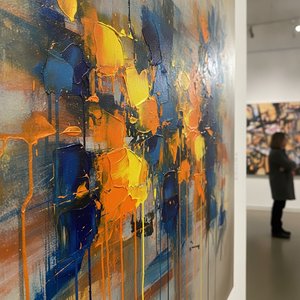
Beyond the Lines: Mastering the High-Impact World of Contemporary Abstraction
Master the high-impact world of contemporary abstraction. Discover how bold colors, textures, and modern movements like Abstract Expressionism can transform your space with premium, high-energy art curated for the design-conscious professional.

Expresionismo Abstracto: 10 Obras Maestras que Transformaron el Arte |
Descubre las 10 obras maestras del Expresionismo Abstracto: Pollock, Rothko y más. Explora la historia, técnica y significado de estos lienzos icónicos. Reproducciones de arte exclusivas en .

Kandinsky: Las 25 Obras Maestras del Pionero de la Abstracción | OriginalUniqueArt
Descubre las 25 obras maestras de Wassily Kandinsky, pionero del arte abstracto. Explora su expresionismo, composiciones únicas y la historia detrás de cada cuadro. Reproducciones de alta calidad para decorar tu hogar con arte moderno en OriginalUniqueArt.com.


