Vista previa
 Compartir
 Compartir
 Ver detalles
 Guía
Guía

 Descargar
 Ver artículos similares
 Radiografía
 Presentación de diapositivas
 Estadísticas
Descent from the Cross
 Oil On Canvas
- WallArt
- Neoclassical Revival
 Early Modern
 366.0 x 183.0 cm
 St John's College
 Leer más
Giclée / Impresión de arte
Impresiones giclée o en lienzo de calidad de museo con producción rápida y opciones de acabado flexibles. ( Encargar reproducción pintada a mano Ver versión en imagen digital)




P118B €10

P118H €10

P118W €10

P438Z €10

P508JH €12

P508YH €12

P805H €10

P805Z €10

P919BZ €10

P919G €10

P919XJ €10

P959ZH €10

P968JZ €12

W106C €8

W218G €10

W218JH €8

W218Y €10

W307PJ €10

W316G €10

W316PJ €8

W316Y €10

W398PJ €8

W4111J €10

W500HY €15

W500JH €15

W692G €12

W849H €8

W940BG €15

W953PJ €8




Elija entre nuestros tamaños predefinidos que respetan las proporciones originales de la obra.

Puede introducir sus propias dimensiones para adaptarse a un marco o espacio específico. Si el tamaño seleccionado no coincide con las proporciones de la imagen original, recortaremos la obra de arte o extenderemos la imagen con un borde con efecto espejo o de color sólido. Se enviará una maqueta digital para su aprobación antes de que comience la producción.
Tenga en cuenta que la vista previa en pantalla no refleja el recorte o la extensión real. Solo la maqueta mostrará con precisión la composición final.
Aunque existen tamaños personalizados, recomendamos seleccionar una dimensión de la lista predefinida para preservar las proporciones originales.
Envío a todo el mundo () en 2 semanas en lugar de las 4/5 semanas estándar. (13 octubre)

Envío exprés gratuito a todo el mundo

Lienzo de lino de alta calidad

Seguro de envío completo

Garantía de reembolso de impuestos aduaneros

Garantía de fidelidad cromática exacta

Política de devolución de 100 días (solo por defectos)

Garantía de devolución del 100% del dinero

Oferta por volumen
 La opción de vidrio solo está disponible en tamaños inferiores a 110 cm.

Descent from the Cross
Giclée / Impresión de arte
Tamaño de la reproducción
-


Precio total
€ 69
A Monumental Vision of Faith
In the quiet, hallowed halls of St John's College, Cambridge, hangs a masterpiece that commands both silence and profound contemplation. Anton Raphael Mengs’s "Descent from the Cross" is not merely a depiction of a biblical event; it is a monumental vision of faith captured in oil on canvas. Executed around 1760, this expansive work—measuring an imposing 366 x 183 cm—serves as a bridge between the spiritual intensity of the past and the emerging intellectual clarity of the Enlightenment. The scene captures the heavy, somber moment when the body of Christ is lowered from the cross, surrounded by a group of mourners whose faces reflect a spectrum of human grief, reverence, and devotion.
The composition is masterfully orchestrated to draw the eye toward the central, cruciform arrangement of Christ’s limp form. As the light catches the pale, sculptural anatomy of the Savior, the viewer is struck by the physical weight of the moment. The figures surrounding him—some draped in religious vestments, others clutching sacred texts—create a rhythmic movement that guides the gaze through the crowded, emotional landscape. There is a palpable sense of stillness amidst the sorrow, an atmosphere where the divine meets the earthly in a singular, breathless instant of transition.
The Dawn of Neoclassical Elegance
To understand this work is to understand the pivotal shift in European aesthetics during the mid-18th century. Mengs, a titan of the Neoclassical movement, consciously sought to move away from the dizzying, ornate excesses of the Rococo style. Influenced by the rigorous theories of Johann Joachim Winckelmann, Mengs embraced a philosophy of restraint, clarity, and balanced proportions. In "Descent from the Cross," this is evident in the way he avoids unnecessary flourish, opting instead for a structured composition that mirrors the stability and moral fortitude prized during the Enlightenment.
His technique is nothing short of extraordinary. Utilizing meticulous oil glazing, Mengs achieved a luminous quality that breathes life into the skin tones and fabric of his subjects. Every brushstroke is disciplined, contributing to a sense of hyper-realistic precision that elevates the figures from mere characters to idealized icons of virtue. This technical mastery allows for subtle tonal variations that create depth and volume, making the monumental canvas feel as though it possesses its own internal light, casting a soft, spiritual glow over the entire assembly.
A Timeless Legacy for the Discerning Collector
For the art lover or the interior designer, a reproduction of this magnitude offers more than just decoration; it offers a focal point of historical and emotional gravity. The painting’s symbolism—the intersection of human suffering and divine sacrifice—resonates across centuries, making it an ideal centerpiece for spaces designed for reflection, study, or grand architectural statements. Whether placed in a private library, a formal gallery, or a sophisticated living space, the work brings with it the prestige of the Cambridge collection and the intellectual weight of the Neoclassical era.
Owning a high-quality hand-painted reproduction of Mengs’s masterpiece allows one to invite this profound sense of history into the modern home. It is an opportunity to surround oneself with the beauty of classical ideals—balance, harmony, and truth—and to celebrate a period of art history where the brush was used to capture the very essence of the human soul.
Preguntas y respuestas
¿Qué orientación tiene "Descent from the Cross" de Anton Raphael Mengs?
"Descent from the Cross" de Anton Raphael Mengs tiene un formato Portrait. El formato describe las proporciones de la composición.
¿Dónde se recomienda exhibir el formato Portrait de "Descent from the Cross"?
Con su formato Portrait, se sugiere una reproducción de "Descent from the Cross" para un Living Room.
¿A qué etapa de la evolución de Anton Raphael Mengs pertenece "Descent from the Cross"?
"Descent from the Cross" pertenece al Mature Period de la trayectoria de Anton Raphael Mengs. Esta clasificación vincula la obra con el desarrollo del artista.
¿Cuál es la identidad cromática de "Descent from the Cross" de Anton Raphael Mengs?
"Descent from the Cross" se define por una paleta de Earthy liderada por Espresso (#322a27).
¿Qué tamaño y orientación se recomiendan para una impresión de "Descent from the Cross" de Anton Raphael Mengs?
Tamaño Large, orientación Portrait: esta es la configuración de impresión sugerida para "Descent from the Cross" de Anton Raphael Mengs.
¿Qué tamaño de reproducción se sugiere para "Descent from the Cross" de Anton Raphael Mengs?
Se recomienda imprimir "Descent from the Cross" en un tamaño de Large. Otros tamaños están disponibles con las mismas proporciones.
¿Se puede reproducir legalmente "Descent from the Cross" de Anton Raphael Mengs, que se encuentra en St John's College?
"Descent from the Cross" de Anton Raphael Mengs, conservada en St John's College, es en el dominio público: sus derechos de autor han expirado. Este estado determina si se pueden realizar reproducciones de la imagen.
¿Qué tono predominante recorre "Descent from the Cross" de Anton Raphael Mengs?
Un tono Golden Yellow Range recorre "Descent from the Cross" de Anton Raphael Mengs.
Biografía del artista
Anton Raphael Mengs: Pionero de la Pintura Neoclásica
- Nacido: 22 de marzo de 1728, Ústí nad Labem (Aussig), Bohemia (actual República Checa)
- Fallecido: 29 de junio de 1779, Roma, Italia
Anton Raphael Mengs fue un pintor germano-bohemio que influyó significativamente en la transición de la pintura rococó al neoclasicismo. Activo principalmente en Roma, Madrid y Sajonia, su obra encarna una mezcla de grandeza barroca con ideales clásicos emergentes, estableciéndolo como una figura crucial en el arte del siglo XVIII.
Primeros Años y Formación: La Sombra de Ismael Mengs
El viaje artístico de Mengs comenzó bajo la tutela de su padre, Ismael Mengs, un pintor danés que se había establecido en Dresde. Ismael reconoció el talento de su hijo desde temprano y lo llevó a Roma en 1741. Esta experiencia formativa implicó copiar obras de Rafael para el Elector de Sajonia, moldeando profundamente las sensibilidades estéticas de Anton Raphael. La exposición a la maestría de Rafael le inculcó una profunda apreciación por la forma y composición clásicas, que se convertirían en señas de identidad de su propio estilo.
Carrera Artística: Frescos, Retratos e Ideales Clásicos
La carrera de Mengs floreció a través de varias cortes europeas. En 1749, fue nombrado primer pintor de Federico Augusto, Elector de Sajonia, un puesto que le brindó considerable patrocinio al tiempo que le permitía mantener su base en Roma. Su obra más celebrada es posiblemente la pintura mural de Parnaso en Villa Albani en Roma, que obtuvo un amplio reconocimiento y solidificó su reputación como artista líder. Otras comisiones importantes incluyeron un magnífico fresco sobre la cúpula de la Iglesia de Sant'Eusebio en Roma, demostrando su habilidad en la decoración monumental, y el techo del salón de banquetes del Palacio Real de Madrid, considerado uno de sus logros más destacados.
- Obras Notables: Parnaso (Villa Albani), frescos en Sant’Eusebio, techo del Salón de Banquetes (Palacio Real, Madrid), Johann Joachim Winckelmann (1717–1768)
Si bien influenciado por la tradición barroca romana, Mengs abrazó cada vez más los ideales de la antigüedad clásica. Esta transición fue significativamente impulsada por su estrecha colaboración con Johann Joachim Winckelmann, un destacado historiador del arte y teórico que defendió el resurgimiento de las estéticas griega y romana. Juntos, abogaron por un retorno a la simplicidad, la claridad y las formas idealizadas en el arte, sentando las bases para el movimiento neoclásico.
Aspectos Clave y Rivalidades
- Conversión y Rol en el Vaticano: Mengs se convirtió al catolicismo en 1754 y posteriormente se convirtió en director de la Escuela de Pintura del Vaticano, consolidando aún más su posición dentro de la élite artística.
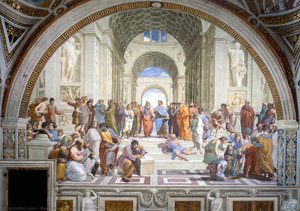
- La Escuela de Atenas: Pintó "La Escuela de Atenas" para el Duque de Northumberland (ahora en el Victoria and Albert Museum), una obra significativa que demuestra su dominio de los temas y la composición clásicos.
- Colaboración con Winckelmann: Su asociación con Winckelmann fue fundamental para dar forma a los principios artísticos neoclásicos.
- Rivalidad y Amistad: Mengs experimentó tanto rivalidades (particularmente con Pompeo Batoni) como amistades (con Giacomo Casanova), reflejando las complejas dinámicas de la escena artística romana durante su tiempo.
Legado y Significado Histórico
Anton Raphael Mengs falleció en Roma en 1779, dejando atrás una importante obra que unió la brecha entre los estilos barroco y neoclásico. Su énfasis en los ideales clásicos, combinado con su habilidad técnica, lo convirtió en una figura clave en el desarrollo del neoclasicismo. Es recordado no solo por sus impresionantes frescos y retratos, sino también por sus contribuciones intelectuales a la teoría del arte a través de su colaboración con Winckelmann. Su influencia se puede ver en generaciones posteriores de artistas que abrazaron la claridad, el orden y las formas idealizadas que caracterizaron la pintura neoclásica.

Anton Raphael Mengs
1728 - 1779 , República Checa
Datos clave
- Artistas Influenciados Por Este Artista: ['Pintura neoclásica']
- Artistas Que Influyeron: ['Rafael']
- Fecha De Muerte: 29 de junio de 1779
- Fecha De Nacimiento: 22 de marzo de 1728
- Lugar De Nacimiento: Ústí nad Labem, República Checa
- Movimiento Artístico: Neoclasicismo
- Nacionalidad: Germano-bohemio
- Nombre Completo: Anton Raphael Mengs
- Obras Notables:
- Parnaso (Villa Albani)
- Frescos en Sant’Eusebio
- Techo del Salón de banquetes
- Retrato de Winckelmann
Artículos relacionados
The Timeless Elegance of Academic Classicism: A Journey Through Order, Precision, and the Pursuit of Perfection
Explore the profound beauty of Academic Classicism. Discover how masters used order, precision, and classical ideals to achieve timeless perfection in art history, from Neoclassical portraits to the pursuit of ideal beauty.

The Enduring Legacy of Oil on Canvas: Technique, History & Aesthetic Impact
Explore the rich history & techniques of oil painting – from Renaissance masters to Impressionism. Discover pigments, layering methods, and why this timeless medium endures. Expert insights for artists & art enthusiasts.

Neoclassical Art: The Timeless Elegance of Order, Virtue, and Classical Grace
Explore the profound elegance of Neoclassical art. Discover the principles of order, symmetry, and virtue through the works of masters like David and Mengs. Immerse yourself in a journey of classical grace and timeless aesthetic perfection.
Timeless Elegance: The Ultimate Buyer's Guide to Choosing Classical Portraits for Sophisticated Interiors
Discover how to select the perfect classical portrait for your home. Our expert guide explores matching art styles to interiors, choosing between hand-painted oils and Giclée prints, and transforming personal photos into timeless masterpieces with professional artistry.

El Óleo sobre Lienzo: Historia, Técnica y la Persistencia de un Medio Artístico Atemporal
Descubre la historia y técnica del óleo sobre lienzo. Explora reproducciones fieles hechas a mano, personalización artística y consejos de expertos con OriginalUniqueArt. ¡Colecciona arte con confianza!