Ver en contexto
 Enviar
 Compartir
 Detalles
 Guía
Guía

 Descargar
 Similares
 Radiografía
 Presentación de diapositivas
 Preguntas y respuestas
 Estadísticas
Walking Lion


 Ver más
Giclée / Impresión de arte
Impresiones giclée o en lienzo de calidad de museo con producción rápida y opciones de acabado flexibles. ( Comprar pintura hecha a mano Cambiar a imagen digital)




P118B €10

P118H €10

P118W €10

P438Z €10

P508JH €12

P508YH €12

P805H €10

P805Z €10

P919BZ €10

P919G €10

P919XJ €10

P959ZH €10

P968JZ €12

W106C €8

W218G €10

W218JH €8

W218Y €10

W307PJ €10

W316G €10

W316PJ €8

W316Y €10

W398PJ €8

W4111J €10

W500HY €15

W500JH €15

W692G €12

W849H €8

W940BG €15

W953PJ €8




Elija entre nuestros tamaños predefinidos que respetan las proporciones originales de la obra.

Introduzca el ancho y el alto que necesite para adaptarse a su marco o pared. Una impresión solo puede recortarse, nunca hacerse más grande que la imagen original, por lo que un tamaño con una forma distinta perderá parte de la obra. Le enviaremos una maqueta digital para su aprobación antes de realizar cualquier impresión. La imagen que se muestra en esta página no refleja el recorte real; solo la maqueta lo hace.
Envío a todo el mundo () en 2 semanas en lugar de las 4/5 semanas estándar. (3 noviembre)

Envío exprés gratuito a todo el mundo

Lienzo de lino de alta calidad

Seguro de envío total

Garantía de reembolso de aranceles aduaneros

Garantía de fidelidad cromática exacta

Política de devolución de 100 días (solo por defectos)

Garantía de devolución del 100% del dinero

Descuento por cantidad
 La opción de vidrio solo está disponible en tamaños inferiores a 110 cm.

Walking Lion
Giclée / Impresión de arte
Dimensiones de la reproducción
-


Precio total final
€ 72
A Regal Presence: Deconstructing the Majesty of Barye’s Walking Lion
Antoine-Louis Barye's "Walking Lion," a bronze sculpture dating from the mid-19th century, isn’t merely a depiction of an animal; it’s a visceral embodiment of power, grace, and untamed wilderness. Born in Paris during a period of profound artistic transformation – the rise of Romanticism – Barye sought to move beyond the static formality of Neoclassical sculpture, instead capturing the dynamic energy and raw emotion inherent in the natural world. This particular piece, rendered with an almost palpable sense of movement, invites us into the heart of the lion’s spirit, a testament to Barye's revolutionary approach to animal representation.
The sculpture immediately commands attention through its sheer physicality. The bronze itself, meticulously cast and patinated to achieve a rich, burnished surface, speaks volumes about Barye’s mastery of lost-wax casting – a technique demanding both technical precision and artistic intuition. Notice the subtle variations in tone; the darker recesses of the musculature contrast beautifully with the highlights that accentuate the lion's powerful form. The texture is crucial: it’s not smooth or polished, but retains a tactile quality, hinting at the rough hide and formidable strength beneath. The wooden base, deliberately simple and rectangular, provides a grounding element, anchoring this embodiment of wildness within a contained space.
Capturing the Spirit of the Animalier
Barye’s work falls squarely within the burgeoning “animalier” movement – a trend that championed the study and representation of animals in sculpture. Prior to Barye, depictions of lions were often idealized or stylized, frequently serving as symbols of royalty or military might. However, Barye sought to capture the *essence* of the lion, its predatory instincts, its territoriality, and its inherent wildness. He achieved this through an intensely detailed anatomical study, meticulously rendering every muscle fiber, every ripple of fur, and every glint of light on the bronze surface. The pose itself – a deliberate stride forward, head held high – conveys a sense of confident authority and unwavering determination.
Consider the influence of Romanticism, which emphasized emotion, individualism, and the sublime power of nature. Barye’s lion embodies these ideals perfectly. It's not simply a beautiful animal; it’s a force of nature, a symbol of courage and resilience. The sculpture resonates with a primal energy, evoking a sense of awe and respect for the untamed wilderness.
Symbolism and Historical Context
The lion has long held significant symbolic weight across cultures – representing strength, nobility, justice, and vigilance. In ancient Egypt, it was associated with the sun god Ra; in Judeo-Christian tradition, it symbolizes Christ as “the Lion of Judah.” Barye’s sculpture taps into this rich tapestry of symbolism, reinforcing the lion's image as a creature of power and majesty. Furthermore, Barye’s work emerged during a period of significant social and political upheaval – the rise of nationalism, the Napoleonic Wars, and the burgeoning industrial revolution. His sculptures served as a powerful antidote to the rigid formality of classical art, offering instead a celebration of the natural world and its inherent beauty.
A Legacy in Bronze: Barye’s Enduring Influence
Antoine-Louis Barye remains one of the most celebrated sculptors of the 19th century. His pioneering work as an animalier fundamentally changed the way artists approached the representation of animals, paving the way for future generations of sculptors and artists. “Walking Lion” stands as a prime example of his genius – a captivating blend of technical skill, artistic vision, and profound understanding of the natural world. Today, reproductions of this iconic sculpture continue to inspire and delight, offering a tangible connection to a bygone era of artistic innovation and romantic fervor.
Preguntas y respuestas
¿Qué representa "Walking Lion" de Antoine-Louis Barye y qué atmósfera transmite?
"Walking Lion" de Antoine-Louis Barye representa bronze sculpture, lion, barye, animalier, power, grace, movement, con un ambiente Romantic. El tema y la atmósfera describen juntos la obra.
¿Es Antoine-Louis Barye, autor de "Walking Lion", conocido por otros nombres?
Otros nombres registrados para Antoine-Louis Barye, creador de "Walking Lion", incluyen Antoine Louis Barye, Antoniu Barye.
¿Qué tipo de pieza es "Walking Lion"?
"Walking Lion" de Antoine-Louis Barye está clasificada como WallArt. Esta categoría describe la técnica o el tipo de obra de arte que representa el original.
Biografía del artista
Antoine-Louis Barye: Un Pionero de la Escultura Animalista
Antoine-Louis Barye, nacido en París el 24 de septiembre de 1795, emergió como una figura fundamental en el mundo de la escultura del siglo XIX. No se limitaba a representar animales; los imbuiaba con una intensidad dramática y precisión anatómica sin precedentes, impulsando así el género *animalier* – un enfoque dedicado a las formas animales – al ámbito del arte refinado. El viaje de Barye no comenzó en el estudio de un escultor, sino como aprendiz joyero, siguiendo los pasos de su padre. Esta formación temprana le inculcó una atención meticulosa al detalle y un dominio técnico que serían invaluables a lo largo de su carrera. Refinó estas habilidades bajo la tutela de escultores como François-Joseph Bosio y Baron Antoine-Jean Gros, absorbiendo principios clásicos mientras desarrollaba simultáneamente una sensibilidad romántica única. Su educación formal en la École des Beaux-Arts le proporcionó una base sólida, pero fue un encuentro con el mundo vivo – específicamente, los animales alojados en el Jardin des Plantes de París alrededor de 1823 – lo que encendió verdaderamente su visión artística.De Joyero a Animalista: Desarrollo de un Estilo Único
La dedicación de Barye a la observación animal fue obsesiva. No se limitaba a observar; estudiaba, dibujaba y analizaba meticulosamente su anatomía, movimientos y comportamientos. Este compromiso con el realismo no era frío ni clínico; estaba impregnado del fervor emocional característico del Romanticismo. Las primeras obras, como “Milo de Crotana Devorado por un León” (1819) y “Hércules con el Jabalí Eritmanteano” (c. 1820), creadas todavía como estudiante, insinuaban su talento emergente para la composición dinámica y la narrativa dramática. Sin embargo, fue con esculturas como "Tigre Devorando un Gavial Crocodilo" (1831) – una monumental pieza de yeso que causó sensación en el Salón – y “León Apresando a una Serpiente” (1832), fundida en bronce, que Barye realmente estableció su firma. Estas no eran representaciones estáticas; eran momentos de poder crudo congelados en el tiempo, capturando la belleza brutal de la lucha por la supervivencia de la naturaleza. Se movió más allá de la mera imitación para transmitir la esencia misma de la vida animal: su fuerza, agilidad y espíritu indómito. Su obra resonaba con una creciente fascinación del público por lo exótico y lo salvaje, reflejando un anhelo romántico por experiencias más allá de los confines de la sociedad civilizada.Obras Maestras y Comisiones Monumentales
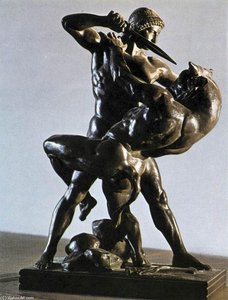
A lo largo de su carrera, Barye produjo una asombrosa variedad de esculturas, cada una demostrando su incomparable habilidad para capturar la forma y el movimiento animal. Más allá de las icónicas "Tigre Devorando un Gavial Crocodilo" y “León Apresando a una Serpiente”, obras maestras como “Teseo y el Minotauro” (1843), “Roger y Angelica sobre el Hipogriffo” (1846), “Lapitha y Centauro” (1848) y “Jaguar Devorando un Liebre” (1850) demostraron su versatilidad e imaginación. No se limitó a representar encuentros depredadores; también exploró escenas mitológicas, impregnándolas con la misma energía dinámica y precisión anatómica que definían sus estudios animales. Su talento se extendía más allá de las pequeñas esculturas de bronce; Barye recibió encargos prestigiosos para obras monumentales, incluyendo el “León de la Columna de Julio”, un poderoso símbolo de la resiliencia francesa, y esculturas que adornaban los jardines de las Tullerías en París. Estos proyectos a gran escala demostraron su capacidad para traducir su visión artística al arte público, consolidando su reputación como uno de los escultores más destacados de Francia.Influencias, Dificultades y Significado Duradero
El trabajo de Barye fue una síntesis de diversas influencias. La énfasis romántico en la emoción e individualidad es palpable en la tensión dramática de sus esculturas. Al mismo tiempo, se inspiró en el arte clásico, evidente en su atención a la precisión anatómica e ideales formales. Sin embargo, lo que realmente lo distinguió fue su enfoque científico para la observación – un resultado directo de incontables horas pasadas estudiando animales en el Jardin des Plantes. A pesar de lograr reconocimiento crítico, la vida de Barye no estuvo exenta de dificultades. Luchó con problemas financieros a lo largo de gran parte de su carrera, en gran medida debido a una mala gestión empresarial. Una bancarrota en 1848 le obligó a vender sus modelos y moldes, lo que provocó un período en el que esculturas inferiores inundaron el mercado, dañando su reputación. Encontró cierta estabilidad como profesor de dibujos en el Museo de Historia Natural en 1854, pero solo posthumously recibió el reconocimiento total de su genio. Hoy en día, Antoine-Louis Barye es reconocido como el padre de la escultura animalista moderna. Su influencia en las generaciones posteriores de artistas es innegable, y sus obras son celebradas por su poder, realismo y belleza perdurable. Elevió al género *animalier* del mero pasatiempo a una forma de expresión artística respetada, dejando una huella imborrable en la historia de la escultura.
Antoine-Louis Barye
1796 - 1875 , Francia
Datos clave
- Artistic Movement Or Style: Romanticismo
- Artists Or Movements Influenced By This Artist: ['Animal sculptores']
- Artists Who Influenced This Artist:
- Bosio
- Gros
- Date Of Birth: 24 Sept 1795
- Date Of Death: 25 Jun 1875
- Full Name: Antoine-Louis Barye
- Nationality: Francés
- Notable Artworks:
- Tigre devorando Gavial
- León aplastando serpiente
- Place Of Birth: París, Francia
Artículos relacionados

La Esencia del Bronce: Historia, Maestría de la Cera Perdida y su Legado en el Arte Escultórico
Descubre la maestría de la cera perdida y la historia del bronce. Explora el legado de Rodin y Barye ahora.

Esculturas de Bronce Legendarias: 10 Obras Maestras que Transformaron el Arte | OriginalUniqueArt
Descubre las 10 esculturas de bronce más legendarias que revolucionaron el arte. Explora la historia de Rodin, Degas y otros maestros del bronce. Encuentra reproducciones de alta calidad e inspiración para tu hogar en OriginalUniqueArt.com.
The Enduring Legacy of Bronze Sculpture: A Collector's Guide to Form & Cultural Significance
Explore the rich history & enduring appeal of bronze sculpture with expert insights for collectors at OriginalUniqueArt. Learn about casting techniques, iconic artists, and collecting tips to build a discerning art collection.

Las 10 Obras Maestras de Bronce que Revolucionaron la Historia del Arte | OriginalUniqueArt
Descubre las 10 esculturas de bronce más influyentes de la historia del arte. Explora obras maestras de Rodin, Degas y otros genios. Encuentra reproducciones de arte de calidad museo en OriginalUniqueArt.com.

The Enduring Legacy of Bronze: A Historical & Artistic Exploration for the Collector
Explore the rich history & enduring appeal of bronze sculpture with expert insights for collectors at OriginalUniqueArt. Learn about casting techniques, iconic artists, collecting tips & contemporary interpretations.