 Vista previa
 Compartir
 Compartir
 Ver detalles
 Guía
Guía

 Descargar
 Ver artículos similares
 Radiografía
 Presentación de diapositivas
 Estadísticas
Philip II
 Oil
Oil- WallArt
- Spanish Renaissance
 1570
1570- Early Modern
 115.0 x 93.0 cm
 Pollok House
 Leer más
Reproducción al óleo hecha a mano
Óleo sobre lienzo pintado a mano en el tamaño y marco de su elección, realizado por encargo por nuestros artistas. ( Cambiar a formato impreso Ver versión en imagen digital)




P118B €10

P118H €10

P118W €10

P438Z €10

P508JH €12

P508YH €12

P805H €10

P805Z €10

P919BZ €10

P919G €10

P919XJ €10

P959ZH €10

P968JZ €12

W106C €8

W218G €10

W218JH €8

W218Y €10

W307PJ €10

W316G €10

W316PJ €8

W316Y €10

W398PJ €8

W4111J €10

W500HY €15

W500JH €15

W692G €12

W849H €8

W940BG €15

W953PJ €8




Elija entre nuestros tamaños predefinidos que respetan las proporciones originales de la obra.

Escriba el ancho y el alto que necesite para adaptarse a su marco o a su pared. Al ser una obra pintada a mano, para un tamaño con una forma distinta, el artista puede pintar un poco más alrededor de la imagen o recortar un poco; usted elige. Le enviaremos una maqueta digital para su aprobación antes de comenzar la pintura. La imagen que se muestra en esta página no refleja el resultado real; solo la maqueta lo hace.
Tras realizar el pedido, el equipo de OriginalUniqueArt.com enviará un correo electrónico al cliente para solicitar instrucciones y proporcionarle una vista previa del boceto.
Envío a todo el mundo () en 3-4 semanas en lugar de las 5 semanas estándar. (24 octubre). Sin comprometer la calidad.

Envío exprés gratuito a todo el mundo

Lienzo de lino de alta calidad

Seguro de envío completo

Garantía de reembolso de impuestos aduaneros

Garantía de fidelidad cromática exacta

Política de devolución de 100 días (solo por defectos)

Garantía de devolución del 100% del dinero

Oferta por volumen
 La opción de vidrio solo está disponible en tamaños inferiores a 110 cm.

Philip II
Técnica de reproducción
Tamaño de la reproducción
-


Precio total
€ 263
The Majesty of Sovereignty: A Glimpse into the Spanish Golden Age
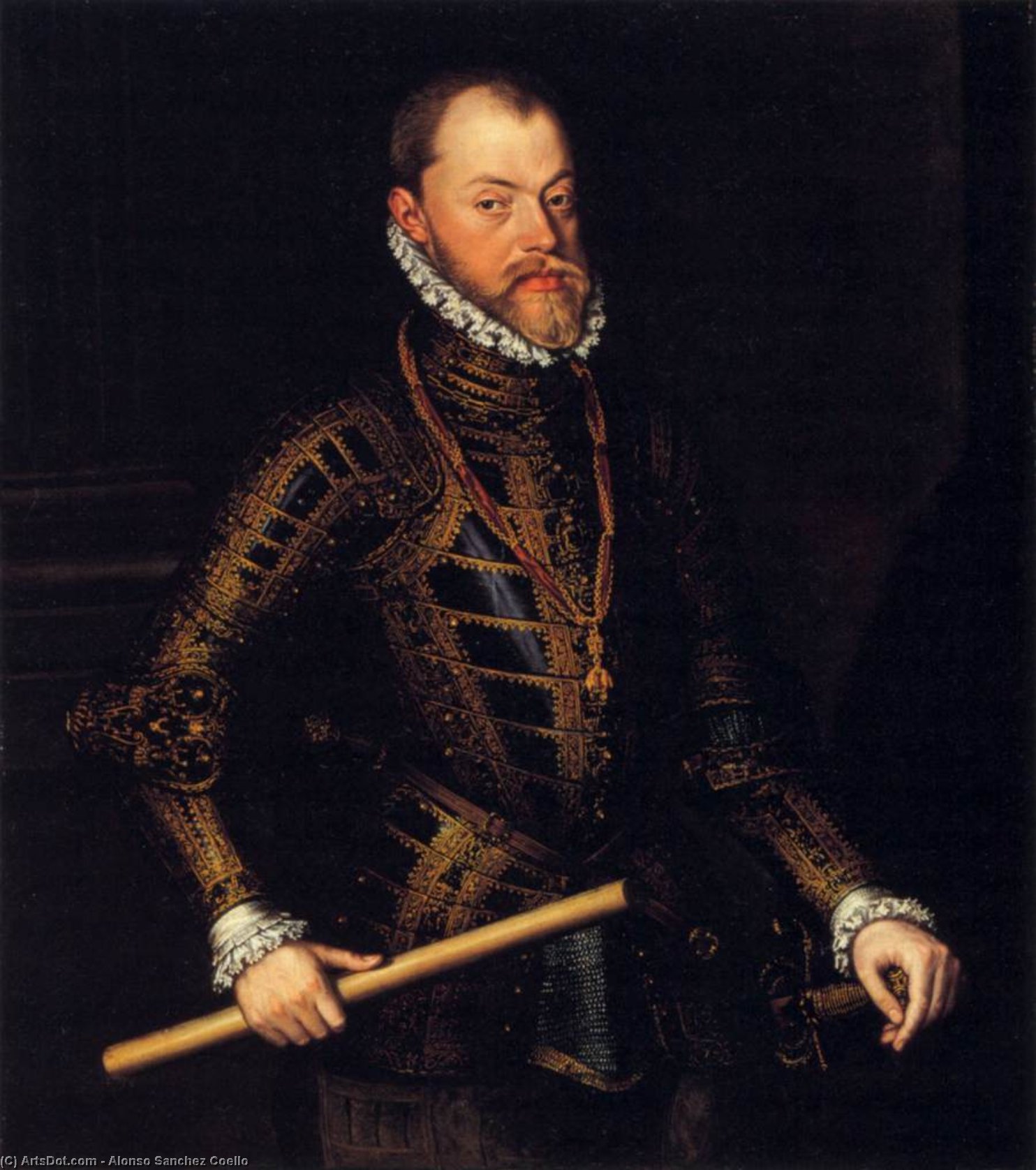
In the profound stillness of Alonso Sánchez Coello’s 1570 portrait, Philip II emerges not merely as a man, but as the very embodiment of imperial authority. To gaze upon this masterpiece is to step through a portal into the heart of the sixteenth-century Spanish Court, where every brushstroke serves to reinforce the divine right of kings. The subject stands with a commanding presence, his gaze steady and resolute, framed by the intricate textures of a period defined by opulence and rigid social hierarchy. As a premier court painter, Coello possessed the rare ability to capture the weight of a crown without the need for a literal diadem, using instead the subtle language of posture and attire to communicate power.
The composition is a masterclass in focused intensity. By utilizing a deep, somber background, Coello ensures that the viewer’s eye is immediately drawn to the luminous details of the monarch's personage. The play of light across the ruffled collar—a hallmark of Renaissance aristocratic fashion—creates a rhythmic interplay of shadow and brilliance, highlighting the meticulous craftsmanship of the textile. This technique, which blends the objective precision of the Flemish tradition with a certain Venetian warmth, allows the textures of the fabric and the sheen of the steel to feel almost tactile, inviting the observer to appreciate the material wealth of the era.
Symbolism and the Art of Presence
Every element within this portrait is a deliberate symbol of the Spanish Empire's zenith. The sword held by Philip II is far more than a mere accessory; it is a potent signifier of his role as the defender of the faith and the arbiter of justice across vast territories. It introduces an element of latent strength into the composition, suggesting that beneath the refined elegance of his suit lies the iron will required to govern a global superpower. The meticulous rendering of his beard and mustache further emphasizes a mature, seasoned leadership, projecting an image of stability and wisdom to both contemporary subjects and modern viewers alike.
For the discerning collector or interior designer, this piece offers more than just historical interest; it provides a profound emotional anchor for any space. The painting exudes a sense of timeless dignity and quiet confidence. When placed within a curated collection or as a focal point in a sophisticated study, the portrait commands respect and fosters an atmosphere of intellectual depth. It is a work that does not shout for attention but rather earns it through its sheer, understated gravity, making it an ideal selection for those looking to infuse their environment with the grandeur of classical European history.
A Legacy Captured in Oil
The technical brilliance of Alonso Sánchez Coello lies in his ability to balance the individual's humanity with the iconographic requirements of royalty. Through a sophisticated use of chiaroscuro, he sculpts the features of Philip II, giving the face a three-dimensional vitality that has endured for centuries. This mastery of light and shadow ensures that the portrait remains dynamic, shifting in character as the ambient light of a room changes throughout the day. It is this enduring quality—this ability to breathe life into the pigments—that makes a high-quality reproduction of this work such a captivating investment for lovers of fine art.
Owning a piece that echoes the splendor of the Spanish Golden Age allows one to participate in a long tradition of aesthetic appreciation. Whether you are drawn to the historical narrative of the Habsburg dynasty or the exquisite technical execution of the Renaissance masters, this portrait serves as a window into a world of unparalleled elegance. It is an invitation to surround oneself with the echoes of greatness, bringing the sophisticated soul of the sixteenth century into the contemporary home.
Preguntas y respuestas
¿Dónde puedo comprar una reproducción pintada a mano de "Philip II" de Alonso Sánchez Coello?
"Philip II" está disponible como una reproducción al óleo pintada a mano sobre lienzo de lino. El pedido puede realizarse en su página de Reproducción pintada a mano, con una variedad de tamaños para elegir.
¿Se puede reproducir libremente la imagen de "Philip II" de Alonso Sánchez Coello?
La información sobre los derechos de autor de "Philip II" de Alonso Sánchez Coello: la obra es en el dominio público: sus derechos de autor han expirado. Esto determina si las reproducciones de la imagen pueden realizarse libremente.
¿Para quién es un buen regalo "Philip II" de Alonso Sánchez Coello?
"Philip II" de Alonso Sánchez Coello se recomienda como regalo para Corporate Gift, especialmente para Focal. Una reproducción de la obra puede entregarse como obsequio.
Biografía del artista
Primeros Años y Formación
- Nacido: Benifaió, España (1531)
- Pasó su infancia cerca de Valencia hasta la muerte de su padre.
- Alrededor de 1541/42, se mudó a Portugal para vivir con su abuelo, un noble al servicio de los monarcas portugueses.
- Estudió con Anthonis Mor (Antonio Moro) en Flandes alrededor de 1550.
- Recibió el patrocinio de Antoine de Granville, Obispo de Arras, también patrono de Mor.
Carrera en la Corte Española
- Trabajó para la familia real portuguesa y más tarde para la corte de João Manuel, Príncipe de Portugal.
- Se trasladó a la corte española de Felipe II en 1555, recomendado por Juana, hermana de Felipe II.
- Se convirtió en Pintor de Cámara en 1560.
- Se casó con Luisa Reyaltes, hija de un silversmith, alrededor de 1560/61.
- Su hija, Isabel Sánchez, también se convirtió en pintora y asistió en su taller.
- Se mudó con la corte a Toledo y se estableció en Madrid en 1561.
Estilo Artístico e Influencias
- Estilo: Combinó la objetividad flamenca con la sensualidad veneciana.
- Influencias: Principalmente influenciado por Anthonis Mor y Tiziano.
- Aprendió precisión de Mor.
- Incorporó tonos dorados venecianos, generosa factura y el uso de la luz de Tiziano.
- Conocido por retratos marcados por facilidad de pose, dignidad, sobriedad y calidez del color.
Obras Principales y Logros
- Produjo tanto retratos como pinturas religiosas.
- Las obras religiosas eran convencionales pero demuestran un estilo austero.
- Retratos notables:
- Felipe II sosteniendo un Rosario (1573)
- Retratos de la Infanta Isabel Clara Eugenia (1571)
- Serie de pinturas que representan a los hijos de Felipe II.
- Doble retrato de las infantas Isabella Clara Eugenia y Catalina Micaela (1568–9).
- Pintó obras religiosas para El Escorial.
- Produjo una vista topográfica del puerto de Sevilla.
Legado y Significado Histórico
- Su reputación como retratista se ha complicado por numerosas copias e imitaciones.
- Considerado una figura significativa en el arte renacentista español, particularmente por sus retratos cortesanos.
- Su obra influyó a artistas posteriores, incluyendo Velázquez, con respecto a la representación de texturas como armaduras y drapeados.
- Falleció en Madrid el 8 de agosto de 1588.

Alonso Sánchez Coello
1531 - 1588 , España
Datos clave
- Artistas Influenciados: ['Velázquez']
- Artistas Que Influyeron:
- Anthonis Mor
- Tiziano
- Fecha De Muerte: 1588
- Fecha De Nacimiento: c. 1531
- Lugar De Nacimiento: Benifaió, España
- Movimiento Artístico: Renacimiento español
- Nacionalidad: Iberia
- Nombre Completo: Alonso Sánchez Coello
- Obras Notables:
- Felipe II con rosario
- Retrato de Isabel Clara Eugenia
- Hijas de Felipe II
- La dama del abanico
Artículos relacionados

Mastering the Shadows: A Journey Through the Chiaroscuro and Soul of Iconic Spanish Painting
Embark on a sophisticated exploration of Spanish art history, from the chiaroscuro mastery of Velázquez to the profound shadows of Goya. Discover how the dramatic light and emotional depth of Spain's greatest masters continue to inspire collectors and connoisseurs today.
Diego Velázquez: Master of the Spanish Golden Age – Technique, Influence & Courtly Portraiture
Explore the life & work of Diego Velázquez, master of the Spanish Golden Age. Discover his innovative techniques, iconic paintings like Las Meninas, and lasting influence on art history. Expert insights for collectors.
Rafael de Penagos: A Study in Spanish Portraiture & Artistic Identity
Explore the life & art of Rafael de Penagos, a leading Spanish Art Deco illustrator. Discover his iconic 'Penagos Woman', commercial work, and lasting legacy. Learn about this pivotal figure in 20th-century Spanish art history.
The Golden Age Reforged: Dramatic Realism & Religious Zeal in Spanish Baroque Art
Explore the dramatic world of Spanish Baroque art! Discover masters like Zurbarán & the powerful influence of religious zeal on painting techniques – a guide for collectors and enthusiasts.
Las 25 Obras Maestras del Prado: Arte Español e Inspiración para tu Hogar
Descubre las 25 obras maestras del Museo del Prado: Velázquez, Goya, El Greco y más. Explora la historia, técnica y belleza de cada cuadro español. Encuentra reproducciones de arte exclusivas e inspira tu hogar con OriginalUniqueArt.com.