

 Vista previa
 Compartir
 Compartir
 Ver detalles
 Guía
Guía

 Descargar
 Ver artículos similares
 Radiografía
 Presentación de diapositivas
 Estadísticas
Autumn Flowers


 Leer más
Reproducción al óleo hecha a mano
Óleo sobre lienzo pintado a mano en el tamaño y marco de su elección, realizado por encargo por nuestros artistas. ( Cambiar a formato impreso Ver versión en imagen digital)




P118B €10

P118H €10

P118W €10

P438Z €10

P508JH €12

P508YH €12

P805H €10

P805Z €10

P919BZ €10

P919G €10

P919XJ €10

P959ZH €10

P968JZ €12

W106C €8

W218G €10

W218JH €8

W218Y €10

W307PJ €10

W316G €10

W316PJ €8

W316Y €10

W398PJ €8

W4111J €10

W500HY €15

W500JH €15

W692G €12

W849H €8

W940BG €15

W953PJ €8




Elija entre nuestros tamaños predefinidos que respetan las proporciones originales de la obra.

Puede ingresar sus propias dimensiones para adaptarse a un marco o espacio específico. Si el tamaño seleccionado no coincide con las proporciones de la imagen original, recortaremos la obra o extenderemos la pintura con elementos adicionales pintados a mano. Se le enviará una maqueta digital para su aprobación antes de comenzar la producción.
Tenga en cuenta que la vista previa en pantalla no refleja el recorte o la extensión reales. Solo la maqueta mostrará con precisión la composición final.
Si bien existen tamaños personalizados, recomendamos seleccionar una dimensión de la lista predefinida para preservar las proporciones originales.
Tras realizar el pedido, el equipo de OriginalUniqueArt.com enviará un correo electrónico al cliente para solicitar instrucciones y proporcionarle una vista previa del boceto.
Envío a todo el mundo () en 3-4 semanas en lugar de las 5 semanas estándar. (4 octubre). Sin comprometer la calidad.

Envío exprés gratuito a todo el mundo

Lienzo de lino de alta calidad

Seguro de envío completo

Garantía de reembolso de impuestos aduaneros

Garantía de fidelidad cromática exacta

Política de devolución de 100 días (solo por defectos)

Garantía de devolución del 100% del dinero

Oferta por volumen
 La opción de vidrio solo está disponible en tamaños inferiores a 110 cm.

Autumn Flowers
Técnica de reproducción
Tamaño de la reproducción
-


Precio total
€ 258
A Portrait of a Moment: The Enigmatic Beauty of *Autumn Flowers*
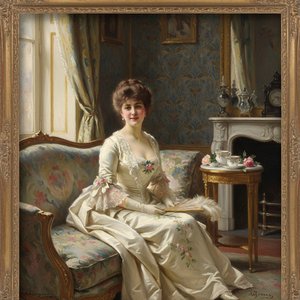
Alfred Stevens’s *Autumn Flowers*, painted in 1867, isn't merely a depiction of a woman amidst flowers; it’s an exquisitely crafted meditation on stillness, light, and the subtle poetry of everyday life. At first glance, the painting presents a seemingly simple arrangement: a seated lady, her posture suggesting quiet contemplation, surrounded by a still-life tableau of fabrics, blossoms, and a delicately rendered table. Yet, beneath this surface lies a profound exploration of form, color, and the very essence of observation – a hallmark of Stevens’s unique artistic vision.
Stevens, a pivotal figure in 19th-century Belgian art, deliberately eschewed the prevailing trends of his time. Rejecting the fleeting effects of Impressionism's vibrant light and atmosphere, he instead focused on capturing an immutable quality – the frozen gesture, the fixed expression, the enduring presence of the subject. This deliberate choice is powerfully evident in *Autumn Flowers*. The woman’s hand, poised as if about to touch a flower, isn’t caught in motion; it's suspended, imbued with a sense of timelessness. Her gaze, directed slightly off-canvas, invites us into her private world, suggesting an inner life beyond the immediate scene.
The Language of Color and Texture: Stevens’s Masterful Technique
What immediately draws the eye is Stevens's extraordinary command of color and texture. He employs a remarkably restrained palette – primarily shades of grey, black, and muted browns – punctuated by flashes of pastel pink, chestnut brown, and the glossy sheen of the table cover. This deliberate limitation isn’t a sign of restraint but rather a strategic choice to emphasize form and light. The artist masterfully utilizes chiaroscuro, creating dramatic contrasts between light and shadow that sculpt the figures and objects with remarkable precision. Notice how the highlights on the woman's chignon and the delicate folds of her dress draw our attention while simultaneously deepening the shadows around her face, lending a sense of mystery and depth.
Stevens’s technique is equally noteworthy for its meticulous detail. He employs a smooth, almost polished surface – reminiscent of 17th-century Dutch masters like Rembrandt and Vermeer – achieved through careful layering of paint and the use of a knife to blend colors seamlessly. This creates an illusion of tactile reality, inviting us to reach out and touch the fabrics, feel the texture of the flowers, and appreciate the subtle variations in color and tone. The artist’s attention to detail extends beyond mere representation; it's a deliberate attempt to capture the *essence* of each element within the composition.
Symbolism and the Portrait of Modernity
Beyond its technical brilliance, *Autumn Flowers* is rich in symbolic meaning. The woman herself represents a type of modern femininity – poised, elegant, and seemingly detached from the bustle of Parisian life. Her attire, with its jet frills and flounces, speaks to the fashionable trends of the era while simultaneously conveying a sense of quiet dignity. The surrounding still-life elements—the fabrics, flowers, and table—are not merely decorative; they function as a carefully constructed visual language, hinting at themes of luxury, domesticity, and the fleeting beauty of life.
Stevens’s comparison to Gustave Vanzype – that the painting is a still life composed of the fabrics in which she is dressed and the things around her – reveals a deeper intention. He wasn't simply depicting a woman; he was creating a miniature world, a carefully orchestrated tableau that captures a specific moment in time and reflects the values and aesthetics of his era. The reference to Whistler’s ambition to “use colours to compete with the musician who uses sounds” underscores Stevens’s own desire to elevate color from mere decoration to an expressive element within the painting.
A Legacy of Stillness: Stevens's Enduring Appeal
*Autumn Flowers* stands as a testament to Alfred Stevens’s singular artistic vision. It is a painting that rewards careful observation, inviting us to linger and contemplate its subtle nuances. Its enduring appeal lies not in dramatic gestures or fleeting effects but in its quiet beauty, its masterful technique, and its profound exploration of the human condition. Reproductions of this captivating work offer a window into a bygone era, capturing the elegance and sophistication of 19th-century Parisian life while simultaneously reminding us of the timeless power of stillness and observation.
Preguntas y respuestas
¿Puedo ver "Autumn Flowers" de Alfred Stevens en mi propia pared antes de comprarlo?
"Autumn Flowers" tiene una vista previa en realidad aumentada: la página de Vista previa AR de la obra permite visualizarla en su propio espacio mediante un dispositivo compatible.
¿Qué edad tenía Alfred Stevens cuando creó "Autumn Flowers" en 1867?
Alfred Stevens tenía 44 años cuando creó "Autumn Flowers" en 1867. La edad se calcula a partir del año de nacimiento del artista, 1823.
¿Cómo equilibra la luz y la sombra "Autumn Flowers"?
"Autumn Flowers" de Alfred Stevens presenta un nivel de brillo de deep_shadow, con una luminancia de Dark.
¿Quién es el artista detrás de "Autumn Flowers"?
El artista detrás de "Autumn Flowers" es Alfred Stevens. La obra está catalogada bajo el nombre de Alfred Stevens.
¿En qué año se creó "Autumn Flowers" de Alfred Stevens?
"Autumn Flowers" de Alfred Stevens fue creada en 1867.
¿Es "Autumn Flowers" de Alfred Stevens una composición en formato retrato, paisaje o cuadrado?
"Autumn Flowers" de Alfred Stevens es una composición en Portrait. Se recomienda revisar las proporciones antes de elegir un tamaño de impresión.
¿Hay obras similares a "Autumn Flowers"?
Las obras similares a "Autumn Flowers" se encuentran listadas en la página de Similares de la obra.
Biografía del artista
Early Life and Training
Alfred Émile Léopold Stevens (1823–1906) was born in Brussels, Belgium, on May 11, 1823. His family possessed a deep connection to the visual arts; his elder brother Joseph (1816–1892) and son Léopold (1866–1935) were painters, while another brother Arthur (1825–99) served as an art dealer and critic. This familial heritage profoundly shaped Stevens’ artistic upbringing and instilled in him a passion for observation and meticulous craftsmanship. He began his artistic journey at the Académie Royale des Beaux-Arts in Brussels, where he studied under the guidance of François Navez, a neo-classical painter who championed idealized forms and harmonious compositions. Navez's teachings solidified Stevens’ foundational understanding of artistic principles and established him on a path toward mastering traditional techniques.Artistic Career
Stevens relocated to Paris in 1843, joining his brother Joseph, and enrolled at the École des Beaux-Arts, furthering his education amidst a vibrant intellectual milieu. Although scholarly debate persists regarding whether he formally studied under Jean Auguste Dominique Ingres—a titan of neoclassical painting—Stevens’ formative years undeniably exposed him to Ingres's monumental style and unwavering commitment to classical ideals. His early works, notably “The Pardon or Absolution” (Hermitage, St. Petersburg), signed and dated 1849, exemplify Stevens’ initial stylistic inclinations: a deliberate embrace of conventional naturalistic representation rooted in the aesthetic traditions of seventeenth-century Dutch genre painting. This stylistic choice reflects Stevens' desire to honor artistic heritage while simultaneously exploring contemporary subjects with nuanced detail.Rise to Prominence
Stevens achieved considerable recognition within Parisian artistic circles upon his debut at the Brussels Salon in 1851, securing a third-class medal and subsequently earning acclaim at the Paris Salon of 1853 and the Universal Exposition of Paris in 1855. The painting “Ce qu’on appelle le vagabondage” (Musée d’Orsay, Paris) garnered particular attention from Napoleon III, prompting a transformative shift in Stevens' artistic focus—a deliberate engagement with social realism and a compassionate portrayal of poverty. This pivotal moment underscored Stevens’ conviction that art could serve as a vehicle for empathy and social commentary.Notable Works and Legacy
Stevens’ oeuvre encompasses a diverse range of subjects, demonstrating his versatility as an artist. “La Dame en Rose” (Musées Royaux des Beaux-Arts de Belgique, Brussels), completed in 1866, stands as a quintessential example of Stevens' artistic style during this period—a masterful fusion of fashionable attire and meticulous anatomical rendering informed by Japanese decorative motifs. His unwavering dedication to realism and refined execution cemented his reputation as one of the foremost painters of his time. He received the Legion of Honor (Chevalier) from the French government in 1863 and ascended to Officer of the Legion of Honor in 1867, acknowledging his contributions to artistic excellence and national prestige. Stevens’ legacy continues to inspire artists today, securing his place as a pivotal figure in Belgian art history and a champion of humanist values expressed through visual artistry.Further Exploration
You can discover more about Alfred Stevens' life and work on OriginalUniqueArt.com: Alfred Stevens | 122 artworks Explore More: The French Academic Art Movement And Also: Rodolfo Amoedo | Brazilian Painter, Designer, and Decorator Don't Miss: Alfred Stevens: Moonlit Seascape (46 x 37 cm, Academicism, Oil)
Alfred Stevens
1823 - 1906 , Bélgica
Datos clave
- Artistic Movement Or Style: Academic Realism
- Artists Or Movements Influenced By This Artist: ['Dutch Genre Painting']
- Artists Who Influenced This Artist:
- Jean Auguste Dominique Ingres
- Dutch Masters
- Date Of Birth: May 11, 1823
- Date Of Death: August 24, 1906
- Full Name: Alfred Émile Léopold Stevens
- Nationality: Belgian
- Notable Artworks:
- La Dame en Rose
- Visit to the Studio
- Dessin préparatoire au 'Panorama du siècle', 'L'Impératrice Joséphine et sa Cour
- Place Of Birth: Brussels, Belgium
Artículos relacionados

Alfred Munnings: Las 25 Obras Maestras del Pintor de Caballos | OriginalUniqueArt
Descubre las 25 obras maestras de Alfred Munnings, el pintor británico de caballos por excelencia. Explora su impresionismo inglés, escenas campestres y técnica única. Encuentra reproducciones de arte de alta calidad en OriginalUniqueArt.com.

Alfred Stevens: Capturing Parisian Life with Intimate Realism & Symbolist Flair
Explore the captivating world of Alfred Stevens, a pioneer of intimate realism & Symbolist painting. Discover his elegant portraits of Parisian women and learn about his Dutch influences & lasting legacy. Art history insights at OriginalUniqueArt.
Alfred Stevens: Capturing Parisian Elegance & Fin-de-Siècle Intimacy
Discover the captivating world of Alfred Stevens, master of Parisian elegance & intimate portraiture. Explore his techniques, influences, and legacy – a prized collection for discerning art enthusiasts.

10 Obras Maestras del Realismo Romántico que Debes Conocer
Explora la emoción y el detalle del Realismo Romántico. Un viaje por 10 obras maestras que capturan la esencia humana con técnica y alma. Encuentra inspiración y reproducciones de calidad museo para tu hogar en OriginalUniqueArt.com. ¡Descubre toda la colección online!
Realismo en el Arte: 10 Obras Maestras para Decorar con Autenticidad
Descubre 10 obras maestras del realismo, desde Courbet a Vermeer. Explora la historia, técnica y significado de estos icónicos cuadros. Encuentra reproducciones de arte de museo en OriginalUniqueArt.com y decora con autenticidad.