Ver en contexto
 Enviar
 Compartir
 Detalles

 Descargar
 Similares
 Radiografía
 Presentación de diapositivas
 Estadísticas
Taking the
 Watercolor
- WallArt
- Contemporary Realism
 1837
1837- 19th Century
 27.0 x 20.0 cm
 Amon Carter Museo de Arte Estadounidense
 Ver más
Giclée / Impresión de arte
Impresiones giclée o en lienzo de calidad de museo con producción rápida y opciones de acabado flexibles. ( Comprar pintura hecha a mano Cambiar a imagen digital)




P118B $10

P118H $10

P118W $10

P438Z $10

P508JH $12

P508YH $12

P805H $10

P805Z $10

P919BZ $10

P919G $10

P919XJ $10

P959ZH $10

P968JZ $12

W106C $8

W218G $10

W218JH $8

W218Y $10

W307PJ $10

W316G $10

W316PJ $8

W316Y $10

W398PJ $8

W4111J $10

W500HY $15

W500JH $15

W692G $12

W849H $8

W940BG $15

W953PJ $8




Elija entre nuestros tamaños predefinidos que respetan las proporciones originales de la obra.

Puede introducir sus propias dimensiones para adaptarse a un marco o espacio específico. Si el tamaño seleccionado no coincide con las proporciones de la imagen original, recortaremos la obra de arte o extenderemos la imagen con un borde con efecto espejo o de color sólido. Se enviará una maqueta digital para su aprobación antes de que comience la producción.
Tenga en cuenta que la vista previa en pantalla no refleja el recorte o la extensión real. Solo la maqueta mostrará con precisión la composición final.
Aunque existen tamaños personalizados, recomendamos seleccionar una dimensión de la lista predefinida para preservar las proporciones originales.
Envío a todo el mundo () en 2 semanas en lugar de las 4/5 semanas estándar. (12 septiembre)

Envío exprés gratuito a todo el mundo

Lienzo de lino de alta calidad

Seguro de envío total

Garantía de reembolso de impuestos aduaneros

Garantía de fidelidad cromática exacta

Política de devolución de 100 días (solo por defectos)

Garantía de devolución del 100% del dinero

Descuento por cantidad
 La opción de vidrio solo está disponible en tamaños inferiores a 110 cm.

Taking the
Giclée / Impresión de arte
Dimensiones de la reproducción
-


Precio total final
$ 80
Taking the Hump Rib
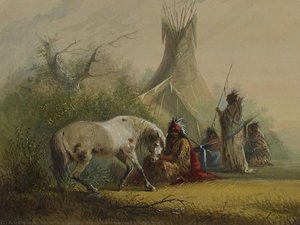
Alfred Jacob Miller’s “Taking the Hump Rib” stands as an arresting testament to the Romantic spirit of American art—specifically, its fascination with the untamed frontier and the portrayal of indigenous cultures amidst the grandeur of the Rocky Mountains. Completed in 1837, this watercolor painting captures a pivotal moment during William Drummond Stewart's expedition into the West, documenting not merely scenery but also the complex interactions between European observers and Native American communities. The artwork’s composition immediately draws the eye to a central scene: a group of men—likely fur traders—engaged in assisting a horseman struggling to ascend a steep incline, aptly named “Hump Rib.” Miller skillfully employs watercolor techniques—characterized by delicate washes and subtle gradations of color—to convey both the ruggedness of the landscape and the palpable tension within the tableau. The muted palette—dominated by browns, greens, and blues—reflects the prevailing atmospheric conditions of the region during that time, lending an air of authenticity to the depiction. Beyond its technical prowess, “Taking the Hump Rib” resonates with deeper symbolic significance. It embodies the Romantic ideal of confronting nature’s challenges head-on, mirroring Stewart's ambition to explore and document the wilderness while simultaneously acknowledging the vulnerability of human endeavor against its formidable forces. The horseman represents not only physical exertion but also the pursuit of progress—a theme central to the burgeoning American Westward expansion. Simultaneously, Miller subtly portrays the collaborative spirit between Europeans and Native Americans, highlighting the necessity of mutual respect and understanding in navigating unfamiliar territories. The painting’s emotional impact is undeniable. It evokes a sense of immediacy and drama, transporting viewers back to 1837 and immersing them in the sights and sounds of the expedition. Miller's meticulous observation—evident in the detailed rendering of clothing, equipment, and facial expressions—transforms the scene into more than just a visual record; it becomes a window into the human experience within the context of an era defined by exploration, discovery, and cultural exchange.- Artist: Alfred Jacob Miller
- Year Created: 1837
- Medium: Watercolor
- Dimensions: 27 x 20 cm
- Location: Private Collection
Historical Context: The Fur Trade Era and Stewart’s Expedition
The painting emerged during the height of the fur trade era—a period marked by intense competition between European nations for control over lucrative trading routes in North America. William Drummond Stewart's expedition aimed to establish a foothold for the American Fur Company (AFC) among Native American tribes, primarily the Crow and Pawnee. Miller’s artwork serves as invaluable documentation of this undertaking, capturing not only the physical landscape but also the social dynamics inherent in intercultural encounters. The AFC sought to forge alliances with indigenous peoples while simultaneously exploiting their resources—a complex relationship that fueled both economic prosperity and cultural disruption.Technique: Watercolor Rendering and Observational Detail
Miller’s masterful watercolor technique—characterized by layering translucent washes of pigment—allowed him to achieve remarkable luminosity and tonal subtlety. He meticulously studied the effects of light on the terrain, skillfully capturing the rugged contours of the mountains and the diffuse glow of twilight. Furthermore, Miller's keen eye for detail extended beyond mere topographical representation; he painstakingly rendered clothing, equipment, and facial expressions, conveying a profound understanding of human behavior within the context of an unfamiliar environment.Symbolism: Confrontation with Nature and Collaboration Between Cultures
“Taking the Hump Rib” embodies several symbolic motifs that encapsulate the Romantic worldview prevalent during Miller’s time. The arduous climb represents humanity's struggle against nature—a recurring theme in Romantic art—while simultaneously symbolizing ambition and aspiration. Simultaneously, the collaborative effort between Stewart and his men underscores the importance of mutual respect and understanding in navigating intercultural relations—a sentiment particularly pertinent to the historical context of the fur trade era.Biografía del artista
Alfred Jacob Miller: Pionero del Arte Occidental Americano
- Nacido: 2 de enero de 1810, Baltimore, Estados Unidos de América
- Fallecido: 1874
Primeros Años y Formación Artística
El viaje de Alfred Jacob Miller comenzó en Baltimore, Maryland, donde nació en una familia de nueve hijos. Su padre, un comerciante y posadero, le brindó una educación estable. Si bien asistió a la Academia John D. Craig, Miller no recibió instrucción artística formal. Sin embargo, se cree que recibió las primeras lecciones del renombrado artista Thomas Sully, sentando las bases para sus futuras aspiraciones artísticas. Un momento crucial llegó en 1832 cuando Miller viajó a París para estudiar arte. Fue admitido como oyente en clases de dibujo de figura viva en la École des Beaux-Arts, sumergiéndose en las tradiciones artísticas europeas y perfeccionando sus habilidades a través de la observación y la práctica diligentes.La Expedición al Oeste y el Avance Artístico
La carrera de Miller dio un giro dramático cuando conoció a Sir William Drummond Stewart, un aristócrata escocés con una pasión por el oeste americano. En 1837, Stewart encargó a Miller que lo acompañara en una expedición de caza a las Montañas Rocosas, documentando los paisajes y culturas encontradas en el camino. Este viaje demostró ser transformador para el desarrollo artístico de Miller. Meticulosamente dibujó escenas de nativos americanos, tramperos, vida silvestre y la vida fronteriza, capturando la esencia del oeste americano con un detalle y sensibilidad notables. Al regresar a Nueva Orleans, Miller transformó estos bocetos en una serie de pinturas que establecerían su reputación como una figura significativa en el arte estadounidense.Estilo y Obras Notables
El estilo artístico de Miller se caracteriza por su mezcla única de realismo y romanticismo. Representaba meticulosamente los detalles de la vida fronteriza, como la ropa, el equipo y los paisajes, al tiempo que infundía sus obras con un sentido de drama y aventura. Algunas de sus pinturas más celebradas incluyen:- El Lago Su Pecho Solitario se Expande Hacia el Cielo
- Escena del Campamento (Sioux)
- Gran Cuenco (Un Jefe Crow)
- Argali - Borrego Cimarrón de Montaña
- Indios Serpiente Cazando Alce
- Shoshone Indio y Su Caballo Mascota
Legado y Significado Histórico
El legado de Alfred Jacob Miller como pionero del arte occidental americano está firmemente establecido. Fue uno de los primeros artistas en capturar el espíritu y la esencia del oeste americano con tanta autenticidad y habilidad artística. Sus pinturas continúan inspirando a artistas y entusiastas del arte por igual, brindando una ventana a una época pasada. El trabajo de Miller ha sido exhibido en galerías y museos de todo Estados Unidos, lo que consolida su lugar como un contribuyente significativo al desarrollo del arte estadounidense. Sus detalladas representaciones de los nativos americanos ofrecen valiosa documentación histórica, mientras que sus retratos romanticizados capturan el atractivo y la aventura de la frontera.
Alfred Jacob Miller
1810 - 1874 , Estados Unidos de América
Datos clave
- Artistas Que Influyeron: ['Thomas Sully']
- Fecha De Fallecimiento: 1874
- Fecha De Nacimiento: 2 de enero de 1810
- Lugar De Nacimiento: Baltimore, EE. UU.
- Movimiento Artístico: Realismo y Romanticismo
- Nacionalidad: Estadounidense
- Nombre Completo: Alfred Jacob Miller
- Obras Notables:
- El lago su seno expande al cielo
- Escena de campamento (Sioux)
- Gran cuenco (Jefe Crow)
- Argali - Borrego cimarrón
- Indios serpiente cazando alce
- Indio Shoshone y su caballo
Artículos relacionados

Grant Wood & American Regionalism: Identity, Myth & the Rural Landscape
Explore the world of Grant Wood & American Regionalism with OriginalUniqueArt. Discover the symbolism behind 'American Gothic', recurring themes, and the movement's lasting impact on art history. High-quality reproductions available.

Benjamin West: Transatlantic Ambition & Shaping American Art
Explore the life & legacy of Benjamin West, pioneering American artist and Royal Academy president. Discover his Neoclassical masterpieces, transatlantic influence, and lasting impact on art history. Learn more at OriginalUniqueArt.

Alfred Jacob Miller: Chronicling the American West Through Artistic Observation & Narrative
Explore the captivating art of Alfred Jacob Miller, chronicler of the American West. Discover his iconic paintings, techniques & lasting legacy – a valuable addition to any serious collection. Learn more at OriginalUniqueArt.

Alfred Munnings: Las 25 Obras Maestras del Pintor de Caballos | OriginalUniqueArt
Descubre las 25 obras maestras de Alfred Munnings, el pintor británico de caballos por excelencia. Explora su impresionismo inglés, escenas campestres y técnica única. Encuentra reproducciones de arte de alta calidad en OriginalUniqueArt.com.
Alfred Henry Maurer: Reassessing the Pioneer of American Modernist Abstraction
Explore the groundbreaking work of Alfred Henry Maurer, a pivotal figure in American Modernism. Discover his Fauvist & Cubist paintings and understand his lasting influence on abstract art. Expert analysis for collectors.