Vista previa
 Compartir
 Compartir
 Ver detalles
 Guía
Guía

 Descargar
 Ver artículos similares
 Radiografía
 Presentación de diapositivas
 Estadísticas
The Disturbance


 Leer más
Reproducción al óleo hecha a mano
Óleo sobre lienzo pintado a mano en el tamaño y marco de su elección, realizado por encargo por nuestros artistas. ( Cambiar a formato impreso Ver versión en imagen digital)




P118B €10

P118H €10

P118W €10

P438Z €10

P508JH €12

P508YH €12

P805H €10

P805Z €10

P919BZ €10

P919G €10

P919XJ €10

P959ZH €10

P968JZ €12

W106C €8

W218G €10

W218JH €8

W218Y €10

W307PJ €10

W316G €10

W316PJ €8

W316Y €10

W398PJ €8

W4111J €10

W500HY €15

W500JH €15

W692G €12

W849H €8

W940BG €15

W953PJ €8




Elija entre nuestros tamaños predefinidos que respetan las proporciones originales de la obra.

Puede ingresar sus propias dimensiones para adaptarse a un marco o espacio específico. Si el tamaño seleccionado no coincide con las proporciones de la imagen original, recortaremos la obra o extenderemos la pintura con elementos adicionales pintados a mano. Se le enviará una maqueta digital para su aprobación antes de comenzar la producción.
Tenga en cuenta que la vista previa en pantalla no refleja el recorte o la extensión reales. Solo la maqueta mostrará con precisión la composición final.
Si bien existen tamaños personalizados, recomendamos seleccionar una dimensión de la lista predefinida para preservar las proporciones originales.
Tras realizar el pedido, el equipo de OriginalUniqueArt.com enviará un correo electrónico al cliente para solicitar instrucciones y proporcionarle una vista previa del boceto.
Envío a todo el mundo () en 3-4 semanas en lugar de las 5 semanas estándar. (13 octubre). Sin comprometer la calidad.

Envío exprés gratuito a todo el mundo

Lienzo de lino de alta calidad

Seguro de envío completo

Garantía de reembolso de impuestos aduaneros

Garantía de fidelidad cromática exacta

Política de devolución de 100 días (solo por defectos)

Garantía de devolución del 100% del dinero

Oferta por volumen
 La opción de vidrio solo está disponible en tamaños inferiores a 110 cm.

The Disturbance
Técnica de reproducción
Tamaño de la reproducción
-


Precio total
€ 259
A Snapshot of Prussian Life: The Intimate Drama of "The Disturbance"
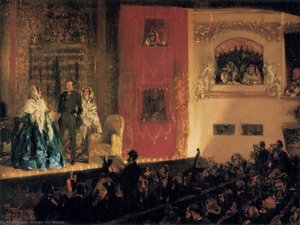
Adolph von Menzel’s “The Disturbance,” painted in 1846, isn't merely a portrait; it’s a meticulously observed slice of bourgeois life rendered with the precision and psychological depth characteristic of the German Realist movement. This intimate scene, housed within the State Art Gallery of Karlsruhe, captures a fleeting moment of domestic tension – a subtle discordance simmering beneath the veneer of polite society. The painting depicts two women seated in a dimly lit parlor, one at a piano while the other stands nearby, seemingly observing or perhaps even subtly challenging her companion’s focus. The room itself is richly detailed: a vase sits on a side table, suggesting an attempt to maintain order and elegance amidst the underlying unease, while a clock hangs above the piano, a silent reminder of the passage of time and the pressures of societal expectations.
Menzel's Masterclass in Detail and Observation
Menzel’s genius lay not just in his technical skill – though undeniably masterful – but in his ability to distill complex human emotions into deceptively simple compositions. He was a student of observation, spending countless hours sketching everyday scenes, from bustling marketplaces to quiet moments within private homes. This dedication is evident in the incredibly detailed rendering of the women’s clothing, the textures of the furniture, and even the subtle shadows that play across their faces. The artist's use of light and shadow creates a sense of depth and realism, drawing the viewer into this intimate tableau. Notably, Menzel employed a technique known as *pointillé*, using tiny dots of paint to build up texture and create an illusion of shimmering surface detail – a hallmark of his mature style.
A Window into 19th-Century Prussia
“The Disturbance” offers a fascinating glimpse into the social dynamics of mid-19th century Prussia. Menzel, deeply sympathetic to the Prussian monarchy and its values, frequently depicted scenes from Frederick the Great’s reign, but also sought to capture the complexities of everyday life within the kingdom. This painting reflects the growing interest in documenting the realities of bourgeois society – a shift away from idealized historical narratives towards a more nuanced portrayal of contemporary life. The scene speaks to the constraints placed upon women during this era, suggesting a subtle power dynamic and perhaps even a hint of suppressed rebellion. The quiet tension between the two figures hints at unspoken desires or unresolved conflicts, reflecting the anxieties and uncertainties of a rapidly changing society.
Symbolism and Emotional Resonance
While seemingly straightforward, “The Disturbance” is rich in symbolic meaning. The piano, often associated with domestic harmony and refinement, becomes a focal point of discord. The woman at the instrument represents perhaps a desire for creative expression or social engagement, while her companion’s stance suggests a degree of detachment or disapproval. The muted color palette – dominated by browns, grays, and creams – reinforces the atmosphere of quiet tension and unspoken emotions. Menzel masterfully uses these visual cues to evoke a sense of melancholy and introspection, inviting viewers to contemplate the hidden currents beneath the surface of everyday life. The painting’s enduring power lies in its ability to capture a universal human experience: the subtle complexities of relationships and the ever-present undercurrent of unspoken feelings.
Reproductions & Beyond
A faithful reproduction of “The Disturbance” brings this captivating scene into any space, offering a touch of understated elegance and intellectual depth. Available in various sizes, from compact 5x90cm prints to larger formats suitable for statement walls, these reproductions capture Menzel’s meticulous detail and evocative atmosphere. Consider framing options that complement the painting's muted tones – a simple black frame will highlight the artwork's inherent drama, while a warmer wood tone can add a touch of rustic charm. “The Disturbance” is more than just a beautiful image; it’s an invitation to engage with the complexities of human emotion and the enduring legacy of one of Germany’s greatest artists.
Preguntas y respuestas
¿Es "The Disturbance" de Adolph von Menzel una obra de tonos claros u oscuros?
"The Disturbance" de Adolph von Menzel presenta un nivel de brillo de deep_shadow, con una luminancia de Dark.
¿Cómo se relacionan entre sí los colores de "The Disturbance"?
Los colores de "The Disturbance" de Adolph von Menzel muestran una armonía Unified Palette. La armonía describe cómo se relacionan los colores entre sí.
¿Qué proporciones tiene "The Disturbance" de Adolph von Menzel y cuáles son sus dimensiones?
El formato de "The Disturbance" es Portrait y la obra original mide 5 x 90 cm. Ambos datos son útiles al planificar una reproducción.
¿Cuál es el tono emocional de "The Disturbance" de Adolph von Menzel?
El tono emocional registrado para "The Disturbance" de Adolph von Menzel es Reflective. Este resume el sentimiento que expresa la obra.
¿Cuándo y con qué materiales se realizó "The Disturbance"?
"The Disturbance" fue creada en 1846 mediante la técnica de Acrylic On Canvas. El material y la fecha describen cómo y cuándo se realizó la obra original.
¿Cómo puedo conseguir una lámina de "The Disturbance" de Adolph von Menzel?
"The Disturbance" está disponible como una impresión de bellas artes sobre lienzo de algodón o papel de lienzo de archivo. Los pedidos se realizan en esta página, en el tamaño de su elección.
¿Es "The Disturbance" de Adolph von Menzel una composición en formato retrato, paisaje o cuadrado?
"The Disturbance" de Adolph von Menzel es una composición en Portrait. Se recomienda revisar las proporciones antes de elegir un tamaño de impresión.
¿Qué tamaño debería elegir para imprimir "The Disturbance" en mi habitación?
La combinación recomendada para "The Disturbance" de Adolph von Menzel: una impresión de Medium en un/a Living Room.
Biografía del artista
Una vida dedicada a la excelencia artística (1815-1905)
Adolph Friedrich Erdmann von Menzel, un artista realista alemán, dejó una huella imborrable en el mundo del arte con sus dibujos, grabados y pinturas. Nacido en Breslau, Silesia (actualmente Wrocław, Polonia), el 8 de diciembre de 1815, la vida de Menzel fue un testimonio de su dedicación a capturar la esencia de la realidad a través de su arte.Primeros años y formación
El padre de Menzel, un litógrafo, inicialmente pretendía que su hijo se convirtiera en profesor. Sin embargo, la pasión por el arte de Adolph prevaleció, llevándolo a estudiar brevemente en la Academia de Arte de Berlín en 1833. Posteriormente, se convirtió en autodidacta, perfeccionando sus habilidades a través de una práctica incansable.Logros artísticos y evolución
- El taller de forja (1872-1875), una obra maestra que muestra la aguda observación y el dominio técnico de Menzel. Esta pintura monumental retrata el proceso industrial con un realismo asombroso, capturando la energía y el movimiento de los trabajadores y las máquinas.
- El mercado de Verona, un testimonio de su capacidad para capturar la atmósfera de la vida cotidiana. Menzel se destacaba en representar escenas urbanas con gran detalle y vitalidad.
- Predicación en la iglesia parroquial de Innsbruck (1857), un ejemplo impresionante de su maestría, que se encuentra en la colección del museo Hugo Fischer (Bühl, Alemania). Esta obra demuestra su habilidad para representar figuras humanas y escenas religiosas con gran realismo y expresividad.
- Menzel también es conocido por sus pinturas históricas, como Fritz Coburgo en la batalla de Kerschenfeld, que reflejan su interés por la historia prusiana y su habilidad para representar eventos históricos con dramatismo y precisión.
Influencias y legado
La reputación póstuma de Menzel se basó en gran medida en sus trabajos gráficos y pinturas informales. Su influencia se extendió más allá de Alemania; Edgar Degas admiraba y copiaba su obra, llamándolo "el maestro vivo más grande". La asociación de Menzel con el arte francés e inglés es evidente en sus pinturas de género, como la ventana francesa y el jardín del palacio del príncipe Alberto. Su capacidad para capturar la luz y la atmósfera, así como su atención al detalle, lo convirtieron en un artista influyente. Menzel fue un cronista visual de su época, documentando la vida cotidiana, los avances industriales y los eventos históricos con una precisión y un realismo sin precedentes. Su legado perdura como uno de los artistas más importantes del siglo XIX alemán, reconocido por su habilidad técnica, su aguda observación y su capacidad para capturar la esencia de la realidad.Museos que exhiben obras de Menzel
Experimente la brillantez del arte de Adolph von Menzel explorando sus obras en OriginalUniqueArt.com.
Adolph von Menzel
1815 - 1905 , Polonia
Datos clave
- Artistas Que Influyeron: ['Edgar Degas']
- Estilo Artístico: Realismo alemán
- Fecha De Fallecimiento: 1905
- Fecha De Nacimiento: 8 de diciembre de 1815
- Influencia Artística: ['Franz Ritter von Stuck']
- Lugar De Nacimiento: Wrocław, Polonia
- Nacionalidad: Alemán
- Nombre Completo: Adolph Friedrich Erdmann von Menzel
- Obras Notables:
- Molino de hierro (1872-1875)
- El mercado de Verona
- Kanzelpredigt en Innsbruck (1857)
Artículos relacionados

The Enduring Legacy of Formal Portraiture: Power, Identity & Artistic Exploration
Explore the rich history of formal portraiture & its enduring power to capture identity and shape perception. Discover investment-worthy artworks, expert appraisals, and custom reproduction services at OriginalUniqueArt.
The Enduring Muse: Women as Subject & Symbol in Art History
Explore the rich history of women in art – from archetypal representations to contemporary voices challenging norms. Discover iconic artists & movements, and learn about reclaiming female narratives through painting and beyond.

Adolph von Menzel: Realism, Prussian Society & the Painterly Chronicle of a Changing Era
Explore the life & work of Adolph von Menzel, a leading German Realist painter. Discover his detailed depictions of Prussian society, innovative techniques, and lasting influence on art history. Hand-painted reproductions available at OriginalUniqueArt.
Portrayals of Power & Perception: A Historical Survey of Women in Art
Explore the rich history of women in art – from iconic muses to groundbreaking artists. Discover feminist movements & reclaim female narratives with OriginalUniqueArt. Expert insights for discerning collectors.

The Enduring Muse: Women as Subject & Symbol in Art History
Explore the rich history of women in art – from iconic muses to groundbreaking artists. Discover feminist movements, global perspectives & reclaim female narratives with OriginalUniqueArt.