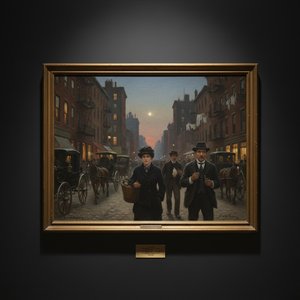
Obra al óleo
 Todo sobre Second Class - the parting:







































 Para obras de arte o reproducciones que midan más de 105 cm (aproximadamente 41 pulgadas) en cualquiera de sus lados, el marco se enviará como un kit desmontado. Este método garantiza una entrega segura y evita daños durante el transporte.


From the early 1800s, the British were encouraged to emigrate to Australia and become wealthy by working the land or, from the 1850s, by trying their luck on the goldfields. This work represents the changing popular response to emigration to Australia.When Abraham Solomon painted Second Class in 1854, circumstances in England and Australia had changed dramatically. Gold had been discovered in Australia, transportation had virtually ceased and the political print had lost its popularity in England. Solomon’s painting shows a young man leaving for the goldfields, his family accompanying him on the train journey. The work is aimed at a sentimental middle-class market – when will the mother see her son again?This painting forms part of a wider genre presenting free settlers (and gold rush emigrants) to Australia and other British empire colonies. After receiving accolades at the Royal Academy, Second Class, together with its counterpart First Class 1954, became popular through printed reproductions,being produced as a lithographic print both in England and Germany.Roger ButlerText © National Gallery of Australia, Canberra 2010From: Anne Gray (ed), Australian art in the National Gallery of Australia, National Gallery of Australia, Canberra, 2002
Preguntas y respuestas
¿Es Second Class - the parting: una obra pintada a mano o una impresión?
Pintado a mano: un pintor profesional recrea Second Class - the parting: al óleo sobre lienzo de lino.
¿Qué tamaño debo elegir para Second Class - the parting: ?
La obra original mide 966 x 694 cm. Los tamaños van desde 25.8 x 38.7 cm (€178) hasta 164.8 x 246.8 cm (€1357); la tabla de esta página detalla las opciones principales y sus precios.
¿Cuánto tarda el envío?
El plazo de entrega es de 4 a 5 semanas, con envío exprés gratuito a todo el mundo; en esta página se ofrece una opción de producción urgente. Puede realizar la devolución en un plazo de 100 días para obtener un reembolso completo, sin condiciones.
¿Dónde se encuentra la obra original Second Class - the parting: ?
La obra original forma parte de la colección del Galería Nacional de Australia, Canberra.
 Ver en contexto

 Enviar
 Compartir
 Detalles
 Ficha técnica


 Descargar
 Similares
 Radiografía
 Presentación de diapositivas
 Preguntas y respuestas

 Estadísticas