Text size

() ·

A painting made for you, by hand

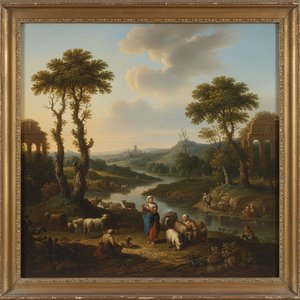
Landscape with Peasants Resting

Reproducción al óleo hecha a mano

Óleo sobre lienzo pintado a mano en el tamaño y marco de su elección, realizado por encargo por nuestros artistas. ( Cambiar a impresiones Cambiar a imagen digital)

Descripción del objeto

Admire Abraham Bloemaert's masterful 'Landscape with Peasants Resting,' a serene Dutch Golden Age depiction of rural life, housed at Staatliche Museen Berlin.

Biografía del artista

Descubre a Abraham Bloemaert (1564-1651), maestro barroco holandés conocido por pinturas históricas dramáticas y paisajes impresionantes. ¡Explora su arte!

from ·

Chapter 1

How large should it be?

Slide to change the size; the picture on the left shows the frame at its real width. The proportions of the original are kept.

Tamaño estándar
a medida
CM
INCH

Elija entre nuestros tamaños predefinidos que respetan las proporciones originales de la obra.

ancho
altura

Indique el ancho y el alto que necesite para adaptarse a su marco o pared. Al tratarse de una obra pintada a mano, si requiere un tamaño con una proporción distinta, el artista puede pintar un poco más alrededor de la imagen o recortarla ligeramente; usted elige. Le enviaremos una maqueta digital para su aprobación antes de comenzar la pintura. La imagen que se muestra en esta página no refleja el resultado real; solo la maqueta lo hace.

Chapter 2

How should it arrive?

Choose the edges of the stretched canvas

Choose your frame

Corner sample of the WhiteWrap canvas edge finish, stretched on madera maciza bars
White €1
Corner sample of the BlurSideWrap canvas edge finish, stretched on madera maciza bars
Blurside €1
Corner sample of the ExtendedWrap canvas edge finish, stretched on madera maciza bars
Extended €1
Corner sample of the P118B picture frame: poliestireno moldeado, 5 cm wide and 3 cm thick
P118B €10
Corner sample of the P118H picture frame: poliestireno moldeado, 5 cm wide and 3 cm thick
P118H €10
Corner sample of the P118W picture frame: poliestireno moldeado, 5 cm wide and 3 cm thick
P118W €10
Corner sample of the P438Z picture frame: poliestireno moldeado, 5.5 cm wide and 3.5 cm thick
P438Z €10
Corner sample of the P508JH picture frame: poliestireno moldeado, 7 cm wide and 3.5 cm thick
P508JH €12
Corner sample of the P508YH picture frame: poliestireno moldeado, 7 cm wide and 3.5 cm thick
P508YH €12
Corner sample of the P805H picture frame: poliestireno moldeado, 5 cm wide and 3.5 cm thick
P805H €10
Corner sample of the P805Z picture frame: poliestireno moldeado, 5 cm wide and 3.5 cm thick
P805Z €10
Corner sample of the P919BZ picture frame: poliestireno moldeado, 7 cm wide and 3.5 cm thick
P919BZ €10
Corner sample of the P919G picture frame: poliestireno moldeado, 7 cm wide and 3.5 cm thick
P919G €10
Corner sample of the P919XJ picture frame: poliestireno moldeado, 7 cm wide and 3.5 cm thick
P919XJ €10
Corner sample of the P959ZH picture frame: poliestireno moldeado, 5 cm wide and 3 cm thick
P959ZH €10
Corner sample of the P968JZ picture frame: poliestireno moldeado, 6 cm wide and 4 cm thick
P968JZ €12
Corner sample of the W106C picture frame: madera maciza, 5 cm wide and 3 cm thick
W106C €8
Corner sample of the W218G picture frame: madera maciza, 5 cm wide and 3 cm thick
W218G €10
Corner sample of the W218JH picture frame: madera maciza, 5 cm wide and 3 cm thick
W218JH €8
Corner sample of the W218Y picture frame: madera maciza, 5 cm wide and 3 cm thick
W218Y €10
Corner sample of the W307PJ picture frame: madera maciza, 6 cm wide and 3 cm thick
W307PJ €10
Corner sample of the W316G picture frame: madera maciza, 6 cm wide and 3 cm thick
W316G €10
Corner sample of the W316PJ picture frame: madera maciza, 6 cm wide and 3 cm thick
W316PJ €8
Corner sample of the W316Y picture frame: madera maciza, 6 cm wide and 3 cm thick
W316Y €10
Corner sample of the W398PJ picture frame: madera maciza, 5 cm wide and 3 cm thick
W398PJ €8
Corner sample of the W4111J picture frame: madera maciza, 6.5 cm wide and 3.5 cm thick
W4111J €10
Corner sample of the W500HY picture frame: madera maciza, 7 cm wide and 5 cm thick
W500HY €15
Corner sample of the W500JH picture frame: madera maciza, 7 cm wide and 5 cm thick
W500JH €15
Corner sample of the W692G picture frame: madera maciza, 8 cm wide and 4 cm thick
W692G €12
Corner sample of the W849H picture frame: madera maciza, 5 cm wide and 3 cm thick
W849H €8
Corner sample of the W940BG picture frame: madera maciza, 7.5 cm wide and 4.5 cm thick
W940BG €15
Corner sample of the W953PJ picture frame: madera maciza, 6 cm wide and 3.5 cm thick
W953PJ €8
Corner sample of the H24-GOLD picture frame: madera tallada con estuco, 10 cm wide and 6 cm thick
H24-GOLD €30
Corner sample of the H24-SILVER picture frame: madera tallada con estuco, 10 cm wide and 6 cm thick
H24-SILVER €30
Corner sample of the H36-GOLD picture frame: madera tallada con estuco, 15 cm wide and 6.5 cm thick
H36-GOLD €45
Corner sample of the H36-SILVER picture frame: madera tallada con estuco, 15 cm wide and 6.5 cm thick
H36-SILVER €45

Moulding: . Overall size with the frame: .

Chapter 3

Who paints it, and should anything change?

Examples of what can be changed: Replace face with customer photo; Add pet (e.g., replace cat with dog); Include hidden message in background; Change background landscape or elements.
After order, OriginalUniqueArt.com team will email client for instructions and provide a mockup preview

Envío a todo el mundo () en 3-4 semanas en lugar de las 5 semanas estándar. (2 noviembre). Sin comprometer la calidad.

Chapter 4

The finishing touches

A nameplate, as in a museum?

Detalles de la placa de bronce grabada

This elegant plaque features the artist's name and the title of the artwork, finely engraved for a timeless presentation.

It is made from bronze with a refined, elegant finish. The text is precisely laser-engraved for a sharp and permanent result. Measuring 9x2 cm, the plaque is compact yet easy to read. It's built to be durable and scratch-resistant, offering a professional, museum-quality look. Mounting is simple thanks to the included adhesive backing.

Detalles de la placa de acrílico transparente

The plaque includes essential engraved details such as the artist's name, the title of the artwork, the date it was created, the type of media used-like oil on canvas or watercolor-a brief description of the piece, and a QR code that links to the complete artwork information.

It is crafted from clear acrylic, offering a sleek, modern appearance. The text is UV-engraved in black to ensure strong visual contrast. With a size of 10x15 cm, it ensures optimal readability. It comes equipped with two metal hooks for secure wall mounting. The plaque is designed to be weather-resistant, making it suitable for various environments, and it includes interactive features that work seamlessly with smartphone scanning.

Detalles de la placa de acrílico negro

This elegant plaque includes engraved information such as the artist's name, the title of the artwork, the date it was created, the type of media used (like oil on canvas or watercolor), a short description of the artwork, and a QR code for quick access to more information.

The plaque itself is made from refined black acrylic with a premium finish. The text is laser-engraved in white for high contrast and readability. Its size is 10x15 cm, designed to be easy to read. It comes with two metal hooks for professional mounting. The design is sleek and fits any interior style. It is also weather-resistant and durable, with built-in digital integration for mobile compatibility.

A protective varnish?

When do you need it?

Chapter 5

Your painting, as you ordered it

Landscape with Peasants Resting

Técnica de reproducción

Dimensiones de la reproducción

-

Selección de artistas premium

Mayor nivel de detalle, delicadeza y tiempo de producción adicional

-

Enmarcado de reproducción

-

-

Para obras de arte o reproducciones que midan más de 105 cm (aproximadamente 41 pulgadas) en cualquiera de sus lados, el marco se enviará como un kit desmontado. Este método garantiza una entrega segura y evita daños durante el transporte.

Se requiere montaje profesional: este no es un producto para hacer usted mismo (DIY).
El kit debe ser ensamblado y el lienzo tensado por un enmarcador profesional con experiencia, utilizando cola para madera (no incluida), una tenaza para tensar lienzos y sargentos para mantener los bastidores alineados mientras la cola se seca. Un montaje incorrecto o una tensión desigual del lienzo pueden dañar la obra de arte de forma permanente y no están cubiertos por nuestra garantía.

  • Se incluyen todos los listones de madera maciza, cortados con precisión según las medidas.

  • Se ensambla con los tornillos incluidos, además de cola para madera para las uniones de las esquinas, la cual no se incluye y debe ser proporcionada por su enmarcador.

  • Se requieren herramientas profesionales que no están incluidas: un alicate para tensar lienzos (tensor) y abrazaderas para mantener los bastidores alineados mientras se seca el pegamento.

Importante:
Las uniones de las esquinas requieren cola para madera, los listones deben sujetarse con prensas hasta que la cola esté completamente seca, y para tensar el lienzo en el bastidor ensamblado se requiere una pinza para tensar lienzos. Ninguno de estos elementos está incluido en el kit. Por favor, contacte con un profesional del enmarcado con experiencia antes de realizar un pedido de este tamaño.

Cartela

-

-

Barniz protector

Barniz brillante (realza los colores y protege contra la luz y la humedad)

-

Personalizar mi obra

Ejemplos de lo que se puede personalizar: sustituir el rostro por una foto del cliente; añadir una mascota (por ejemplo, cambiar un gato por un perro); incluir un mensaje oculto en el fondo; cambiar el paisaje o los elementos del fondo.

-

Envío urgente

Envío a todo el mundo () en 3 o 4 semanas, en lugar de las 5 semanas habituales. (2 noviembre). Sin comprometer la calidad.

-

Envío urgente

Envío internacional () en 5 semanas. (9 noviembre).

Incluido

Precio total final

€ 267

Precio total € 267

La opción de vidrio solo está disponible en tamaños inferiores a 110 cm.

Included with every order

  • Envío exprés gratuito a todo el mundo
  • Lienzo de lino de alta calidad
  • Seguro de envío total
  • Garantía de reembolso de aranceles aduaneros
  • Garantía de fidelidad cromática exacta
  • Política de devolución de 100 días (solo por defectos)
  • Garantía de devolución del 100% del dinero
  • Descuento por cantidad

A Window Into Seventeenth Century Dutch Pastoral

The painting “Landscape with Peasants Resting,” attributed to Abraham Bloemaert and completed in 1650, offers a captivating glimpse into the artistic sensibilities of the Dutch Golden Age—a period characterized by unparalleled creativity and intellectual fervor. Currently residing at Staatliche Museen Berlin, this monumental canvas (91 x 133 cm) transcends mere depiction; it embodies an idealized vision of rural tranquility deeply rooted in humanist ideals prevalent during its creation. Bloemaert’s masterful command of oil paint on canvas—a technique perfected by artists like Rembrandt and Frans Hals—allows for a remarkable level of textural detail, capturing the subtle nuances of light and shadow that imbue the scene with palpable atmosphere.

Style and Technique: Echoes of Mannerism and Embracing Baroque Luminosity

Bloemaert’s stylistic approach skillfully blends elements characteristic of Mannerism – notably asymmetrical compositions and stylized figures – with burgeoning Baroque principles emphasizing dramatic lighting and vibrant color palettes. The artist eschews strict realism, favoring instead a carefully crafted illusion that prioritizes expressive beauty over photographic accuracy. Observe how Bloemaert employs chiaroscuro—the interplay between light and dark—to sculpt the forms of the peasants beneath the sheltering branches of an ancient oak tree. This technique not only enhances visual impact but also serves to convey a profound sense of solemn contemplation, mirroring the spiritual concerns that underpinned much Baroque art.

Historical Context: Reflecting Religious Reform and Societal Values

Painted amidst the turbulent backdrop of the Dutch Reformation—a movement aimed at purging Catholicism from Dutch society—Bloemaert’s landscape reflects broader societal anxieties regarding morality and faith. The depiction of peasants engaging in quiet repose underscores the importance of piety and contemplation within the everyday lives of ordinary citizens. Furthermore, the inclusion of livestock – cows and chickens – speaks to the economic realities of rural communities and reinforces the prevailing belief in God's provision for humankind. Bloemaert’s work stands as a testament to the humanist conviction that beauty could inspire moral virtue and elevate the human spirit.

Symbolism: Oak Tree, Hearth Fire, and the Cycle of Life

The oak tree dominating the composition symbolizes strength, resilience, and longevity—attributes revered in medieval symbolism and retained throughout the Baroque era. Its expansive branches provide refuge from the sun’s glare, representing divine protection and fostering a sense of serenity among the resting peasants. Equally significant is the depiction of a humble wooden house with a thatched roof and a flickering hearth fire. This domestic emblem embodies warmth, comfort, and familial unity—values central to Dutch cultural identity during Bloemaert's time. The presence of animals reinforces the cyclical nature of life – birth, growth, decay, and renewal – mirroring God’s eternal dominion over creation.

Emotional Impact: A Balm for Troubled Times

Ultimately, “Landscape with Peasants Resting” transcends its formal qualities to evoke a powerful emotional response in the viewer. The painting's serene beauty offers respite from the anxieties of Reformation-era Holland—a balm for troubled souls seeking solace amidst worldly concerns. Bloemaert’s masterful use of color and light creates an immersive experience that transports us back to a bygone era, reminding us of the enduring power of art to inspire contemplation and reaffirm our connection to the natural world. It remains a timeless masterpiece—a testament to the artistic genius of Abraham Bloemaert and the profound spiritual values of the Dutch Golden Age.

Preguntas y respuestas

¿Qué nivel de luminosidad transmite "Landscape with Peasants Resting" de Abraham Bloemaert?

En cuanto a la luminosidad percibida, "Landscape with Peasants Resting" de Abraham Bloemaert es brilliant.

¿A qué se debe el estado de los derechos de autor de "Landscape with Peasants Resting"?

"Landscape with Peasants Resting" de Abraham Bloemaert es de en el dominio público: sus derechos de autor han expirado. La vigencia de los derechos de autor se cuenta a partir del fallecimiento del artista, que tuvo lugar en 1651.

¿Quién es el autor y en qué fecha se creó "Landscape with Peasants Resting"?

"Landscape with Peasants Resting" fue creada por Abraham Bloemaert en 1650.

More about this painting

Ver en contexto Vista previa en RA Cambiar a impresiones Cambiar a imagen digital Enviar
Detalles Guía Añadir a favoritos Descargar Similares Radiografía Presentación de diapositivas Q&A Estadísticas

In numbers

  • 1650the year it was painted
  • 29frames to choose from
  • standard sizes, in its own proportions
  • 5weeks to paint and deliver it
Abraham Bloemaert

Abraham Bloemaert

1564 - 1651, Países Bajos

Quick facts about Abraham Bloemaert

  • Artistic Movement Or Style: Barroco, Maneirismo
  • Artists Or Movements Influenced By This Artist: ['Utrecht Caravaggisti']
  • Artists Who Influenced This Artist: ['Hieronymus Francken']
  • Date Of Birth: 1564
  • Date Of Death: 1651
  • Full Name: Abraham Bloemaert
  • Nationality: Holandés
  • Notable Artworks:
    • Expulsión de Hagar y Ismael
    • Venus y Adonis
    • Paisaje con campesinos
  • Place Of Birth: Gorinchem, Países Bajos

Biografía del artista

A Life Immersed in Art: The World of Abraham Bloemaert

Abraham Bloemaert, born in Gorinchem in 1564 and passing away in Utrecht in 1651, stands as a pivotal figure bridging the Mannerist and Baroque periods in Dutch painting. His long and prolific career unfolded against a backdrop of religious and political upheaval, yet he consistently produced works imbued with both dramatic intensity and subtle beauty. Bloemaert’s journey began under the tutelage of his father, Cornelis Bloemaert I, an architect who instilled in him a foundational understanding of form and composition. This early training was further refined through studies with Gerrit Splinter and Joos de Beer in Utrecht, laying the groundwork for his artistic explorations. A crucial period followed – three years spent in Paris from 1581 to 1583. There, he absorbed influences from Jehan Bassot and Maistre Herry, while also encountering the works of Hieronymus Francken, a fellow Dutch artist who broadened his stylistic horizons. This Parisian sojourn proved formative, exposing him to the refined elegance of the French School and setting the stage for his later innovations.

From Mannerism to Baroque: A Shifting Aesthetic

Initially, Bloemaert’s style aligned with the prevailing Haarlem Mannerism – characterized by elongated figures, elegant poses, and often complex allegorical narratives. Artists like Hendrick Ter Brugghen and Jacob Saam practiced similar techniques during this time. However, he was not content to remain solely within this framework. As the 17th century dawned, Bloemaert began to embrace the emerging Baroque aesthetic, a shift marked by increased dynamism, emotional intensity, and a heightened sense of realism. This transition wasn’t abrupt; rather, it represented a gradual evolution, blending elements of both styles into a uniquely personal artistic language. He skillfully incorporated dramatic lighting effects, rich color palettes, and expressive gestures to convey powerful narratives and evoke profound emotions in his viewers. His paintings began to resonate with a new energy, reflecting the changing cultural landscape of the Dutch Republic. The Utrecht Caravaggisti – artists like Gerrit van Honthorst and Bartholomeus Breenbergh – were particularly influenced by Bloemaert’s embrace of Baroque principles.

A Master of Diverse Subjects and Techniques

Bloemaert's artistic output was remarkably diverse. He excelled in history painting, bringing biblical stories and classical myths to life with compelling detail and emotional depth. Notable examples include “The Expulsion of Hagar and Ishmael” and “Venus and Adonis,” which demonstrate his masterful command of composition and color. Beyond painting, Bloemaert was a highly skilled printmaker, proficient in both etching and engraving. These prints served to disseminate his artistic vision more widely, contributing significantly to his reputation and influence. His technical mastery extended to still lifes and animal paintings as well, demonstrating an exceptional versatility that set him apart from many of his contemporaries. He meticulously studied the works of artists like Peter Paul Rubens and Caravaggio, adapting their techniques to suit his own distinctive style.

A Prolific Teacher and Lasting Legacy

Abraham Bloemaert was not only a gifted artist but also an influential teacher. He established a thriving workshop in Utrecht, attracting numerous students who would go on to become prominent artists themselves. Remarkably, his four sons – Hendrick, Frederick, Cornelis, and Adriaan – all followed in his footsteps, achieving considerable success as painters and engravers. His influence extended beyond his immediate family, mentoring a generation of Dutch artists, including Jan Aerntsz de Hel and Nicolaes van Bercheyck. Bloemaert’s teachings helped to shape their distinctive style, solidifying his position as a central figure in the development of Dutch Baroque painting. His legacy continues to resonate today, with his works admired for their technical brilliance, emotional power, and historical significance—a testament to a life dedicated to artistic exploration and innovation.

Datos clave

  • Artist: Abraham Bloemaert
  • Location: Staatliche Museen (Berlin, Germany)
  • Influences: Mannerism
  • Artistic style: Baroque
  • Notable elements or techniques: Detailed depiction of rural life; Atmospheric perspective
  • Medium: Oil on Canvas

Test de conocimientos artísticos

Cada pregunta tiene una única respuesta correcta.

Pregunta 1:
What artistic movement is “Landscape with Peasants Resting” primarily associated with?
Pregunta 2:
In what year was Abraham Bloemaert’s masterpiece “Landscape with Peasants Resting” created?
Pregunta 3:
Where is “Landscape with Peasants Resting” currently housed?
Pregunta 4:
What technique did Bloemaert employ to achieve the luminous quality of the sky in this painting?
Pregunta 5:
The depiction of a thatched roof and livestock contributes to what overarching theme within the artwork?