The Soul of the Welsh Landscape: The Life and Vision of Evan Walters
Evan John Walters stands as a singular figure in the tapestry of Welsh art history, a visionary whose brush bridged the gap between industrial grit and profound artistic expression. Born in 1893 in Llanfylech, nestled within a landscape defined by both rural tradition and the burgeoning shadows of industry, Walters possessed an innate sensitivity to the textures of his homeland. His formative years, spent amidst the valleys of Llangyfelach and Mynyddbach, instilled in him a deep-seated connection to Welsh culture and language—a foundation that would later allow him to translate the heavy atmosphere of mining communities into evocative visual narratives.
His artistic journey was one of both practical discipline and academic refinement. Beginning his training at Morriston Technical School, Walters developed a foundational skill set as a painter and decorator, a craft that granted him a unique, tactile understanding of surface and pigment. This technical grounding was later elevated through rigorous studies at the Swansea School of Ser Art and the Regent Street Polytechnic in London. As he moved toward the Royal Academy Schools, his work began to absorb the broader currents of European modernism, particularly the emotive power of Expressionism, which would eventually infuse his portraits and landscapes with a haunting, psychological depth.
From Camouflage to Character: A Transformative Career
The trajectory of Walters's life was irrevocably altered by the tides of global conflict. In 1915, amidst the upheaval of World War I, he emigrated to America, serving in a capacity that demanded an extraordinary mastery of color and perception: as a camouflage painter. This period of meticulous observation—learning to manipulate light, shadow, and shape to deceive the eye—sharpened his ability to translate complex visual information into powerful artistic statements. It was during this era of global movement that his technical precision met a growing interest in the human condition.
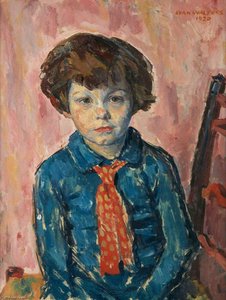
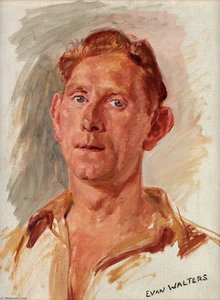
Upon returning to Wales after the war, Walters transitioned into a celebrated portrait artist, renowned for his ability to capture not just a likeness, but the very essence of his subjects. His career was significantly bolstered by the transformative patronage of Winifred Tennant, whose early recognition of his talent provided him with the stability to explore more ambitious themes. Through her commissions, Walters moved beyond simple representation, using the portraiture of the era's influential figures to weave a deeper social commentary into his repertoire.
A Legacy of Texture and Emotion
The enduring significance of Evan Walters lies in his ability to find beauty within the industrial struggle. His oeuvre is characterized by a remarkable versatility, ranging from the intimate warmth found in works like Eve to the vibrant, textured vitality of Still Life with Chrysanthemums. Whether he was depicting the heavy, soot-stained atmosphere of a mining village or the delicate play of light on a floral arrangement, his work remained anchored in a profound respect for the subject's inherent character.
Walters's contributions to 20th-century art are marked by several key elements:
- The Synthesis of Styles: His unique ability to blend classical Royal Academy techniques with the raw, emotive energy of Expressionism.
- Social Documentation: His role in documenting the changing face of Wales, capturing the dignity of the working class and the shifting industrial landscape.
- Technical Mastery: A sophisticated use of color theory and texture, likely influenced by his early experiences in camouflage and decorative arts.
Today, the works of Evan Walters serve as a vital window into a bygone era of Welsh identity. He remains an artist who did not merely observe the world but felt its weight, leaving behind a legacy that continues to resonate with anyone seeking the intersection of historical truth and poetic beauty.