Oil Edition
 Everything about Marsarkis




































 For artworks or reproductions larger than 105 cm (approximately 41 inches) on any side, the frame will be shipped as a kit, disassembled. This method ensures safe delivery and prevents damage during transport.


The Landscape Depiction of Marsarkis
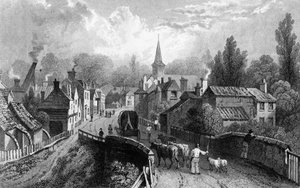
Marsarkis by William Henry Bartlett presents a mountainous region defined by steep slopes and a vast valley. The scene captures a rugged landscape where human figures and livestock move through the terrain. These elements suggest a connection between the inhabitants and the land they occupy. The presence of people and animals amidst the scale of the mountains implies a sense of habitation within the wilderness.
The subject matter focuses on a mountainous valley, emphasizing the physical reality of the terrain. Through the depiction of these figures and animals, William Henry Bartlett conveys the atmosphere of exploration and travel. The landscape functions as a record of a specific environment, documenting the intersection of human activity and the natural world.
Composition and Visual Elements
The scene is structured through distinct layers that establish a sense of depth and scale. In the immediate foreground, a winding path provides a starting point for the viewer's eye, which is then directed toward a distant valley. A prominent pine tree dominates the left side of the frame, acting as a vertical anchor against the expansive landscape. This arrangement guides the gaze from the textured foreground through steep, vegetated slopes toward the hazy horizon.
Spatial depth is achieved through the application of both linear and atmospheric perspective. Linear perspective is utilized via the receding path and the diminishing size of distant elements, creating a clear sense of distance. Simultaneously, atmospheric perspective is evident in the hazy background, where the mountains lose clarity and detail as they recede. Organic shapes define the composition, with the irregular forms of the mountains, trees, and clouds providing a natural contrast to the more defined lines of the path.
Technique and Artistic Medium
Executed in a realistic style, the work is rendered as an etching or engraving on paper. The process likely involved the use of a metal plate, such as copper or steel, which was etched with fine lines using acid. This method allowed for the precise, controlled application of detail necessary to define the rugged contours of the landscape.
The artist relies on extensive cross-hatching and fine lines to establish texture and depth. These intersecting strokes create a sense of volume on rocky surfaces and foliage, while varying the density of the lines produces a range of tonal values. This systematic use of hatching provides the structural weight required to represent the mountainous terrain and the atmospheric haze of the distant valley.
Questions & Answers
Is this Marsarkis painted by hand or printed?
Painted by hand: a trained painter copies Marsarkis in oil on linen canvas.
What size should I choose for Marsarkis?
Sizes run from 25.6 x 39.1 cm ($319) to 163.2 x 249.3 cm ($1804); the table on this page lists the main steps and their prices.
How long does delivery take?
Delivery takes 4 to 5 weeks, with free worldwide express shipping; an urgent production option is offered on this page. You can return it within 100 days for a full refund, with no condition.
What medium did William Henry Bartlett use for Marsarkis?
Engraving.
More about this painting
 Preview

 Send
 Share
 Details
 Fact sheet


 Download
 Similars
 X-Ray
 Diaporama
 Q&A

 Stats